

5.15 Biological Generation of Sounds
143
vibrations. Because of the precision of the mechanical vibrational frequency,
piezoelectric crystals are commonly found in clocks and computers, where they
are placed in electrical timing circuits. Quartz, tourmaline, and Rochelle salt are
commonly used.
5.15 Biological Generation of Sounds
5.15.1 Vocalization
Many species of animals living in air and water use sound as a method to
communicate. Some use sound echoes to navigate, locate food, sense predators,
and find other objects.
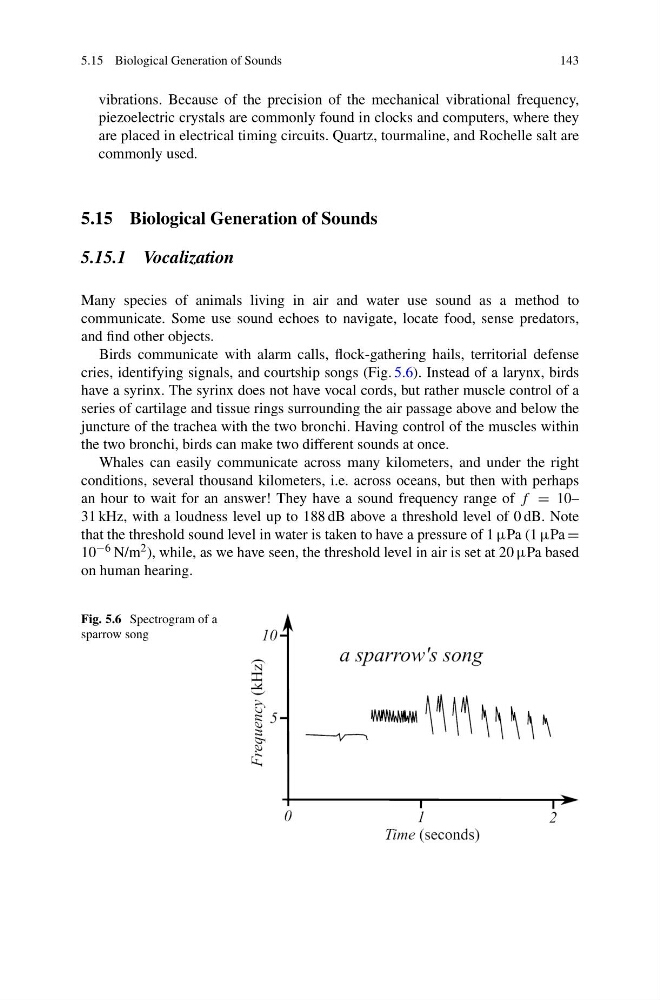
Birds communicate with alarm calls, flock-gathering hails, territorial defense
cries, identifying signals, and courtship songs (Fig. 5.6). Instead of a larynx, birds
have a syrinx. The syrinx does not have vocal cords, but rather muscle control of a
series of cartilage and tissue rings surrounding the air passage above and below the
juncture of the trachea with the two bronchi. Having control of the muscles within
the two bronchi, birds can make two different sounds at once.
Whales can easily communicate across many kilometers, and under the right
conditions, several thousand kilometers, i.e. across oceans, but then with perhaps
an hour to wait for an answer! They have a sound frequency range of f = 10–
31 kHz, with a loudness level up to 188 dB above a threshold level of 0 dB. Note
that the threshold sound level in water is taken to have a pressure of 1 μPa (1 μPa =
10 −6 N/m 2 ), while, as we have seen, the threshold level in air is set at 20 μPa based
on human hearing.
Fig. 5.6 Spectrogram of a
sparrow song
143
vibrations. Because of the precision of the mechanical vibrational frequency,
piezoelectric crystals are commonly found in clocks and computers, where they
are placed in electrical timing circuits. Quartz, tourmaline, and Rochelle salt are
commonly used.
5.15 Biological Generation of Sounds
5.15.1 Vocalization
Many species of animals living in air and water use sound as a method to
communicate. Some use sound echoes to navigate, locate food, sense predators,
and find other objects.
Birds communicate with alarm calls, flock-gathering hails, territorial defense
cries, identifying signals, and courtship songs (Fig. 5.6). Instead of a larynx, birds
have a syrinx. The syrinx does not have vocal cords, but rather muscle control of a
series of cartilage and tissue rings surrounding the air passage above and below the
juncture of the trachea with the two bronchi. Having control of the muscles within
the two bronchi, birds can make two different sounds at once.
Whales can easily communicate across many kilometers, and under the right
conditions, several thousand kilometers, i.e. across oceans, but then with perhaps
an hour to wait for an answer! They have a sound frequency range of f = 10–
31 kHz, with a loudness level up to 188 dB above a threshold level of 0 dB. Note
that the threshold sound level in water is taken to have a pressure of 1 μPa (1 μPa =
10 −6 N/m 2 ), while, as we have seen, the threshold level in air is set at 20 μPa based
on human hearing.
Fig. 5.6 Spectrogram of a
sparrow song