

5.13 Supersonic and Subsonic Motion
139
Fig. 5.4 Energy transfer to a
harmonic oscillator as a
function of the frequency of
the driving external force
1
0.8
0.6
0.4
0.2
0
0.5
1
1.5
2
2.5
3
f / f R
e / e R
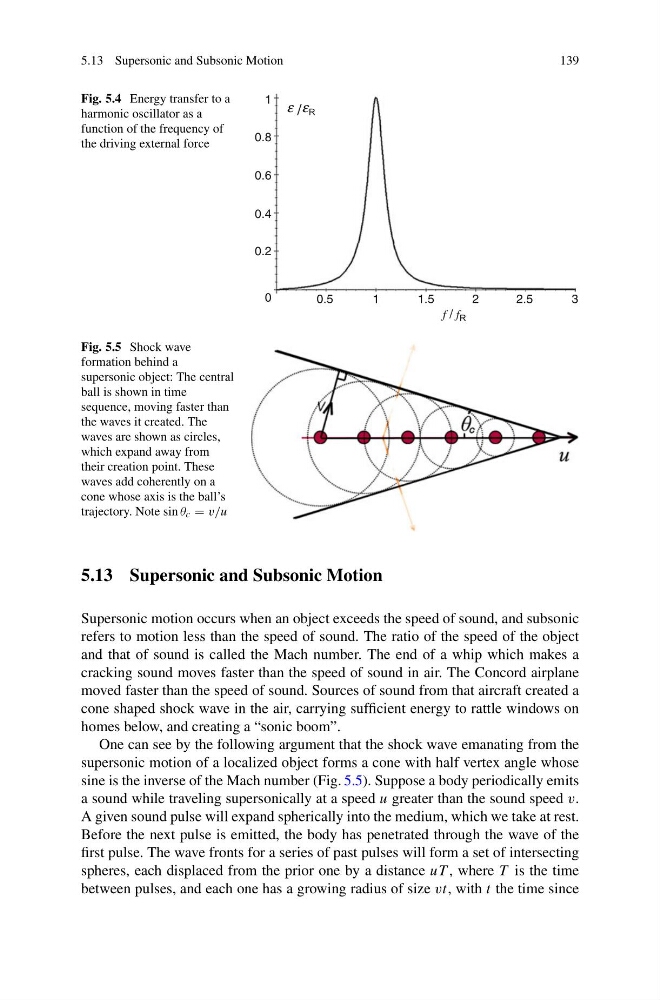
Fig. 5.5 Shock wave
formation behind a
supersonic object: The central
ball is shown in time
sequence, moving faster than
the waves it created. The
waves are shown as circles,
which expand away from
their creation point. These
waves add coherently on a
cone whose axis is the ball’s
trajectory. Note sin θ c = v/u
5.13 Supersonic and Subsonic Motion
Supersonic motion occurs when an object exceeds the speed of sound, and subsonic
refers to motion less than the speed of sound. The ratio of the speed of the object
and that of sound is called the Mach number. The end of a whip which makes a
cracking sound moves faster than the speed of sound in air. The Concord airplane
moved faster than the speed of sound. Sources of sound from that aircraft created a
cone shaped shock wave in the air, carrying sufficient energy to rattle windows on
homes below, and creating a “sonic boom”.
One can see by the following argument that the shock wave emanating from the
supersonic motion of a localized object forms a cone with half vertex angle whose
sine is the inverse of the Mach number (Fig. 5.5). Suppose a body periodically emits
a sound while traveling supersonically at a speed u greater than the sound speed v.
A given sound pulse will expand spherically into the medium, which we take at rest.
Before the next pulse is emitted, the body has penetrated through the wave of the
first pulse. The wave fronts for a series of past pulses will form a set of intersecting
spheres, each displaced from the prior one by a distance uT , where T is the time
between pulses, and each one has a growing radius of size vt, with t the time since
139
Fig. 5.4 Energy transfer to a
harmonic oscillator as a
function of the frequency of
the driving external force
1
0.8
0.6
0.4
0.2
0
0.5
1
1.5
2
2.5
3
f / f R
e / e R
Fig. 5.5 Shock wave
formation behind a
supersonic object: The central
ball is shown in time
sequence, moving faster than
the waves it created. The
waves are shown as circles,
which expand away from
their creation point. These
waves add coherently on a
cone whose axis is the ball’s
trajectory. Note sin θ c = v/u
5.13 Supersonic and Subsonic Motion
Supersonic motion occurs when an object exceeds the speed of sound, and subsonic
refers to motion less than the speed of sound. The ratio of the speed of the object
and that of sound is called the Mach number. The end of a whip which makes a
cracking sound moves faster than the speed of sound in air. The Concord airplane
moved faster than the speed of sound. Sources of sound from that aircraft created a
cone shaped shock wave in the air, carrying sufficient energy to rattle windows on
homes below, and creating a “sonic boom”.
One can see by the following argument that the shock wave emanating from the
supersonic motion of a localized object forms a cone with half vertex angle whose
sine is the inverse of the Mach number (Fig. 5.5). Suppose a body periodically emits
a sound while traveling supersonically at a speed u greater than the sound speed v.
A given sound pulse will expand spherically into the medium, which we take at rest.
Before the next pulse is emitted, the body has penetrated through the wave of the
first pulse. The wave fronts for a series of past pulses will form a set of intersecting
spheres, each displaced from the prior one by a distance uT , where T is the time
between pulses, and each one has a growing radius of size vt, with t the time since