

138
5 Acoustics in Biology and Medicine
the left is caused by a ‘damping force’, which we take proportional to the speed
of the mass. The factor β is called the ‘damping coefficient’. The third term comes
from an elastic restoring force on the mass due to interactions by adjacent material.
The number f o is the natural vibrational frequency of the mass. The right-hand side
is the forcing term (per unit mass), and is taken as a cosine wave. The number f is
the frequency of the forcing term.
The solution to Eq. (5.44) has a piece which remains after an initial transient dies
out, expressed by
ξ(t) =
F o /m
4π 2
(f 2 − f 2
0 ) 2 + β 2 f 2
1/2 cos (2πf t − φ)
(5.45)
where tan φ = βf/(f 2
0 − f 2 ).
One can see that the amplitude of the motion, after the initial transient, will peak
at f M =
f 2
0 − β 2 /2 . As shown below, this is near the frequency of resonance
when β << f 0 . The strength and width of the resonance amplitude depends on the
damping (dissipation) in the system, i.e. the mechanisms for loss of energy.
The steady energy transferred per cycle from the forcing term to the oscillator
will be
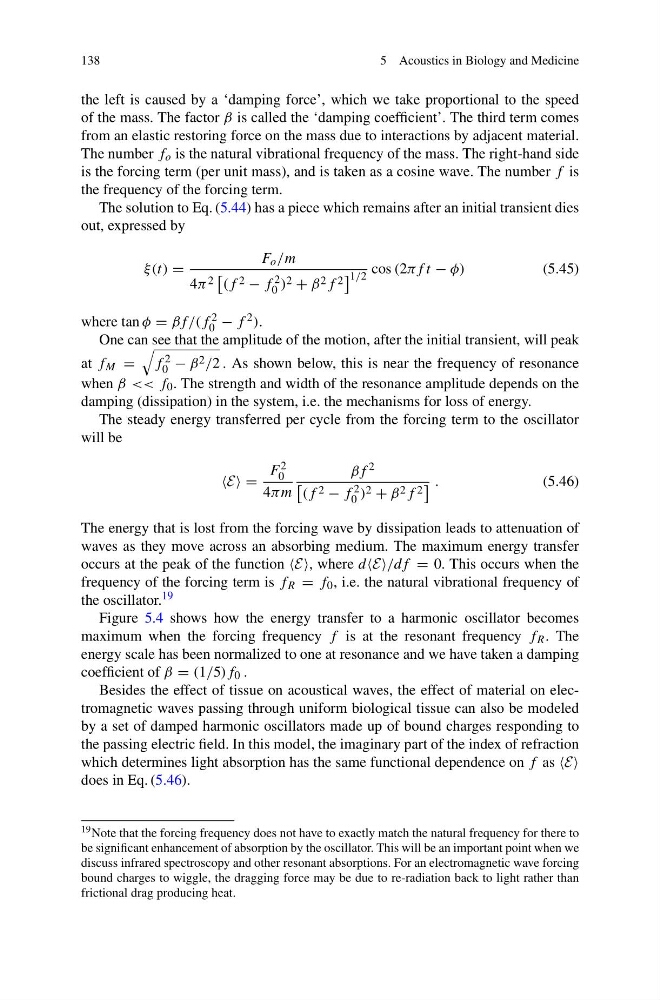
E =
F 2
0
4πm
βf 2
(f 2 − f 2
0 ) 2 + β 2 f 2
.
(5.46)
The energy that is lost from the forcing wave by dissipation leads to attenuation of
waves as they move across an absorbing medium. The maximum energy transfer
occurs at the peak of the function E, where dE/df = 0. This occurs when the
frequency of the forcing term is f R = f 0 , i.e. the natural vibrational frequency of
the oscillator. 19
Figure 5.4 shows how the energy transfer to a harmonic oscillator becomes
maximum when the forcing frequency f is at the resonant frequency f R . The
energy scale has been normalized to one at resonance and we have taken a damping
coefficient of β = (1/5)f 0 .
Besides the effect of tissue on acoustical waves, the effect of material on electromagnetic waves passing through uniform biological tissue can also be modeled
by a set of damped harmonic oscillators made up of bound charges responding to
the passing electric field. In this model, the imaginary part of the index of refraction
which determines light absorption has the same functional dependence on f as E
does in Eq. (5.46).
19 Note that the forcing frequency does not have to exactly match the natural frequency for there to
be significant enhancement of absorption by the oscillator. This will be an important point when we
discuss infrared spectroscopy and other resonant absorptions. For an electromagnetic wave forcing
bound charges to wiggle, the dragging force may be due to re-radiation back to light rather than
frictional drag producing heat.
5 Acoustics in Biology and Medicine
the left is caused by a ‘damping force’, which we take proportional to the speed
of the mass. The factor β is called the ‘damping coefficient’. The third term comes
from an elastic restoring force on the mass due to interactions by adjacent material.
The number f o is the natural vibrational frequency of the mass. The right-hand side
is the forcing term (per unit mass), and is taken as a cosine wave. The number f is
the frequency of the forcing term.
The solution to Eq. (5.44) has a piece which remains after an initial transient dies
out, expressed by
ξ(t) =
F o /m
4π 2
(f 2 − f 2
0 ) 2 + β 2 f 2
1/2 cos (2πf t − φ)
(5.45)
where tan φ = βf/(f 2
0 − f 2 ).
One can see that the amplitude of the motion, after the initial transient, will peak
at f M =
f 2
0 − β 2 /2 . As shown below, this is near the frequency of resonance
when β << f 0 . The strength and width of the resonance amplitude depends on the
damping (dissipation) in the system, i.e. the mechanisms for loss of energy.
The steady energy transferred per cycle from the forcing term to the oscillator
will be
E =
F 2
0
4πm
βf 2
(f 2 − f 2
0 ) 2 + β 2 f 2
.
(5.46)
The energy that is lost from the forcing wave by dissipation leads to attenuation of
waves as they move across an absorbing medium. The maximum energy transfer
occurs at the peak of the function E, where dE/df = 0. This occurs when the
frequency of the forcing term is f R = f 0 , i.e. the natural vibrational frequency of
the oscillator. 19
Figure 5.4 shows how the energy transfer to a harmonic oscillator becomes
maximum when the forcing frequency f is at the resonant frequency f R . The
energy scale has been normalized to one at resonance and we have taken a damping
coefficient of β = (1/5)f 0 .
Besides the effect of tissue on acoustical waves, the effect of material on electromagnetic waves passing through uniform biological tissue can also be modeled
by a set of damped harmonic oscillators made up of bound charges responding to
the passing electric field. In this model, the imaginary part of the index of refraction
which determines light absorption has the same functional dependence on f as E
does in Eq. (5.46).
19 Note that the forcing frequency does not have to exactly match the natural frequency for there to
be significant enhancement of absorption by the oscillator. This will be an important point when we
discuss infrared spectroscopy and other resonant absorptions. For an electromagnetic wave forcing
bound charges to wiggle, the dragging force may be due to re-radiation back to light rather than
frictional drag producing heat.