

136
5 Acoustics in Biology and Medicine
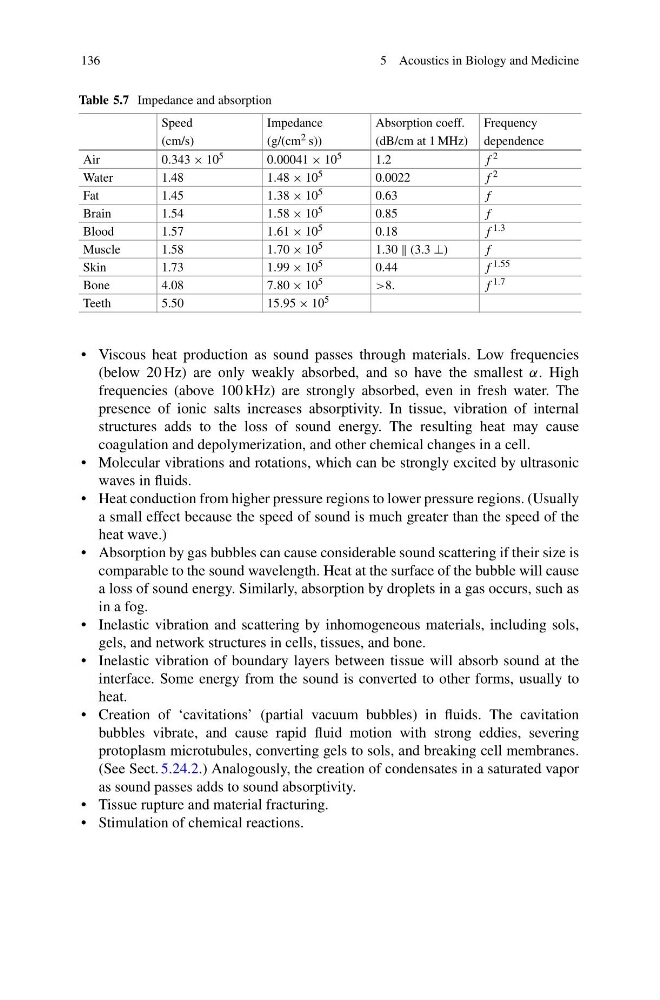
Table 5.7 Impedance and absorption
Speed
Impedance
Absorption coeff.
Frequency
(cm/s)
(g/(cm 2 s))
(dB/cm at 1 MHz) dependence
Air
0.343 × 10 5
0.00041 × 10 5
1.2
f 2
Water
1.48
1.48 × 10 5
0.0022
f 2
Fat
1.45
1.38 × 10 5
0.63
f
Brain
1.54
1.58 × 10 5
0.85
f
Blood
1.57
1.61 × 10 5
0.18
f 1.3
Muscle
1.58
1.70 × 10 5
1.30 (3.3 ⊥)
f
Skin
1.73
1.99 × 10 5
0.44
f 1.55
Bone
4.08
7.80 × 10 5
>8.
f 1.7
Teeth
5.50
15.95 × 10 5
• Viscous heat production as sound passes through materials. Low frequencies
(below 20 Hz) are only weakly absorbed, and so have the smallest α. High
frequencies (above 100 kHz) are strongly absorbed, even in fresh water. The
presence of ionic salts increases absorptivity. In tissue, vibration of internal
structures adds to the loss of sound energy. The resulting heat may cause
coagulation and depolymerization, and other chemical changes in a cell.
• Molecular vibrations and rotations, which can be strongly excited by ultrasonic
waves in fluids.
• Heat conduction from higher pressure regions to lower pressure regions. (Usually
a small effect because the speed of sound is much greater than the speed of the
heat wave.)
• Absorption by gas bubbles can cause considerable sound scattering if their size is
comparable to the sound wavelength. Heat at the surface of the bubble will cause
a loss of sound energy. Similarly, absorption by droplets in a gas occurs, such as
in a fog.
• Inelastic vibration and scattering by inhomogeneous materials, including sols,
gels, and network structures in cells, tissues, and bone.
• Inelastic vibration of boundary layers between tissue will absorb sound at the
interface. Some energy from the sound is converted to other forms, usually to
heat.
• Creation of ‘cavitations’ (partial vacuum bubbles) in fluids. The cavitation
bubbles vibrate, and cause rapid fluid motion with strong eddies, severing
protoplasm microtubules, converting gels to sols, and breaking cell membranes.
(See Sect. 5.24.2.) Analogously, the creation of condensates in a saturated vapor
as sound passes adds to sound absorptivity.
• Tissue rupture and material fracturing.
• Stimulation of chemical reactions.
5 Acoustics in Biology and Medicine
Table 5.7 Impedance and absorption
Speed
Impedance
Absorption coeff.
Frequency
(cm/s)
(g/(cm 2 s))
(dB/cm at 1 MHz) dependence
Air
0.343 × 10 5
0.00041 × 10 5
1.2
f 2
Water
1.48
1.48 × 10 5
0.0022
f 2
Fat
1.45
1.38 × 10 5
0.63
f
Brain
1.54
1.58 × 10 5
0.85
f
Blood
1.57
1.61 × 10 5
0.18
f 1.3
Muscle
1.58
1.70 × 10 5
1.30 (3.3 ⊥)
f
Skin
1.73
1.99 × 10 5
0.44
f 1.55
Bone
4.08
7.80 × 10 5
>8.
f 1.7
Teeth
5.50
15.95 × 10 5
• Viscous heat production as sound passes through materials. Low frequencies
(below 20 Hz) are only weakly absorbed, and so have the smallest α. High
frequencies (above 100 kHz) are strongly absorbed, even in fresh water. The
presence of ionic salts increases absorptivity. In tissue, vibration of internal
structures adds to the loss of sound energy. The resulting heat may cause
coagulation and depolymerization, and other chemical changes in a cell.
• Molecular vibrations and rotations, which can be strongly excited by ultrasonic
waves in fluids.
• Heat conduction from higher pressure regions to lower pressure regions. (Usually
a small effect because the speed of sound is much greater than the speed of the
heat wave.)
• Absorption by gas bubbles can cause considerable sound scattering if their size is
comparable to the sound wavelength. Heat at the surface of the bubble will cause
a loss of sound energy. Similarly, absorption by droplets in a gas occurs, such as
in a fog.
• Inelastic vibration and scattering by inhomogeneous materials, including sols,
gels, and network structures in cells, tissues, and bone.
• Inelastic vibration of boundary layers between tissue will absorb sound at the
interface. Some energy from the sound is converted to other forms, usually to
heat.
• Creation of ‘cavitations’ (partial vacuum bubbles) in fluids. The cavitation
bubbles vibrate, and cause rapid fluid motion with strong eddies, severing
protoplasm microtubules, converting gels to sols, and breaking cell membranes.
(See Sect. 5.24.2.) Analogously, the creation of condensates in a saturated vapor
as sound passes adds to sound absorptivity.
• Tissue rupture and material fracturing.
• Stimulation of chemical reactions.