

5.11 Absorption of Sound
135
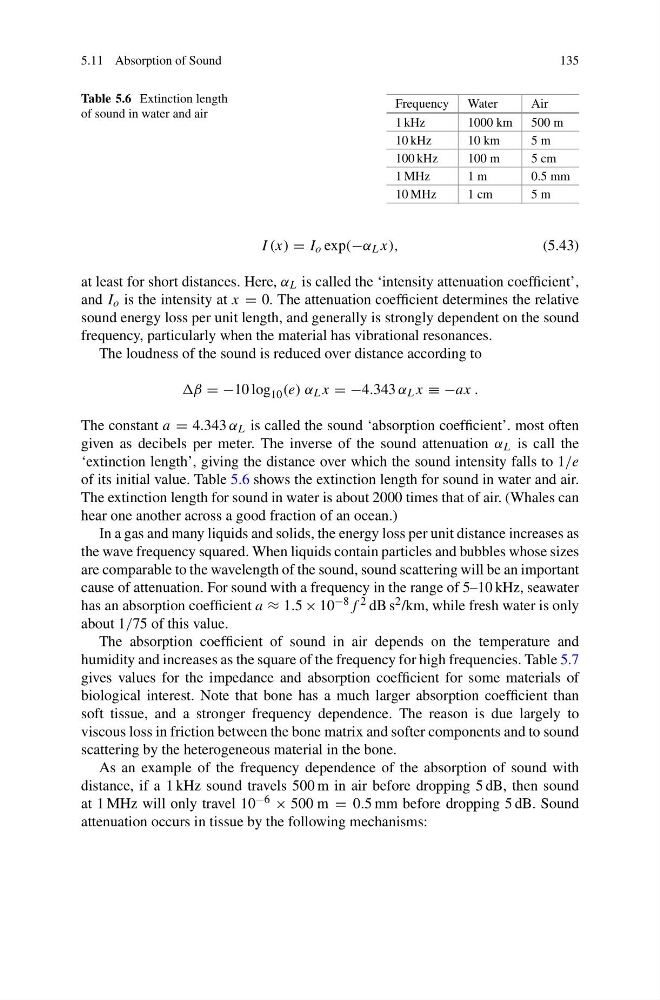
Table 5.6 Extinction length
of sound in water and air
Frequency Water
Air
1 kHz
1000 km 500 m
10 kHz
10 km
5 m
100 kHz
100 m
5 cm
1 MHz
1 m
0.5 mm
10 MHz
1 cm
5 m
I (x) = I o exp(−α L x),
(5.43)
at least for short distances. Here, α L is called the ‘intensity attenuation coefficient’,
and I o is the intensity at x = 0. The attenuation coefficient determines the relative
sound energy loss per unit length, and generally is strongly dependent on the sound
frequency, particularly when the material has vibrational resonances.
The loudness of the sound is reduced over distance according to
β = −10 log 10 (e) α L x = −4.343 α L x ≡ −ax .
The constant a = 4.343 α L is called the sound ‘absorption coefficient’. most often
given as decibels per meter. The inverse of the sound attenuation α L is call the
‘extinction length’, giving the distance over which the sound intensity falls to 1/e
of its initial value. Table 5.6 shows the extinction length for sound in water and air.
The extinction length for sound in water is about 2000 times that of air. (Whales can
hear one another across a good fraction of an ocean.)
In a gas and many liquids and solids, the energy loss per unit distance increases as
the wave frequency squared. When liquids contain particles and bubbles whose sizes
are comparable to the wavelength of the sound, sound scattering will be an important
cause of attenuation. For sound with a frequency in the range of 5–10 kHz, seawater
has an absorption coefficient a ≈ 1.5 × 10 −8 f 2 dB s 2 /km, while fresh water is only
about 1/75 of this value.
The absorption coefficient of sound in air depends on the temperature and
humidity and increases as the square of the frequency for high frequencies. Table 5.7
gives values for the impedance and absorption coefficient for some materials of
biological interest. Note that bone has a much larger absorption coefficient than
soft tissue, and a stronger frequency dependence. The reason is due largely to
viscous loss in friction between the bone matrix and softer components and to sound
scattering by the heterogeneous material in the bone.
As an example of the frequency dependence of the absorption of sound with
distance, if a 1 kHz sound travels 500 m in air before dropping 5 dB, then sound
at 1 MHz will only travel 10 −6 × 500 m = 0.5 mm before dropping 5 dB. Sound
attenuation occurs in tissue by the following mechanisms:
135
Table 5.6 Extinction length
of sound in water and air
Frequency Water
Air
1 kHz
1000 km 500 m
10 kHz
10 km
5 m
100 kHz
100 m
5 cm
1 MHz
1 m
0.5 mm
10 MHz
1 cm
5 m
I (x) = I o exp(−α L x),
(5.43)
at least for short distances. Here, α L is called the ‘intensity attenuation coefficient’,
and I o is the intensity at x = 0. The attenuation coefficient determines the relative
sound energy loss per unit length, and generally is strongly dependent on the sound
frequency, particularly when the material has vibrational resonances.
The loudness of the sound is reduced over distance according to
β = −10 log 10 (e) α L x = −4.343 α L x ≡ −ax .
The constant a = 4.343 α L is called the sound ‘absorption coefficient’. most often
given as decibels per meter. The inverse of the sound attenuation α L is call the
‘extinction length’, giving the distance over which the sound intensity falls to 1/e
of its initial value. Table 5.6 shows the extinction length for sound in water and air.
The extinction length for sound in water is about 2000 times that of air. (Whales can
hear one another across a good fraction of an ocean.)
In a gas and many liquids and solids, the energy loss per unit distance increases as
the wave frequency squared. When liquids contain particles and bubbles whose sizes
are comparable to the wavelength of the sound, sound scattering will be an important
cause of attenuation. For sound with a frequency in the range of 5–10 kHz, seawater
has an absorption coefficient a ≈ 1.5 × 10 −8 f 2 dB s 2 /km, while fresh water is only
about 1/75 of this value.
The absorption coefficient of sound in air depends on the temperature and
humidity and increases as the square of the frequency for high frequencies. Table 5.7
gives values for the impedance and absorption coefficient for some materials of
biological interest. Note that bone has a much larger absorption coefficient than
soft tissue, and a stronger frequency dependence. The reason is due largely to
viscous loss in friction between the bone matrix and softer components and to sound
scattering by the heterogeneous material in the bone.
As an example of the frequency dependence of the absorption of sound with
distance, if a 1 kHz sound travels 500 m in air before dropping 5 dB, then sound
at 1 MHz will only travel 10 −6 × 500 m = 0.5 mm before dropping 5 dB. Sound
attenuation occurs in tissue by the following mechanisms: