

5.9 Dispersion of Sound
133
(1/v 1 ) sin θ 1 = (1/v 2 ) sin θ 2 ,
(5.42)
where the θ i are the angles between the boundary normal at the intersection of a
sound ray (a line perpendicular to a wave front).
Snell’s law is a property of any wave (acoustical or field wave, such as light)
passing through regions of differing wave speed. Physical continuity requires the
wave fronts to be continuous, and causality requires that the frequency of the wave
remains fixed through the region. These two conditions are sufficient to derive the
bending of rays 17 and Snell’s law. Acoustical lenses can be constructed to converge
or diverge sound waves.
5.9 Dispersion of Sound
The dispersion of a wave refers to the separation of waves of different frequencies.
Refraction of sound waves in materials, including biological tissue, with that sound
containing a number of Fourier components, can also show a separation in the
direction of refraction for each of the component waves. Dispersion, or separation,
of waves of different wavelengths may occur if the wavelength of the wave in a
material depends non-linearly on the wave frequency. This is a property of waves
for which the group velocity differs from the phase velocity. For a given frequency,
the phase velocity, v p = f λ, will be proportional to the wavelength, but the group
velocity is v g = df/dκ, where κ is the wavenumber, the inverse of the wavelength.
So if the frequency is not proportional to the wavenumber, wave dispersion can
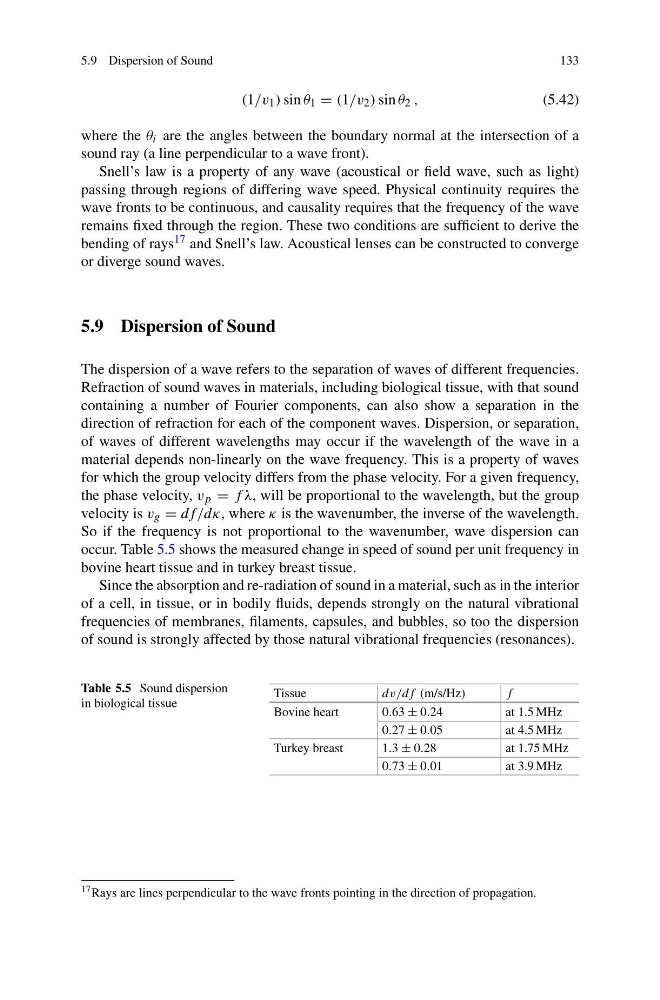
occur. Table 5.5 shows the measured change in speed of sound per unit frequency in
bovine heart tissue and in turkey breast tissue.
Since the absorption and re-radiation of sound in a material, such as in the interior
of a cell, in tissue, or in bodily fluids, depends strongly on the natural vibrational
frequencies of membranes, filaments, capsules, and bubbles, so too the dispersion
of sound is strongly affected by those natural vibrational frequencies (resonances).
Table 5.5 Sound dispersion
in biological tissue
Tissue
dv/df (m/s/Hz)
f
Bovine heart
0.63 ± 0.24
at 1.5 MHz
0.27 ± 0.05
at 4.5 MHz
Turkey breast
1.3 ± 0.28
at 1.75 MHz
0.73 ± 0.01
at 3.9 MHz
17 Rays are lines perpendicular to the wave fronts pointing in the direction of propagation.
133
(1/v 1 ) sin θ 1 = (1/v 2 ) sin θ 2 ,
(5.42)
where the θ i are the angles between the boundary normal at the intersection of a
sound ray (a line perpendicular to a wave front).
Snell’s law is a property of any wave (acoustical or field wave, such as light)
passing through regions of differing wave speed. Physical continuity requires the
wave fronts to be continuous, and causality requires that the frequency of the wave
remains fixed through the region. These two conditions are sufficient to derive the
bending of rays 17 and Snell’s law. Acoustical lenses can be constructed to converge
or diverge sound waves.
5.9 Dispersion of Sound
The dispersion of a wave refers to the separation of waves of different frequencies.
Refraction of sound waves in materials, including biological tissue, with that sound
containing a number of Fourier components, can also show a separation in the
direction of refraction for each of the component waves. Dispersion, or separation,
of waves of different wavelengths may occur if the wavelength of the wave in a
material depends non-linearly on the wave frequency. This is a property of waves
for which the group velocity differs from the phase velocity. For a given frequency,
the phase velocity, v p = f λ, will be proportional to the wavelength, but the group
velocity is v g = df/dκ, where κ is the wavenumber, the inverse of the wavelength.
So if the frequency is not proportional to the wavenumber, wave dispersion can
occur. Table 5.5 shows the measured change in speed of sound per unit frequency in
bovine heart tissue and in turkey breast tissue.
Since the absorption and re-radiation of sound in a material, such as in the interior
of a cell, in tissue, or in bodily fluids, depends strongly on the natural vibrational
frequencies of membranes, filaments, capsules, and bubbles, so too the dispersion
of sound is strongly affected by those natural vibrational frequencies (resonances).
Table 5.5 Sound dispersion
in biological tissue
Tissue
dv/df (m/s/Hz)
f
Bovine heart
0.63 ± 0.24
at 1.5 MHz
0.27 ± 0.05
at 4.5 MHz
Turkey breast
1.3 ± 0.28
at 1.75 MHz
0.73 ± 0.01
at 3.9 MHz
17 Rays are lines perpendicular to the wave fronts pointing in the direction of propagation.