

132
5 Acoustics in Biology and Medicine
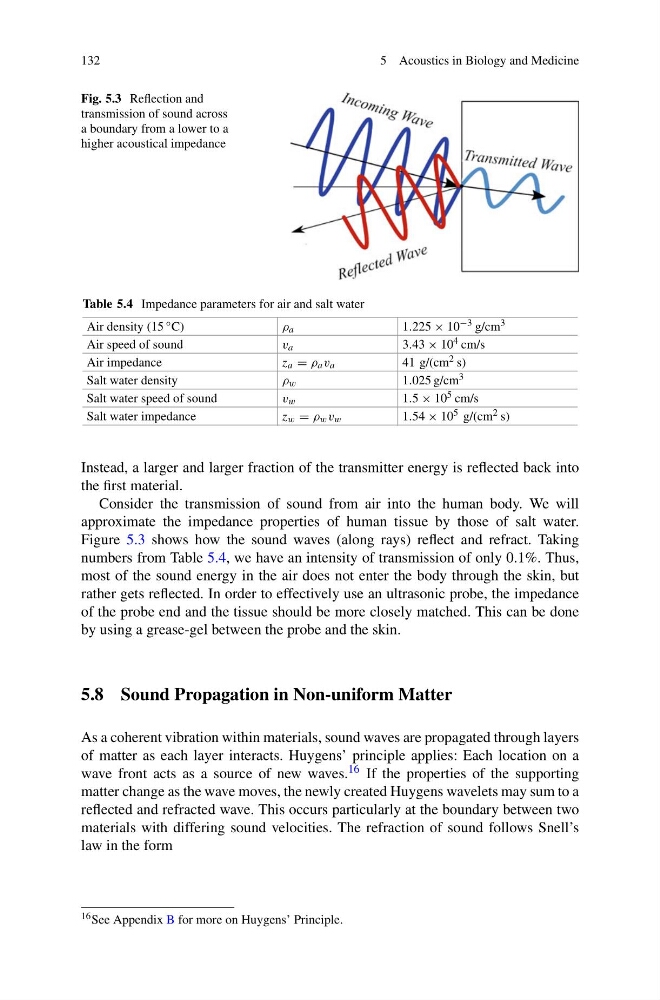
Fig. 5.3 Reflection and
transmission of sound across
a boundary from a lower to a
higher acoustical impedance
Table 5.4 Impedance parameters for air and salt water
Air density (15 ◦ C)
ρ a
1.225 × 10 −3 g/cm 3
Air speed of sound
v a
3.43 × 10 4 cm/s
Air impedance
z a = ρ a v a
41 g/(cm 2 s)
Salt water density
ρ w
1.025 g/cm 3
Salt water speed of sound
v w
1.5 × 10 5 cm/s
Salt water impedance
z w = ρ w v w
1.54 × 10 5 g/(cm 2 s)
Instead, a larger and larger fraction of the transmitter energy is reflected back into
the first material.
Consider the transmission of sound from air into the human body. We will
approximate the impedance properties of human tissue by those of salt water.
Figure 5.3 shows how the sound waves (along rays) reflect and refract. Taking
numbers from Table 5.4, we have an intensity of transmission of only 0.1%. Thus,
most of the sound energy in the air does not enter the body through the skin, but
rather gets reflected. In order to effectively use an ultrasonic probe, the impedance
of the probe end and the tissue should be more closely matched. This can be done
by using a grease-gel between the probe and the skin.
5.8 Sound Propagation in Non-uniform Matter
As a coherent vibration within materials, sound waves are propagated through layers
of matter as each layer interacts. Huygens’ principle applies: Each location on a
wave front acts as a source of new waves. 16 If the properties of the supporting
matter change as the wave moves, the newly created Huygens wavelets may sum to a
reflected and refracted wave. This occurs particularly at the boundary between two
materials with differing sound velocities. The refraction of sound follows Snell’s
law in the form
16 See Appendix B for more on Huygens’ Principle.
5 Acoustics in Biology and Medicine
Fig. 5.3 Reflection and
transmission of sound across
a boundary from a lower to a
higher acoustical impedance
Table 5.4 Impedance parameters for air and salt water
Air density (15 ◦ C)
ρ a
1.225 × 10 −3 g/cm 3
Air speed of sound
v a
3.43 × 10 4 cm/s
Air impedance
z a = ρ a v a
41 g/(cm 2 s)
Salt water density
ρ w
1.025 g/cm 3
Salt water speed of sound
v w
1.5 × 10 5 cm/s
Salt water impedance
z w = ρ w v w
1.54 × 10 5 g/(cm 2 s)
Instead, a larger and larger fraction of the transmitter energy is reflected back into
the first material.
Consider the transmission of sound from air into the human body. We will
approximate the impedance properties of human tissue by those of salt water.
Figure 5.3 shows how the sound waves (along rays) reflect and refract. Taking
numbers from Table 5.4, we have an intensity of transmission of only 0.1%. Thus,
most of the sound energy in the air does not enter the body through the skin, but
rather gets reflected. In order to effectively use an ultrasonic probe, the impedance
of the probe end and the tissue should be more closely matched. This can be done
by using a grease-gel between the probe and the skin.
5.8 Sound Propagation in Non-uniform Matter
As a coherent vibration within materials, sound waves are propagated through layers
of matter as each layer interacts. Huygens’ principle applies: Each location on a
wave front acts as a source of new waves. 16 If the properties of the supporting
matter change as the wave moves, the newly created Huygens wavelets may sum to a
reflected and refracted wave. This occurs particularly at the boundary between two
materials with differing sound velocities. The refraction of sound follows Snell’s
law in the form
16 See Appendix B for more on Huygens’ Principle.