

5.6 Sound Level
127
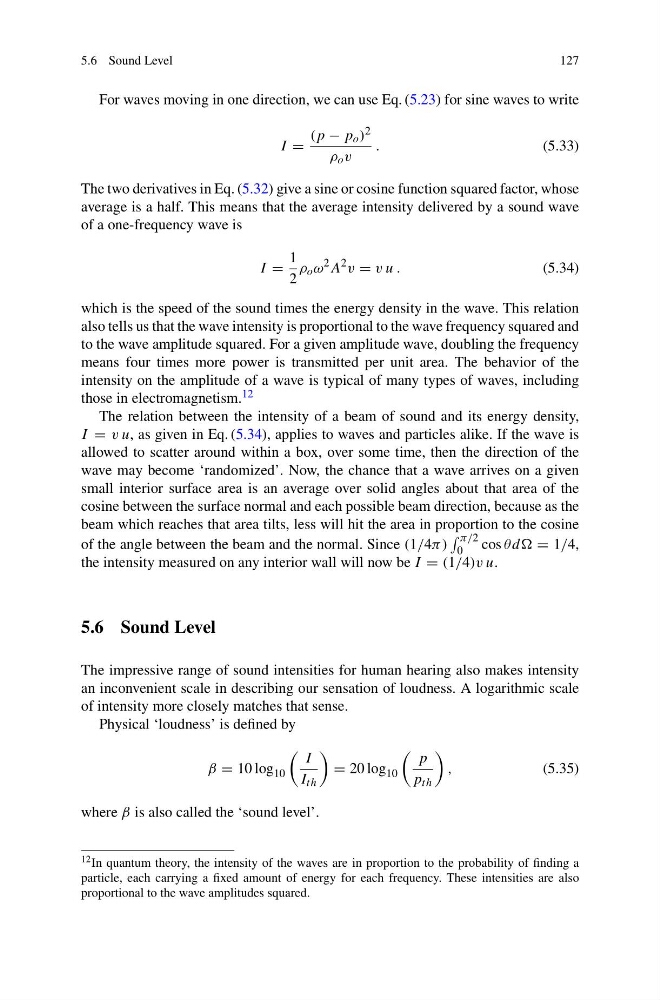
For waves moving in one direction, we can use Eq. (5.23) for sine waves to write
I =
(p − p o ) 2
ρ o v
.
(5.33)
The two derivatives in Eq. (5.32) give a sine or cosine function squared factor, whose
average is a half. This means that the average intensity delivered by a sound wave
of a one-frequency wave is
I =
1
2
ρ o ω
2 A
2 v = v u .
(5.34)
which is the speed of the sound times the energy density in the wave. This relation
also tells us that the wave intensity is proportional to the wave frequency squared and
to the wave amplitude squared. For a given amplitude wave, doubling the frequency
means four times more power is transmitted per unit area. The behavior of the
intensity on the amplitude of a wave is typical of many types of waves, including
those in electromagnetism. 12
The relation between the intensity of a beam of sound and its energy density,
I = v u, as given in Eq. (5.34), applies to waves and particles alike. If the wave is
allowed to scatter around within a box, over some time, then the direction of the
wave may become ‘randomized’. Now, the chance that a wave arrives on a given
small interior surface area is an average over solid angles about that area of the
cosine between the surface normal and each possible beam direction, because as the
beam which reaches that area tilts, less will hit the area in proportion to the cosine
of the angle between the beam and the normal. Since (1/4π)
π/2
0
cos θdd = 1/4,
the intensity measured on any interior wall will now be I = (1/4)v u.
5.6 Sound Level
The impressive range of sound intensities for human hearing also makes intensity
an inconvenient scale in describing our sensation of loudness. A logarithmic scale
of intensity more closely matches that sense.
Physical ‘loudness’ is defined by
β = 10 log 10
I
I th
= 20 log 10
p
p th
,
(5.35)
where β is also called the ‘sound level’.
12 In quantum theory, the intensity of the waves are in proportion to the probability of finding a
particle, each carrying a fixed amount of energy for each frequency. These intensities are also
proportional to the wave amplitudes squared.
127
For waves moving in one direction, we can use Eq. (5.23) for sine waves to write
I =
(p − p o ) 2
ρ o v
.
(5.33)
The two derivatives in Eq. (5.32) give a sine or cosine function squared factor, whose
average is a half. This means that the average intensity delivered by a sound wave
of a one-frequency wave is
I =
1
2
ρ o ω
2 A
2 v = v u .
(5.34)
which is the speed of the sound times the energy density in the wave. This relation
also tells us that the wave intensity is proportional to the wave frequency squared and
to the wave amplitude squared. For a given amplitude wave, doubling the frequency
means four times more power is transmitted per unit area. The behavior of the
intensity on the amplitude of a wave is typical of many types of waves, including
those in electromagnetism. 12
The relation between the intensity of a beam of sound and its energy density,
I = v u, as given in Eq. (5.34), applies to waves and particles alike. If the wave is
allowed to scatter around within a box, over some time, then the direction of the
wave may become ‘randomized’. Now, the chance that a wave arrives on a given
small interior surface area is an average over solid angles about that area of the
cosine between the surface normal and each possible beam direction, because as the
beam which reaches that area tilts, less will hit the area in proportion to the cosine
of the angle between the beam and the normal. Since (1/4π)
π/2
0
cos θdd = 1/4,
the intensity measured on any interior wall will now be I = (1/4)v u.
5.6 Sound Level
The impressive range of sound intensities for human hearing also makes intensity
an inconvenient scale in describing our sensation of loudness. A logarithmic scale
of intensity more closely matches that sense.
Physical ‘loudness’ is defined by
β = 10 log 10
I
I th
= 20 log 10
p
p th
,
(5.35)
where β is also called the ‘sound level’.
12 In quantum theory, the intensity of the waves are in proportion to the probability of finding a
particle, each carrying a fixed amount of energy for each frequency. These intensities are also
proportional to the wave amplitudes squared.