

126
5 Acoustics in Biology and Medicine
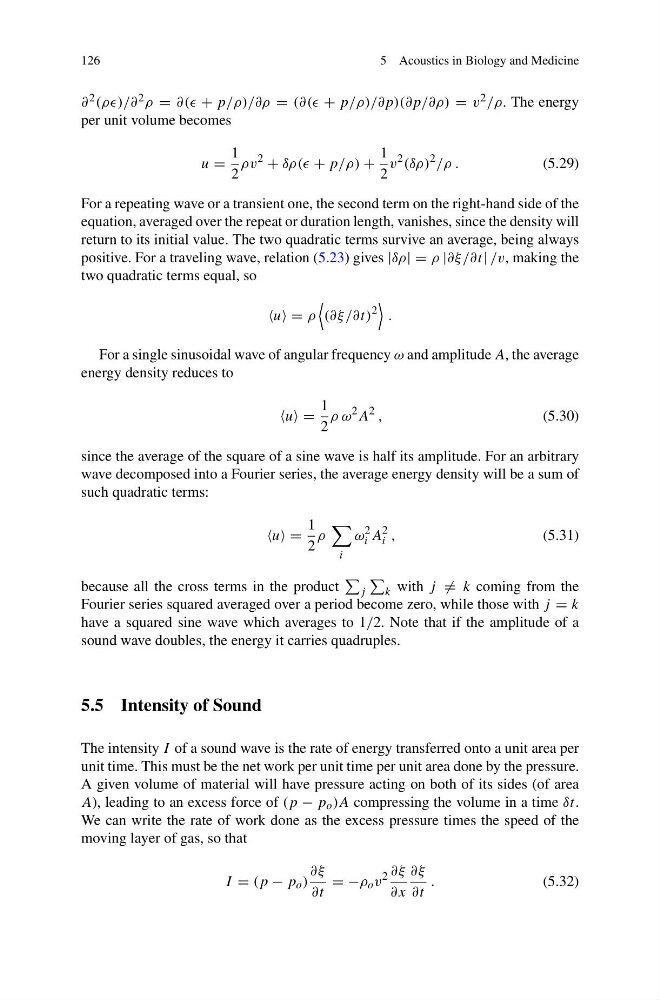
∂ 2 (ρρ)/∂ 2 ρ = ∂(( + p/ρ)/∂ρ = (∂(( + p/ρ)/∂p)(∂p/∂ρ) = v 2 /ρ. The energy
per unit volume becomes
u =
1
2
ρv
2
+ δρ(( + p/ρ) +
1
2
v
2 (δρ)
2 /ρ .
(5.29)
For a repeating wave or a transient one, the second term on the right-hand side of the
equation, averaged over the repeat or duration length, vanishes, since the density will
return to its initial value. The two quadratic terms survive an average, being always
positive. For a traveling wave, relation (5.23) gives |δρ| = ρ |∂ξ/∂t| /v, making the
two quadratic terms equal, so
u = ρ
(∂ξ/∂t)
2
.
For a single sinusoidal wave of angular frequency ω and amplitude A, the average
energy density reduces to
u =
1
2
ρ ω
2 A
2 ,
(5.30)
since the average of the square of a sine wave is half its amplitude. For an arbitrary
wave decomposed into a Fourier series, the average energy density will be a sum of
such quadratic terms:
u =
1
2
ρ
i
ω
2
i A
2
i ,
(5.31)
because all the cross terms in the product
j
k with j = k coming from the
Fourier series squared averaged over a period become zero, while those with j = k
have a squared sine wave which averages to 1/2. Note that if the amplitude of a
sound wave doubles, the energy it carries quadruples.
5.5 Intensity of Sound
The intensity I of a sound wave is the rate of energy transferred onto a unit area per
unit time. This must be the net work per unit time per unit area done by the pressure.
A given volume of material will have pressure acting on both of its sides (of area
A), leading to an excess force of (p − p o )A compressing the volume in a time δt.
We can write the rate of work done as the excess pressure times the speed of the
moving layer of gas, so that
I = (p − p o )
∂ξ
∂t
= −ρ o v
2 ∂ξ
∂x
∂ξ
∂t
.
(5.32)
5 Acoustics in Biology and Medicine
∂ 2 (ρρ)/∂ 2 ρ = ∂(( + p/ρ)/∂ρ = (∂(( + p/ρ)/∂p)(∂p/∂ρ) = v 2 /ρ. The energy
per unit volume becomes
u =
1
2
ρv
2
+ δρ(( + p/ρ) +
1
2
v
2 (δρ)
2 /ρ .
(5.29)
For a repeating wave or a transient one, the second term on the right-hand side of the
equation, averaged over the repeat or duration length, vanishes, since the density will
return to its initial value. The two quadratic terms survive an average, being always
positive. For a traveling wave, relation (5.23) gives |δρ| = ρ |∂ξ/∂t| /v, making the
two quadratic terms equal, so
u = ρ
(∂ξ/∂t)
2
.
For a single sinusoidal wave of angular frequency ω and amplitude A, the average
energy density reduces to
u =
1
2
ρ ω
2 A
2 ,
(5.30)
since the average of the square of a sine wave is half its amplitude. For an arbitrary
wave decomposed into a Fourier series, the average energy density will be a sum of
such quadratic terms:
u =
1
2
ρ
i
ω
2
i A
2
i ,
(5.31)
because all the cross terms in the product
j
k with j = k coming from the
Fourier series squared averaged over a period become zero, while those with j = k
have a squared sine wave which averages to 1/2. Note that if the amplitude of a
sound wave doubles, the energy it carries quadruples.
5.5 Intensity of Sound
The intensity I of a sound wave is the rate of energy transferred onto a unit area per
unit time. This must be the net work per unit time per unit area done by the pressure.
A given volume of material will have pressure acting on both of its sides (of area
A), leading to an excess force of (p − p o )A compressing the volume in a time δt.
We can write the rate of work done as the excess pressure times the speed of the
moving layer of gas, so that
I = (p − p o )
∂ξ
∂t
= −ρ o v
2 ∂ξ
∂x
∂ξ
∂t
.
(5.32)