

116
5 Acoustics in Biology and Medicine
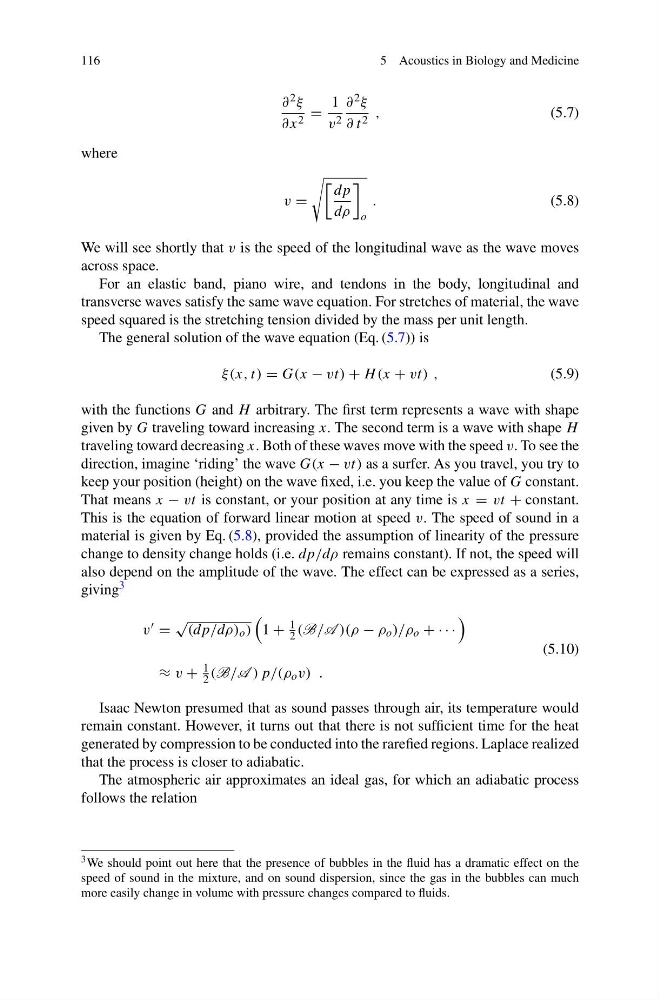
∂ 2 ξ
∂x 2 =
1
v 2
∂ 2 ξ
∂ t 2 ,
(5.7)
where
v =
dp
dρ
o
.
(5.8)
We will see shortly that v is the speed of the longitudinal wave as the wave moves
across space.
For an elastic band, piano wire, and tendons in the body, longitudinal and
transverse waves satisfy the same wave equation. For stretches of material, the wave
speed squared is the stretching tension divided by the mass per unit length.
The general solution of the wave equation (Eq. (5.7)) is
ξ(x, t) = G(x − vt) + H (x + vt) ,
(5.9)
with the functions G and H arbitrary. The first term represents a wave with shape
given by G traveling toward increasing x. The second term is a wave with shape H
traveling toward decreasing x. Both of these waves move with the speed v. To see the
direction, imagine ‘riding’ the wave G(x − vt) as a surfer. As you travel, you try to
keep your position (height) on the wave fixed, i.e. you keep the value of G constant.
That means x − vt is constant, or your position at any time is x = vt + constant.
This is the equation of forward linear motion at speed v. The speed of sound in a
material is given by Eq. (5.8), provided the assumption of linearity of the pressure
change to density change holds (i.e. dp/dρ remains constant). If not, the speed will
also depend on the amplitude of the wave. The effect can be expressed as a series,
giving 3
v =
√
(dp/dρ) o )
1 +
1
2 (B/A )(ρ − ρ o )/ρ o + · · ·
≈ v +
1
2 (B/A ) p/(ρ o v) .
(5.10)
Isaac Newton presumed that as sound passes through air, its temperature would
remain constant. However, it turns out that there is not sufficient time for the heat
generated by compression to be conducted into the rarefied regions. Laplace realized
that the process is closer to adiabatic.
The atmospheric air approximates an ideal gas, for which an adiabatic process
follows the relation
3 We should point out here that the presence of bubbles in the fluid has a dramatic effect on the
speed of sound in the mixture, and on sound dispersion, since the gas in the bubbles can much
more easily change in volume with pressure changes compared to fluids.
5 Acoustics in Biology and Medicine
∂ 2 ξ
∂x 2 =
1
v 2
∂ 2 ξ
∂ t 2 ,
(5.7)
where
v =
dp
dρ
o
.
(5.8)
We will see shortly that v is the speed of the longitudinal wave as the wave moves
across space.
For an elastic band, piano wire, and tendons in the body, longitudinal and
transverse waves satisfy the same wave equation. For stretches of material, the wave
speed squared is the stretching tension divided by the mass per unit length.
The general solution of the wave equation (Eq. (5.7)) is
ξ(x, t) = G(x − vt) + H (x + vt) ,
(5.9)
with the functions G and H arbitrary. The first term represents a wave with shape
given by G traveling toward increasing x. The second term is a wave with shape H
traveling toward decreasing x. Both of these waves move with the speed v. To see the
direction, imagine ‘riding’ the wave G(x − vt) as a surfer. As you travel, you try to
keep your position (height) on the wave fixed, i.e. you keep the value of G constant.
That means x − vt is constant, or your position at any time is x = vt + constant.
This is the equation of forward linear motion at speed v. The speed of sound in a
material is given by Eq. (5.8), provided the assumption of linearity of the pressure
change to density change holds (i.e. dp/dρ remains constant). If not, the speed will
also depend on the amplitude of the wave. The effect can be expressed as a series,
giving 3
v =
√
(dp/dρ) o )
1 +
1
2 (B/A )(ρ − ρ o )/ρ o + · · ·
≈ v +
1
2 (B/A ) p/(ρ o v) .
(5.10)
Isaac Newton presumed that as sound passes through air, its temperature would
remain constant. However, it turns out that there is not sufficient time for the heat
generated by compression to be conducted into the rarefied regions. Laplace realized
that the process is closer to adiabatic.
The atmospheric air approximates an ideal gas, for which an adiabatic process
follows the relation
3 We should point out here that the presence of bubbles in the fluid has a dramatic effect on the
speed of sound in the mixture, and on sound dispersion, since the gas in the bubbles can much
more easily change in volume with pressure changes compared to fluids.