

5.1 The Nature of Sound Waves
115
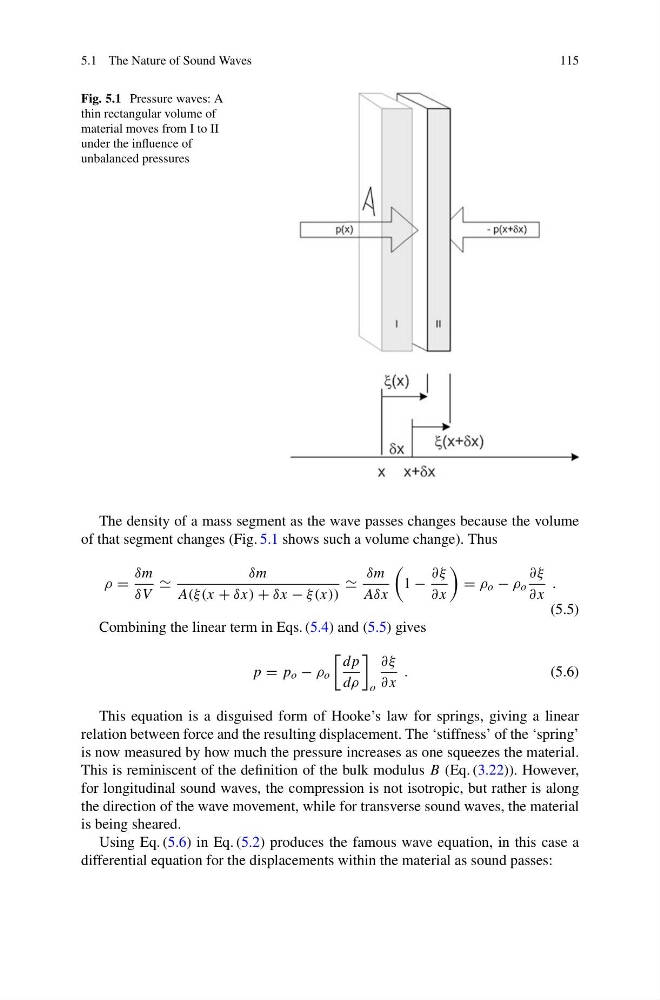
Fig. 5.1 Pressure waves: A
thin rectangular volume of
material moves from I to II
under the influence of
unbalanced pressures
The density of a mass segment as the wave passes changes because the volume
of that segment changes (Fig. 5.1 shows such a volume change). Thus
ρ =
δm
δV
δm
A(ξ(x + δx) + δx − ξ(x))
δm
Aδx
1 −
∂ξ
∂x
= ρ o − ρ o
∂ξ
∂x
.
(5.5)
Combining the linear term in Eqs. (5.4) and (5.5) gives
p = p o − ρ o
dp
dρ
o
∂ξ
∂x
.
(5.6)
This equation is a disguised form of Hooke’s law for springs, giving a linear
relation between force and the resulting displacement. The ‘stiffness’ of the ‘spring’
is now measured by how much the pressure increases as one squeezes the material.
This is reminiscent of the definition of the bulk modulus B (Eq. (3.22)). However,
for longitudinal sound waves, the compression is not isotropic, but rather is along
the direction of the wave movement, while for transverse sound waves, the material
is being sheared.
Using Eq. (5.6) in Eq. (5.2) produces the famous wave equation, in this case a
differential equation for the displacements within the material as sound passes:
115
Fig. 5.1 Pressure waves: A
thin rectangular volume of
material moves from I to II
under the influence of
unbalanced pressures
The density of a mass segment as the wave passes changes because the volume
of that segment changes (Fig. 5.1 shows such a volume change). Thus
ρ =
δm
δV
δm
A(ξ(x + δx) + δx − ξ(x))
δm
Aδx
1 −
∂ξ
∂x
= ρ o − ρ o
∂ξ
∂x
.
(5.5)
Combining the linear term in Eqs. (5.4) and (5.5) gives
p = p o − ρ o
dp
dρ
o
∂ξ
∂x
.
(5.6)
This equation is a disguised form of Hooke’s law for springs, giving a linear
relation between force and the resulting displacement. The ‘stiffness’ of the ‘spring’
is now measured by how much the pressure increases as one squeezes the material.
This is reminiscent of the definition of the bulk modulus B (Eq. (3.22)). However,
for longitudinal sound waves, the compression is not isotropic, but rather is along
the direction of the wave movement, while for transverse sound waves, the material
is being sheared.
Using Eq. (5.6) in Eq. (5.2) produces the famous wave equation, in this case a
differential equation for the displacements within the material as sound passes: