

108
4 Fluid Mechanics Applied to Biosystems
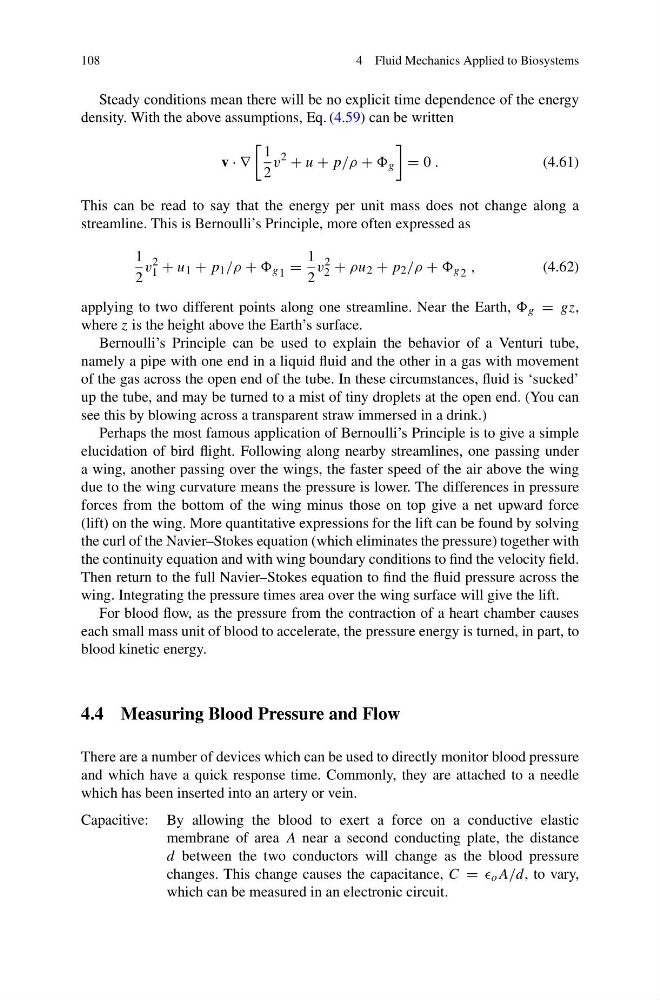
Steady conditions mean there will be no explicit time dependence of the energy
density. With the above assumptions, Eq. (4.59) can be written
v · ∇
1
2
v
2
+ u + p/ρ + g
= 0 .
(4.61)
This can be read to say that the energy per unit mass does not change along a
streamline. This is Bernoulli’s Principle, more often expressed as
1
2
v
2
1 + u 1 + p 1 /ρ + g 1 =
1
2
v
2
2 + ρu 2 + p 2 /ρ + g 2 ,
(4.62)
applying to two different points along one streamline. Near the Earth, g = gz,
where z is the height above the Earth’s surface.
Bernoulli’s Principle can be used to explain the behavior of a Venturi tube,
namely a pipe with one end in a liquid fluid and the other in a gas with movement
of the gas across the open end of the tube. In these circumstances, fluid is ‘sucked’
up the tube, and may be turned to a mist of tiny droplets at the open end. (You can
see this by blowing across a transparent straw immersed in a drink.)
Perhaps the most famous application of Bernoulli’s Principle is to give a simple
elucidation of bird flight. Following along nearby streamlines, one passing under
a wing, another passing over the wings, the faster speed of the air above the wing
due to the wing curvature means the pressure is lower. The differences in pressure
forces from the bottom of the wing minus those on top give a net upward force
(lift) on the wing. More quantitative expressions for the lift can be found by solving
the curl of the Navier–Stokes equation (which eliminates the pressure) together with
the continuity equation and with wing boundary conditions to find the velocity field.
Then return to the full Navier–Stokes equation to find the fluid pressure across the
wing. Integrating the pressure times area over the wing surface will give the lift.
For blood flow, as the pressure from the contraction of a heart chamber causes
each small mass unit of blood to accelerate, the pressure energy is turned, in part, to
blood kinetic energy.
4.4 Measuring Blood Pressure and Flow
There are a number of devices which can be used to directly monitor blood pressure
and which have a quick response time. Commonly, they are attached to a needle
which has been inserted into an artery or vein.
Capacitive: By allowing the blood to exert a force on a conductive elastic
membrane of area A near a second conducting plate, the distance
d between the two conductors will change as the blood pressure
changes. This change causes the capacitance, C = o A/d, to vary,
which can be measured in an electronic circuit.
4 Fluid Mechanics Applied to Biosystems
Steady conditions mean there will be no explicit time dependence of the energy
density. With the above assumptions, Eq. (4.59) can be written
v · ∇
1
2
v
2
+ u + p/ρ + g
= 0 .
(4.61)
This can be read to say that the energy per unit mass does not change along a
streamline. This is Bernoulli’s Principle, more often expressed as
1
2
v
2
1 + u 1 + p 1 /ρ + g 1 =
1
2
v
2
2 + ρu 2 + p 2 /ρ + g 2 ,
(4.62)
applying to two different points along one streamline. Near the Earth, g = gz,
where z is the height above the Earth’s surface.
Bernoulli’s Principle can be used to explain the behavior of a Venturi tube,
namely a pipe with one end in a liquid fluid and the other in a gas with movement
of the gas across the open end of the tube. In these circumstances, fluid is ‘sucked’
up the tube, and may be turned to a mist of tiny droplets at the open end. (You can
see this by blowing across a transparent straw immersed in a drink.)
Perhaps the most famous application of Bernoulli’s Principle is to give a simple
elucidation of bird flight. Following along nearby streamlines, one passing under
a wing, another passing over the wings, the faster speed of the air above the wing
due to the wing curvature means the pressure is lower. The differences in pressure
forces from the bottom of the wing minus those on top give a net upward force
(lift) on the wing. More quantitative expressions for the lift can be found by solving
the curl of the Navier–Stokes equation (which eliminates the pressure) together with
the continuity equation and with wing boundary conditions to find the velocity field.
Then return to the full Navier–Stokes equation to find the fluid pressure across the
wing. Integrating the pressure times area over the wing surface will give the lift.
For blood flow, as the pressure from the contraction of a heart chamber causes
each small mass unit of blood to accelerate, the pressure energy is turned, in part, to
blood kinetic energy.
4.4 Measuring Blood Pressure and Flow
There are a number of devices which can be used to directly monitor blood pressure
and which have a quick response time. Commonly, they are attached to a needle
which has been inserted into an artery or vein.
Capacitive: By allowing the blood to exert a force on a conductive elastic
membrane of area A near a second conducting plate, the distance
d between the two conductors will change as the blood pressure
changes. This change causes the capacitance, C = o A/d, to vary,
which can be measured in an electronic circuit.