

106
4 Fluid Mechanics Applied to Biosystems
Another simplifying case is a fluid with a large enough viscosity that the righthand side of Eq. (4.57) dominates the second term on the left. Then the vorticity
itself satisfies a diffusion equation. The larger the viscosity, the greater the diffusion
of a vortex. Expanding smoke rings that are made by blowing smoky air through a
circular hole are a good example.
4.3.13 Energy Transport in Fluids
To see how energy is transported through fluids, we first recognize that the energy
can be stored in an element of the fluid in both kinetic and potential energy forms.
The potential energy includes energy stored because the fluid has been compressed
(‘pressure energy’), energy stored by a force which pulled the fluid element away
from the Earth (gravitational energy), and energy stored by having an external
electrical force displace the fluid by acting on its net charge (electrical energy). We
will let u(x, y, z, t) be the potential energy stored per unit mass for a fluid element
located at (x, y, z) at time t.
Each element of the fluid is in contact with adjacent elements or a boundary, and
may be in interaction with external fields. This means the energy stored in that fluid
element can change. We will keep our attention on a fixed mass of fluid. We will
follow the small element of fluid with mass δm and internal energy per unit mass
of u. As it moves, its energy,
(1/2)ρv 2 + ρu
δV , changes over time by several
mechanisms: Mechanical energy can be transported into the fluid element through
the work done by external forces. Those forces which act on the surface of the fluid
element (‘contact forces’) include the effects of pressure and viscous shear. The
work done per unit time by a force is the power delivered, force times displacement
per unit time, which is force times velocity. For the work done by pressure p, added
up over the whole surface of the small fluid element, the power delivered by pressure
is P =
p v · dA, where vdt = dr is the displacement of the surface due to the
pressure acting in the time dt. Gauss’ theorem,
F · dA =
∇ · F dV , let us rewrite
the expression in terms of a volume integral, so that P =
∇ · (p v) dV . Similarly,
we can find the power delivered due to viscous shear.
To find the work done per unit time by an external force over the whole body,
such as gravity, we must integrate over the whole volume of the fluid element,
finding the work done per unit time on each piece within. When the external
forces are conservative (as are the forces of gravity and electricity), each can be
expressed in terms of the gradient of a potential. For gravity acting on the fluid
element with volume δV , this reads: δF g = −ρ∇ g δV , while for electric forces,
δF q = −ρ q ∇ q δV . The power delivered to a fluid element by such body forces is
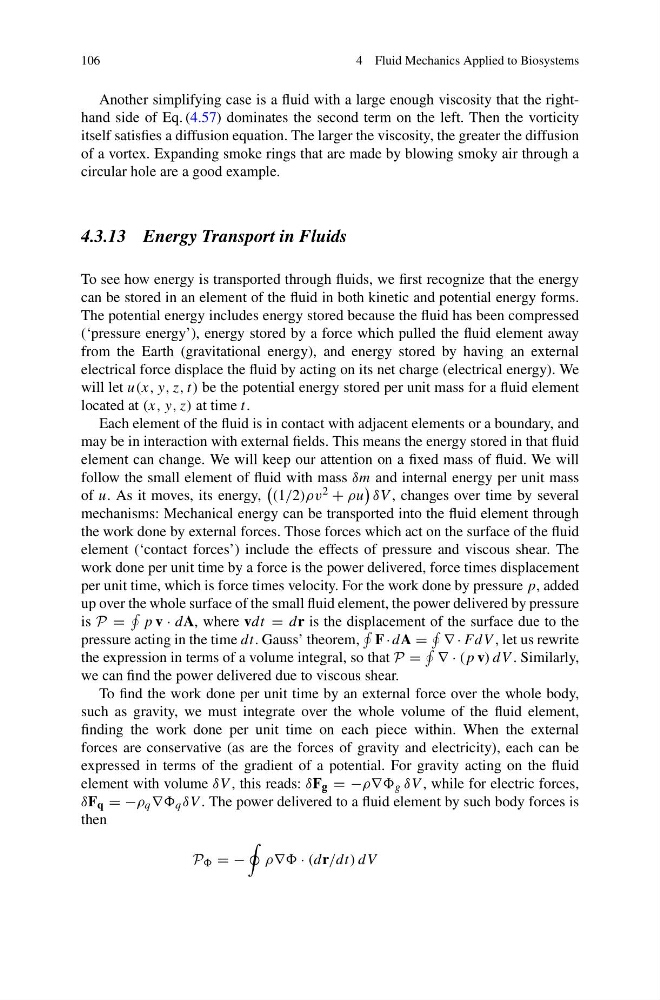
then
P = −
ρ∇ · (dr/dt) dV
4 Fluid Mechanics Applied to Biosystems
Another simplifying case is a fluid with a large enough viscosity that the righthand side of Eq. (4.57) dominates the second term on the left. Then the vorticity
itself satisfies a diffusion equation. The larger the viscosity, the greater the diffusion
of a vortex. Expanding smoke rings that are made by blowing smoky air through a
circular hole are a good example.
4.3.13 Energy Transport in Fluids
To see how energy is transported through fluids, we first recognize that the energy
can be stored in an element of the fluid in both kinetic and potential energy forms.
The potential energy includes energy stored because the fluid has been compressed
(‘pressure energy’), energy stored by a force which pulled the fluid element away
from the Earth (gravitational energy), and energy stored by having an external
electrical force displace the fluid by acting on its net charge (electrical energy). We
will let u(x, y, z, t) be the potential energy stored per unit mass for a fluid element
located at (x, y, z) at time t.
Each element of the fluid is in contact with adjacent elements or a boundary, and
may be in interaction with external fields. This means the energy stored in that fluid
element can change. We will keep our attention on a fixed mass of fluid. We will
follow the small element of fluid with mass δm and internal energy per unit mass
of u. As it moves, its energy,
(1/2)ρv 2 + ρu
δV , changes over time by several
mechanisms: Mechanical energy can be transported into the fluid element through
the work done by external forces. Those forces which act on the surface of the fluid
element (‘contact forces’) include the effects of pressure and viscous shear. The
work done per unit time by a force is the power delivered, force times displacement
per unit time, which is force times velocity. For the work done by pressure p, added
up over the whole surface of the small fluid element, the power delivered by pressure
is P =
p v · dA, where vdt = dr is the displacement of the surface due to the
pressure acting in the time dt. Gauss’ theorem,
F · dA =
∇ · F dV , let us rewrite
the expression in terms of a volume integral, so that P =
∇ · (p v) dV . Similarly,
we can find the power delivered due to viscous shear.
To find the work done per unit time by an external force over the whole body,
such as gravity, we must integrate over the whole volume of the fluid element,
finding the work done per unit time on each piece within. When the external
forces are conservative (as are the forces of gravity and electricity), each can be
expressed in terms of the gradient of a potential. For gravity acting on the fluid
element with volume δV , this reads: δF g = −ρ∇ g δV , while for electric forces,
δF q = −ρ q ∇ q δV . The power delivered to a fluid element by such body forces is
then
P = −
ρ∇ · (dr/dt) dV