

4
K. Yoshizawa and M. Miyanishi
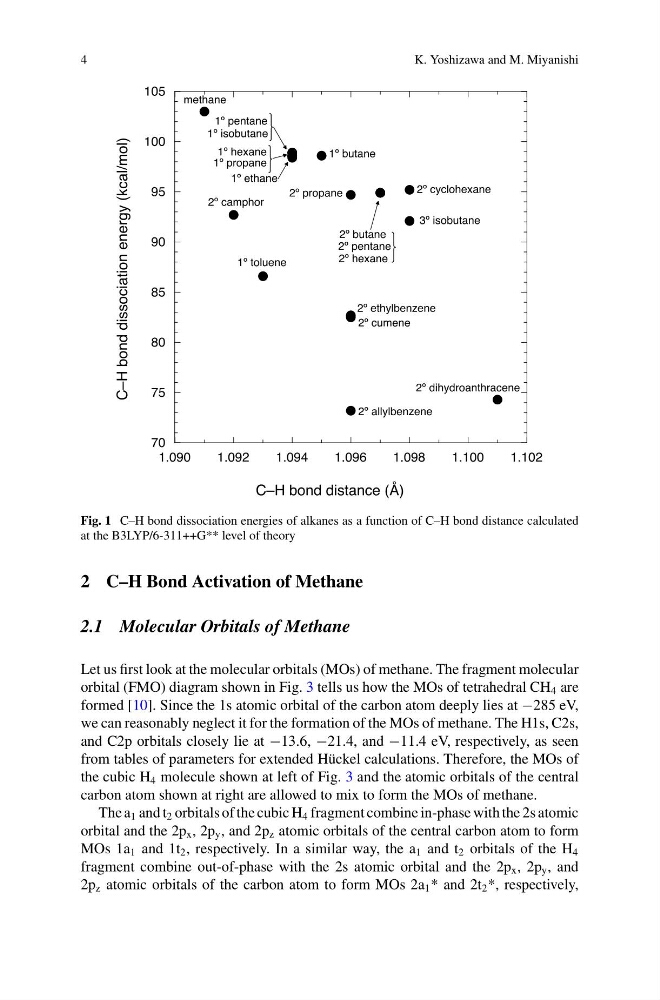
Fig. 1 C–H bond dissociation energies of alkanes as a function of C–H bond distance calculated
at the B3LYP/6-311++G** level of theory
2 C–H Bond Activation of Methane
2.1 Molecular Orbitals of Methane
Let us first look at the molecular orbitals (MOs) of methane. The fragment molecular
orbital (FMO) diagram shown in Fig. 3 tells us how the MOs of tetrahedral CH 4 are
formed [10]. Since the 1s atomic orbital of the carbon atom deeply lies at −285 eV,
we can reasonably neglect it for the formation of the MOs of methane. The H1s, C2s,
and C2p orbitals closely lie at −13.6, −21.4, and −11.4 eV, respectively, as seen
from tables of parameters for extended Hückel calculations. Therefore, the MOs of
the cubic H 4 molecule shown at left of Fig. 3 and the atomic orbitals of the central
carbon atom shown at right are allowed to mix to form the MOs of methane.
The a 1 and t 2 orbitals of the cubic H 4 fragment combine in-phase with the 2s atomic
orbital and the 2p x , 2p y , and 2p z atomic orbitals of the central carbon atom to form
MOs 1a 1 and 1t 2 , respectively. In a similar way, the a 1 and t 2 orbitals of the H 4
fragment combine out-of-phase with the 2s atomic orbital and the 2p x , 2p y , and
2p z atomic orbitals of the carbon atom to form MOs 2a 1 * and 2t 2 *, respectively,
K. Yoshizawa and M. Miyanishi
Fig. 1 C–H bond dissociation energies of alkanes as a function of C–H bond distance calculated
at the B3LYP/6-311++G** level of theory
2 C–H Bond Activation of Methane
2.1 Molecular Orbitals of Methane
Let us first look at the molecular orbitals (MOs) of methane. The fragment molecular
orbital (FMO) diagram shown in Fig. 3 tells us how the MOs of tetrahedral CH 4 are
formed [10]. Since the 1s atomic orbital of the carbon atom deeply lies at −285 eV,
we can reasonably neglect it for the formation of the MOs of methane. The H1s, C2s,
and C2p orbitals closely lie at −13.6, −21.4, and −11.4 eV, respectively, as seen
from tables of parameters for extended Hückel calculations. Therefore, the MOs of
the cubic H 4 molecule shown at left of Fig. 3 and the atomic orbitals of the central
carbon atom shown at right are allowed to mix to form the MOs of methane.
The a 1 and t 2 orbitals of the cubic H 4 fragment combine in-phase with the 2s atomic
orbital and the 2p x , 2p y , and 2p z atomic orbitals of the central carbon atom to form
MOs 1a 1 and 1t 2 , respectively. In a similar way, the a 1 and t 2 orbitals of the H 4
fragment combine out-of-phase with the 2s atomic orbital and the 2p x , 2p y , and
2p z atomic orbitals of the carbon atom to form MOs 2a 1 * and 2t 2 *, respectively,