

Orbital Concept for Methane Activation
5
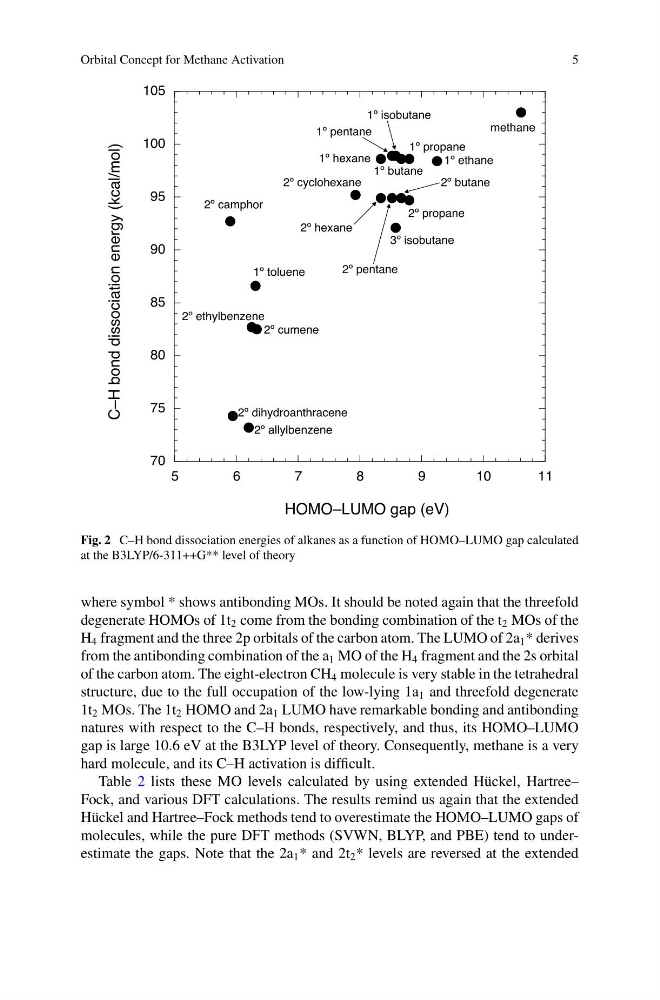
Fig. 2 C–H bond dissociation energies of alkanes as a function of HOMO–LUMO gap calculated
at the B3LYP/6-311++G** level of theory
where symbol * shows antibonding MOs. It should be noted again that the threefold
degenerate HOMOs of 1t 2 come from the bonding combination of the t 2 MOs of the
H 4 fragment and the three 2p orbitals of the carbon atom. The LUMO of 2a 1 * derives
from the antibonding combination of the a 1 MO of the H 4 fragment and the 2s orbital
of the carbon atom. The eight-electron CH 4 molecule is very stable in the tetrahedral
structure, due to the full occupation of the low-lying 1a 1 and threefold degenerate
1t 2 MOs. The 1t 2 HOMO and 2a 1 LUMO have remarkable bonding and antibonding
natures with respect to the C–H bonds, respectively, and thus, its HOMO–LUMO
gap is large 10.6 eV at the B3LYP level of theory. Consequently, methane is a very
hard molecule, and its C–H activation is difficult.
Table 2 lists these MO levels calculated by using extended Hückel, Hartree–
Fock, and various DFT calculations. The results remind us again that the extended
Hückel and Hartree–Fock methods tend to overestimate the HOMO–LUMO gaps of
molecules, while the pure DFT methods (SVWN, BLYP, and PBE) tend to underestimate the gaps. Note that the 2a 1 * and 2t 2 * levels are reversed at the extended
5
Fig. 2 C–H bond dissociation energies of alkanes as a function of HOMO–LUMO gap calculated
at the B3LYP/6-311++G** level of theory
where symbol * shows antibonding MOs. It should be noted again that the threefold
degenerate HOMOs of 1t 2 come from the bonding combination of the t 2 MOs of the
H 4 fragment and the three 2p orbitals of the carbon atom. The LUMO of 2a 1 * derives
from the antibonding combination of the a 1 MO of the H 4 fragment and the 2s orbital
of the carbon atom. The eight-electron CH 4 molecule is very stable in the tetrahedral
structure, due to the full occupation of the low-lying 1a 1 and threefold degenerate
1t 2 MOs. The 1t 2 HOMO and 2a 1 LUMO have remarkable bonding and antibonding
natures with respect to the C–H bonds, respectively, and thus, its HOMO–LUMO
gap is large 10.6 eV at the B3LYP level of theory. Consequently, methane is a very
hard molecule, and its C–H activation is difficult.
Table 2 lists these MO levels calculated by using extended Hückel, Hartree–
Fock, and various DFT calculations. The results remind us again that the extended
Hückel and Hartree–Fock methods tend to overestimate the HOMO–LUMO gaps of
molecules, while the pure DFT methods (SVWN, BLYP, and PBE) tend to underestimate the gaps. Note that the 2a 1 * and 2t 2 * levels are reversed at the extended