

Mechanistic Understanding of Methane …
77
active site structure that catalyzes methane hydroxylation in liquid phase [10–13].
Following the work of Panov and co-workers, Schoonheydt and co-workers reported
O 2 -activated Cu-ZSM-5 and Cu-MOR zeolites, which oxidize methane at 125 °C to
yield methanol with 98% selectivity [14, 15]. A significant amount of studies on these
particular Cu–zeolite catalysts have been reported, owing particularly to their ability
to activate a variety of oxidants including O 2 [14], N 2 O [14], H 2 O 2 [10], and H 2 O
[16]. The [Cu 2 (μ-O)]
2+ and [Cu 3 (μ-O) 3 ]
2+ species have been proposed as the active
sites and debated for the past ten years [17–19], but no consensus has been reached
as to its structure. Beside iron and copper, Co, Ni, Zn, and Rh sites in zeolites were
also reported to be active for methane hydroxylation at low temperature [20–26].
It is known that the oxo/oxyl species of the Fe and Cu active sites in zeolites
abstract one H atom of methane through three possible mechanisms, namely
heterolytic, homolytic, and Fenton-type H-atom abstraction (HAA) mechanisms [28,
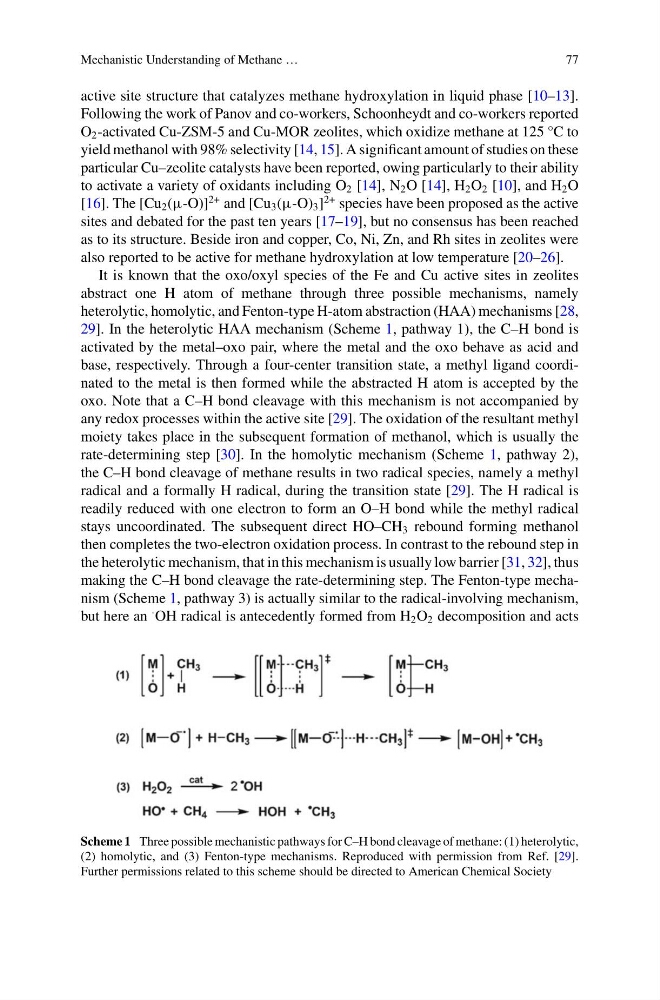
29]. In the heterolytic HAA mechanism (Scheme 1, pathway 1), the C–H bond is
activated by the metal–oxo pair, where the metal and the oxo behave as acid and
base, respectively. Through a four-center transition state, a methyl ligand coordinated to the metal is then formed while the abstracted H atom is accepted by the
oxo. Note that a C–H bond cleavage with this mechanism is not accompanied by
any redox processes within the active site [29]. The oxidation of the resultant methyl
moiety takes place in the subsequent formation of methanol, which is usually the
rate-determining step [30]. In the homolytic mechanism (Scheme 1, pathway 2),
the C–H bond cleavage of methane results in two radical species, namely a methyl
radical and a formally H radical, during the transition state [29]. The H radical is
readily reduced with one electron to form an O–H bond while the methyl radical
stays uncoordinated. The subsequent direct HO–CH 3 rebound forming methanol
then completes the two-electron oxidation process. In contrast to the rebound step in
the heterolytic mechanism, that in this mechanism is usually low barrier [31, 32], thus
making the C–H bond cleavage the rate-determining step. The Fenton-type mechanism (Scheme 1, pathway 3) is actually similar to the radical-involving mechanism,
but here an
· OH radical is antecedently formed from H 2 O 2 decomposition and acts
Scheme 1 Three possible mechanistic pathways for C–H bond cleavage of methane: (1) heterolytic,
(2) homolytic, and (3) Fenton-type mechanisms. Reproduced with permission from Ref. [29].
Further permissions related to this scheme should be directed to American Chemical Society
77
active site structure that catalyzes methane hydroxylation in liquid phase [10–13].
Following the work of Panov and co-workers, Schoonheydt and co-workers reported
O 2 -activated Cu-ZSM-5 and Cu-MOR zeolites, which oxidize methane at 125 °C to
yield methanol with 98% selectivity [14, 15]. A significant amount of studies on these
particular Cu–zeolite catalysts have been reported, owing particularly to their ability
to activate a variety of oxidants including O 2 [14], N 2 O [14], H 2 O 2 [10], and H 2 O
[16]. The [Cu 2 (μ-O)]
2+ and [Cu 3 (μ-O) 3 ]
2+ species have been proposed as the active
sites and debated for the past ten years [17–19], but no consensus has been reached
as to its structure. Beside iron and copper, Co, Ni, Zn, and Rh sites in zeolites were
also reported to be active for methane hydroxylation at low temperature [20–26].
It is known that the oxo/oxyl species of the Fe and Cu active sites in zeolites
abstract one H atom of methane through three possible mechanisms, namely
heterolytic, homolytic, and Fenton-type H-atom abstraction (HAA) mechanisms [28,
29]. In the heterolytic HAA mechanism (Scheme 1, pathway 1), the C–H bond is
activated by the metal–oxo pair, where the metal and the oxo behave as acid and
base, respectively. Through a four-center transition state, a methyl ligand coordinated to the metal is then formed while the abstracted H atom is accepted by the
oxo. Note that a C–H bond cleavage with this mechanism is not accompanied by
any redox processes within the active site [29]. The oxidation of the resultant methyl
moiety takes place in the subsequent formation of methanol, which is usually the
rate-determining step [30]. In the homolytic mechanism (Scheme 1, pathway 2),
the C–H bond cleavage of methane results in two radical species, namely a methyl
radical and a formally H radical, during the transition state [29]. The H radical is
readily reduced with one electron to form an O–H bond while the methyl radical
stays uncoordinated. The subsequent direct HO–CH 3 rebound forming methanol
then completes the two-electron oxidation process. In contrast to the rebound step in
the heterolytic mechanism, that in this mechanism is usually low barrier [31, 32], thus
making the C–H bond cleavage the rate-determining step. The Fenton-type mechanism (Scheme 1, pathway 3) is actually similar to the radical-involving mechanism,
but here an
· OH radical is antecedently formed from H 2 O 2 decomposition and acts
Scheme 1 Three possible mechanistic pathways for C–H bond cleavage of methane: (1) heterolytic,
(2) homolytic, and (3) Fenton-type mechanisms. Reproduced with permission from Ref. [29].
Further permissions related to this scheme should be directed to American Chemical Society