

76
M. H. Mahyuddin et al.
substrates is known to be spin-forbidden, it is reasonable that the metal centers in
MMOs facilitate a spin inversion for O 2 , resulting in a metal-superoxo (M
n+1 O 2
·– ),
-peroxo (M
n+2 O 2
2– ), or -oxo (M
n+4 [O
2– ] 2 ) species that is favorable for the oxidation of methane. However, controlling active sites in enzymes is extremely difficult,
especially when considering mass production. Therefore, comparable metal active
sites isolated in rigid lattices of zeolite have been developed as synthetic catalysts
for methane hydroxylation at low temperature. Zeolites are micropores crystalline
minerals composed of aluminate, silicate, and countercations acting as Brønsted or
Lewis acid sites. These countercations are not covalently bound to the zeolite framework and thus can readily be substituted with a variety of metal cations through
conventional aqueous ion-exchange methods to form reduced metal centers.
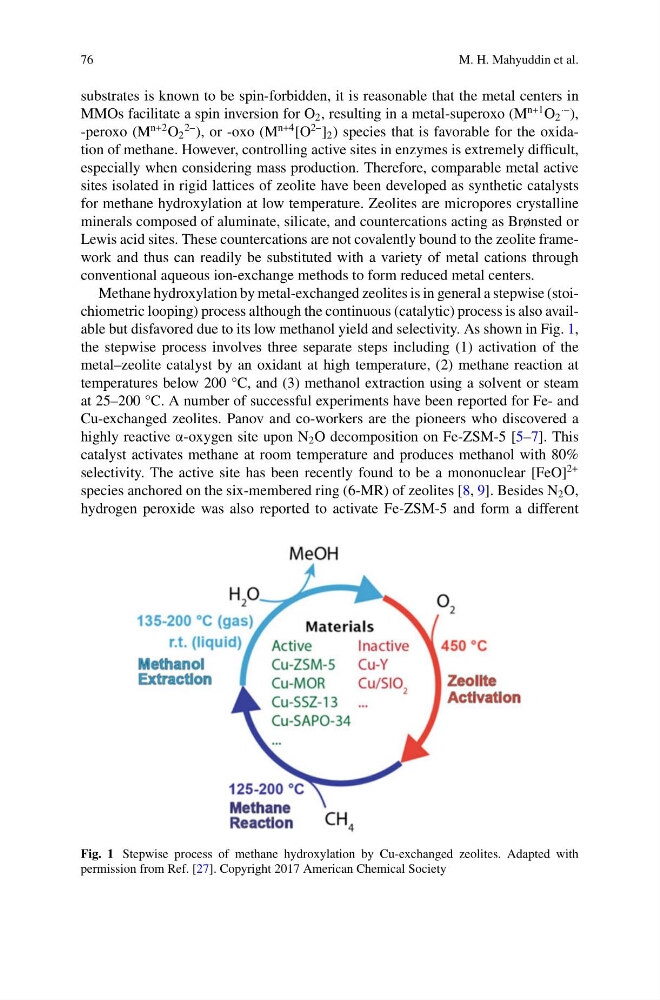
Methane hydroxylation by metal-exchanged zeolites is in general a stepwise (stoichiometric looping) process although the continuous (catalytic) process is also available but disfavored due to its low methanol yield and selectivity. As shown in Fig. 1,
the stepwise process involves three separate steps including (1) activation of the
metal–zeolite catalyst by an oxidant at high temperature, (2) methane reaction at
temperatures below 200 °C, and (3) methanol extraction using a solvent or steam
at 25–200 °C. A number of successful experiments have been reported for Fe- and
Cu-exchanged zeolites. Panov and co-workers are the pioneers who discovered a
highly reactive α-oxygen site upon N 2 O decomposition on Fe-ZSM-5 [5–7]. This
catalyst activates methane at room temperature and produces methanol with 80%
selectivity. The active site has been recently found to be a mononuclear [FeO]
2+
species anchored on the six-membered ring (6-MR) of zeolites [8, 9]. Besides N 2 O,
hydrogen peroxide was also reported to activate Fe-ZSM-5 and form a different
Fig. 1 Stepwise process of methane hydroxylation by Cu-exchanged zeolites. Adapted with
permission from Ref. [27]. Copyright 2017 American Chemical Society
M. H. Mahyuddin et al.
substrates is known to be spin-forbidden, it is reasonable that the metal centers in
MMOs facilitate a spin inversion for O 2 , resulting in a metal-superoxo (M
n+1 O 2
·– ),
-peroxo (M
n+2 O 2
2– ), or -oxo (M
n+4 [O
2– ] 2 ) species that is favorable for the oxidation of methane. However, controlling active sites in enzymes is extremely difficult,
especially when considering mass production. Therefore, comparable metal active
sites isolated in rigid lattices of zeolite have been developed as synthetic catalysts
for methane hydroxylation at low temperature. Zeolites are micropores crystalline
minerals composed of aluminate, silicate, and countercations acting as Brønsted or
Lewis acid sites. These countercations are not covalently bound to the zeolite framework and thus can readily be substituted with a variety of metal cations through
conventional aqueous ion-exchange methods to form reduced metal centers.
Methane hydroxylation by metal-exchanged zeolites is in general a stepwise (stoichiometric looping) process although the continuous (catalytic) process is also available but disfavored due to its low methanol yield and selectivity. As shown in Fig. 1,
the stepwise process involves three separate steps including (1) activation of the
metal–zeolite catalyst by an oxidant at high temperature, (2) methane reaction at
temperatures below 200 °C, and (3) methanol extraction using a solvent or steam
at 25–200 °C. A number of successful experiments have been reported for Fe- and
Cu-exchanged zeolites. Panov and co-workers are the pioneers who discovered a
highly reactive α-oxygen site upon N 2 O decomposition on Fe-ZSM-5 [5–7]. This
catalyst activates methane at room temperature and produces methanol with 80%
selectivity. The active site has been recently found to be a mononuclear [FeO]
2+
species anchored on the six-membered ring (6-MR) of zeolites [8, 9]. Besides N 2 O,
hydrogen peroxide was also reported to activate Fe-ZSM-5 and form a different
Fig. 1 Stepwise process of methane hydroxylation by Cu-exchanged zeolites. Adapted with
permission from Ref. [27]. Copyright 2017 American Chemical Society