

Theoretical Study of the Direct Conversion of Methane …
37
the sextet and quartet spin states tends to be enlarged for the quartet IRC and to be
reduced for the sextet IRC in the region where the quartet surface is a low-energy
path.
SII is found in the vicinity of TS1 at s = −0.50 with an energy of 27.3 kcal/mol
and is only 0.05 kcal/mol lower in energy than TS1 on the quartet surface. SII
exhibits C s symmetry, a C–O distance of 1.565, and one long C–H distance of
1.157 Å. After SII, the sextet surface level shifts over the quartet surface without the
intersection. Of course, the activation energy for TS1 is important as a spin-inversion
point for controlling the reaction efficiency. In the overview of this reaction step,
the Fe–O distance controls the energy gap through the sextet IRC or the quartet
IRC as a parallel for the reaction coordinate. For instance, when an FeO
+ molecule
with an Fe–O distance of 1.700 Å collides with a CH 4 molecule, the two potentialenergy surfaces along the reaction coordinate behave like that in the sextet IRC. The
difference between the sextet and quartet IRC results is due to the difference in the
Fe–O distance at the entrance channel, and we emphasize that the potential energy
in the sextet state changes dramatically. That is, the quartet potential-energy surface
is unaffected by the Fe–O distance.
In Fig. 7a, the quartet potential-energy surface involves a local minimum point
at s = 4.6 with an energy of −16.1 kcal/mol; a slight increase is observed after this
point. The sextet potential energy continues to decrease until the product is formed,
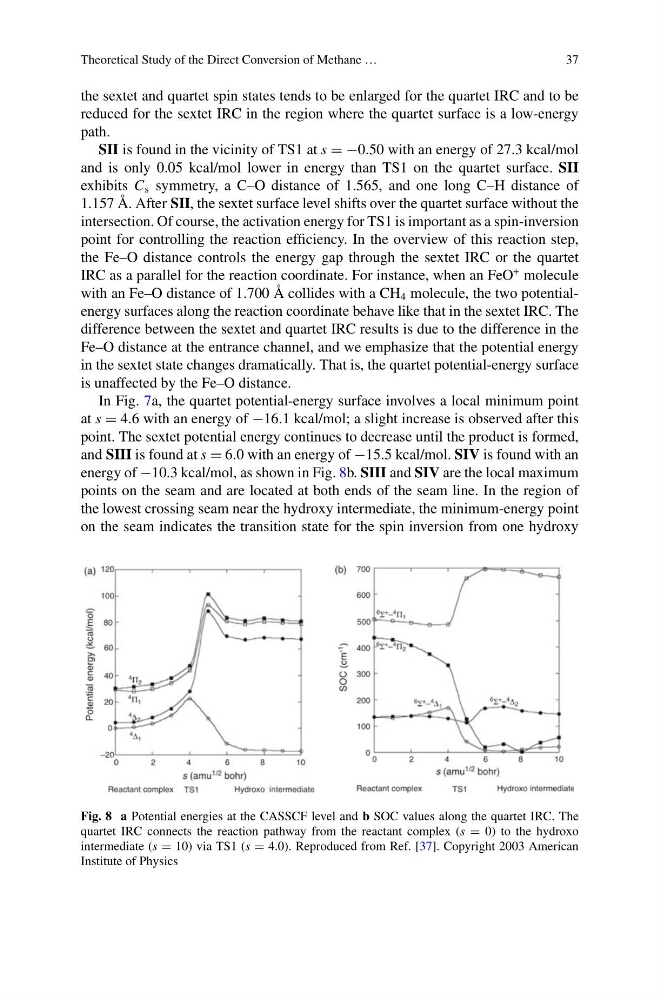
and SIII is found at s = 6.0 with an energy of −15.5 kcal/mol. SIV is found with an
energy of −10.3 kcal/mol, as shown in Fig. 8b. SIII and SIV are the local maximum
points on the seam and are located at both ends of the seam line. In the region of
the lowest crossing seam near the hydroxy intermediate, the minimum-energy point
on the seam indicates the transition state for the spin inversion from one hydroxy
Fig. 8 a Potential energies at the CASSCF level and b SOC values along the quartet IRC. The
quartet IRC connects the reaction pathway from the reactant complex (s = 0) to the hydroxo
intermediate (s = 10) via TS1 (s = 4.0). Reproduced from Ref. [37]. Copyright 2003 American
Institute of Physics
37
the sextet and quartet spin states tends to be enlarged for the quartet IRC and to be
reduced for the sextet IRC in the region where the quartet surface is a low-energy
path.
SII is found in the vicinity of TS1 at s = −0.50 with an energy of 27.3 kcal/mol
and is only 0.05 kcal/mol lower in energy than TS1 on the quartet surface. SII
exhibits C s symmetry, a C–O distance of 1.565, and one long C–H distance of
1.157 Å. After SII, the sextet surface level shifts over the quartet surface without the
intersection. Of course, the activation energy for TS1 is important as a spin-inversion
point for controlling the reaction efficiency. In the overview of this reaction step,
the Fe–O distance controls the energy gap through the sextet IRC or the quartet
IRC as a parallel for the reaction coordinate. For instance, when an FeO
+ molecule
with an Fe–O distance of 1.700 Å collides with a CH 4 molecule, the two potentialenergy surfaces along the reaction coordinate behave like that in the sextet IRC. The
difference between the sextet and quartet IRC results is due to the difference in the
Fe–O distance at the entrance channel, and we emphasize that the potential energy
in the sextet state changes dramatically. That is, the quartet potential-energy surface
is unaffected by the Fe–O distance.
In Fig. 7a, the quartet potential-energy surface involves a local minimum point
at s = 4.6 with an energy of −16.1 kcal/mol; a slight increase is observed after this
point. The sextet potential energy continues to decrease until the product is formed,
and SIII is found at s = 6.0 with an energy of −15.5 kcal/mol. SIV is found with an
energy of −10.3 kcal/mol, as shown in Fig. 8b. SIII and SIV are the local maximum
points on the seam and are located at both ends of the seam line. In the region of
the lowest crossing seam near the hydroxy intermediate, the minimum-energy point
on the seam indicates the transition state for the spin inversion from one hydroxy
Fig. 8 a Potential energies at the CASSCF level and b SOC values along the quartet IRC. The
quartet IRC connects the reaction pathway from the reactant complex (s = 0) to the hydroxo
intermediate (s = 10) via TS1 (s = 4.0). Reproduced from Ref. [37]. Copyright 2003 American
Institute of Physics