

36
Y. Shiota and K. Yoshizawa
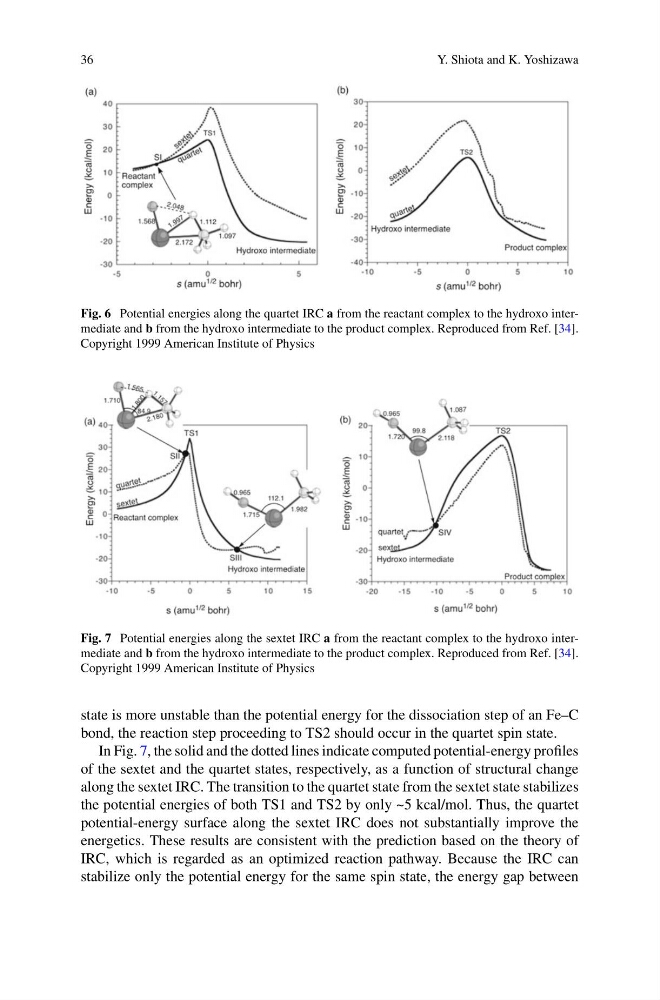
Fig. 6 Potential energies along the quartet IRC a from the reactant complex to the hydroxo intermediate and b from the hydroxo intermediate to the product complex. Reproduced from Ref. [34].
Copyright 1999 American Institute of Physics
Fig. 7 Potential energies along the sextet IRC a from the reactant complex to the hydroxo intermediate and b from the hydroxo intermediate to the product complex. Reproduced from Ref. [34].
Copyright 1999 American Institute of Physics
state is more unstable than the potential energy for the dissociation step of an Fe–C
bond, the reaction step proceeding to TS2 should occur in the quartet spin state.
In Fig. 7, the solid and the dotted lines indicate computed potential-energy profiles
of the sextet and the quartet states, respectively, as a function of structural change
along the sextet IRC. The transition to the quartet state from the sextet state stabilizes
the potential energies of both TS1 and TS2 by only ~5 kcal/mol. Thus, the quartet
potential-energy surface along the sextet IRC does not substantially improve the
energetics. These results are consistent with the prediction based on the theory of
IRC, which is regarded as an optimized reaction pathway. Because the IRC can
stabilize only the potential energy for the same spin state, the energy gap between
Y. Shiota and K. Yoshizawa
Fig. 6 Potential energies along the quartet IRC a from the reactant complex to the hydroxo intermediate and b from the hydroxo intermediate to the product complex. Reproduced from Ref. [34].
Copyright 1999 American Institute of Physics
Fig. 7 Potential energies along the sextet IRC a from the reactant complex to the hydroxo intermediate and b from the hydroxo intermediate to the product complex. Reproduced from Ref. [34].
Copyright 1999 American Institute of Physics
state is more unstable than the potential energy for the dissociation step of an Fe–C
bond, the reaction step proceeding to TS2 should occur in the quartet spin state.
In Fig. 7, the solid and the dotted lines indicate computed potential-energy profiles
of the sextet and the quartet states, respectively, as a function of structural change
along the sextet IRC. The transition to the quartet state from the sextet state stabilizes
the potential energies of both TS1 and TS2 by only ~5 kcal/mol. Thus, the quartet
potential-energy surface along the sextet IRC does not substantially improve the
energetics. These results are consistent with the prediction based on the theory of
IRC, which is regarded as an optimized reaction pathway. Because the IRC can
stabilize only the potential energy for the same spin state, the energy gap between