

34
Y. Shiota and K. Yoshizawa
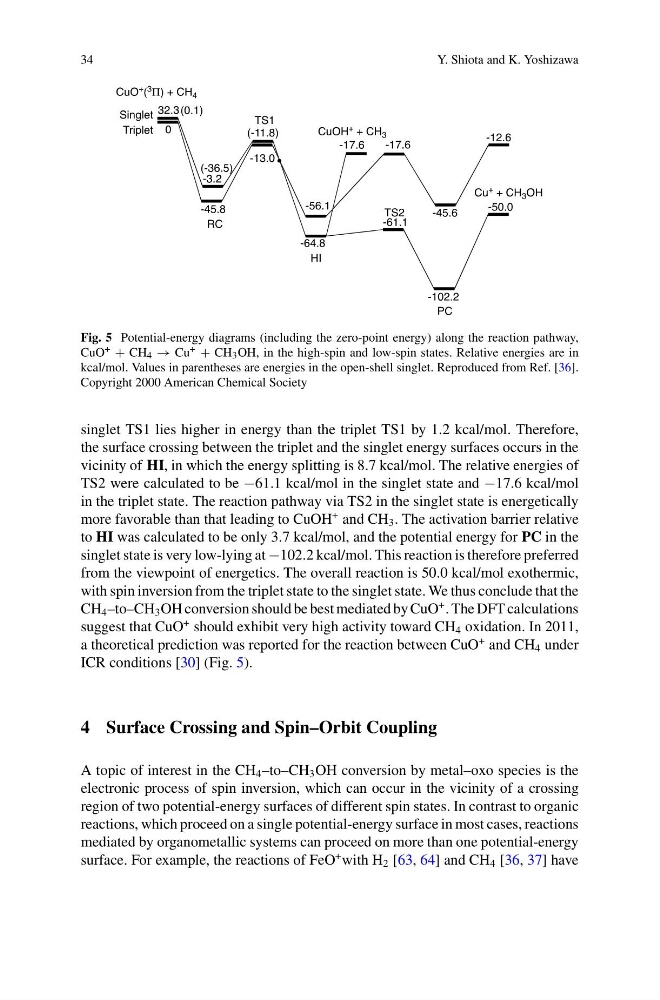
Fig. 5 Potential-energy diagrams (including the zero-point energy) along the reaction pathway,
CuO + + CH 4 → Cu + + CH 3 OH, in the high-spin and low-spin states. Relative energies are in
kcal/mol. Values in parentheses are energies in the open-shell singlet. Reproduced from Ref. [36].
Copyright 2000 American Chemical Society
singlet TS1 lies higher in energy than the triplet TS1 by 1.2 kcal/mol. Therefore,
the surface crossing between the triplet and the singlet energy surfaces occurs in the
vicinity of HI, in which the energy splitting is 8.7 kcal/mol. The relative energies of
TS2 were calculated to be −61.1 kcal/mol in the singlet state and −17.6 kcal/mol
in the triplet state. The reaction pathway via TS2 in the singlet state is energetically
more favorable than that leading to CuOH
+ and CH 3 . The activation barrier relative
to HI was calculated to be only 3.7 kcal/mol, and the potential energy for PC in the
singlet state is very low-lying at −102.2 kcal/mol. This reaction is therefore preferred
from the viewpoint of energetics. The overall reaction is 50.0 kcal/mol exothermic,
with spin inversion from the triplet state to the singlet state. We thus conclude that the
CH 4 –to–CH 3 OH conversion should be best mediated by CuO
+ . The DFT calculations
suggest that CuO
+ should exhibit very high activity toward CH 4 oxidation. In 2011,
a theoretical prediction was reported for the reaction between CuO
+ and CH 4 under
ICR conditions [30] (Fig. 5).
4 Surface Crossing and Spin–Orbit Coupling
A topic of interest in the CH 4 –to–CH 3 OH conversion by metal–oxo species is the
electronic process of spin inversion, which can occur in the vicinity of a crossing
region of two potential-energy surfaces of different spin states. In contrast to organic
reactions, which proceed on a single potential-energy surface in most cases, reactions
mediated by organometallic systems can proceed on more than one potential-energy
surface. For example, the reactions of FeO
+ with H 2 [63, 64] and CH 4 [36, 37] have
Y. Shiota and K. Yoshizawa
Fig. 5 Potential-energy diagrams (including the zero-point energy) along the reaction pathway,
CuO + + CH 4 → Cu + + CH 3 OH, in the high-spin and low-spin states. Relative energies are in
kcal/mol. Values in parentheses are energies in the open-shell singlet. Reproduced from Ref. [36].
Copyright 2000 American Chemical Society
singlet TS1 lies higher in energy than the triplet TS1 by 1.2 kcal/mol. Therefore,
the surface crossing between the triplet and the singlet energy surfaces occurs in the
vicinity of HI, in which the energy splitting is 8.7 kcal/mol. The relative energies of
TS2 were calculated to be −61.1 kcal/mol in the singlet state and −17.6 kcal/mol
in the triplet state. The reaction pathway via TS2 in the singlet state is energetically
more favorable than that leading to CuOH
+ and CH 3 . The activation barrier relative
to HI was calculated to be only 3.7 kcal/mol, and the potential energy for PC in the
singlet state is very low-lying at −102.2 kcal/mol. This reaction is therefore preferred
from the viewpoint of energetics. The overall reaction is 50.0 kcal/mol exothermic,
with spin inversion from the triplet state to the singlet state. We thus conclude that the
CH 4 –to–CH 3 OH conversion should be best mediated by CuO
+ . The DFT calculations
suggest that CuO
+ should exhibit very high activity toward CH 4 oxidation. In 2011,
a theoretical prediction was reported for the reaction between CuO
+ and CH 4 under
ICR conditions [30] (Fig. 5).
4 Surface Crossing and Spin–Orbit Coupling
A topic of interest in the CH 4 –to–CH 3 OH conversion by metal–oxo species is the
electronic process of spin inversion, which can occur in the vicinity of a crossing
region of two potential-energy surfaces of different spin states. In contrast to organic
reactions, which proceed on a single potential-energy surface in most cases, reactions
mediated by organometallic systems can proceed on more than one potential-energy
surface. For example, the reactions of FeO
+ with H 2 [63, 64] and CH 4 [36, 37] have