

Theoretical Study of the Direct Conversion of Methane …
33
Table 1 Measured reaction efficiencies (φ) and product branching ratios for the reaction of MO +
with CH 4 [28]
MO +
φ
MOH + + CH 3
MCH 2
+ + H 2 O
M + + CH 3 OH
MnO +
40
100
–
<1
FeO +
20
87
2
41
CoO +
0.5
–
–
100
NiO +
20
–
–
100
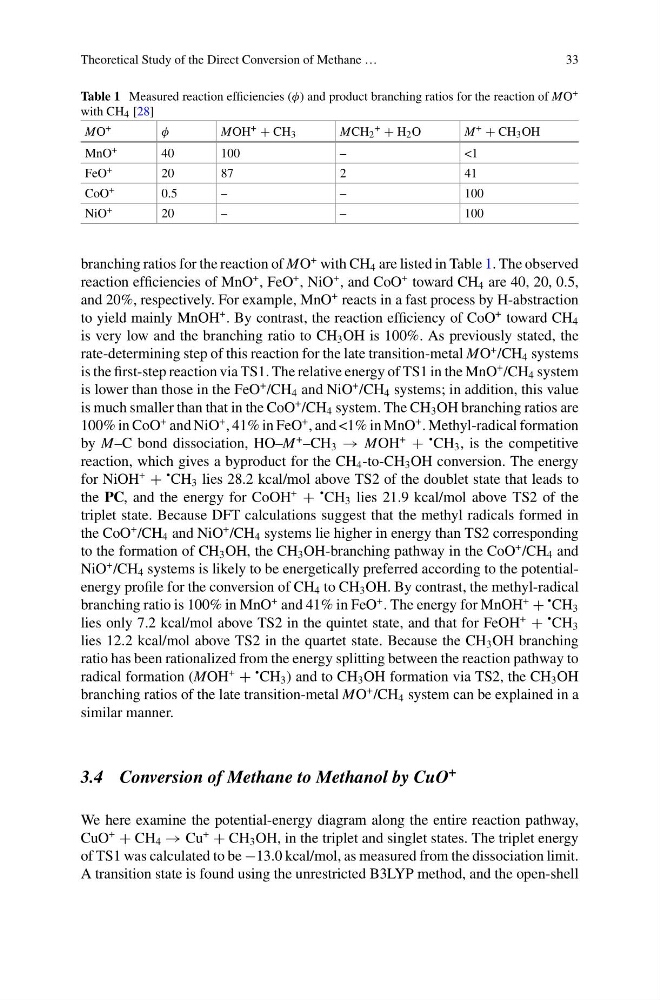
branching ratios for the reaction of MO
+ with CH 4 are listed in Table 1. The observed
reaction efficiencies of MnO
+ , FeO
+ , NiO
+ , and CoO
+ toward CH 4 are 40, 20, 0.5,
and 20%, respectively. For example, MnO
+ reacts in a fast process by H-abstraction
to yield mainly MnOH
+ . By contrast, the reaction efficiency of CoO
+ toward CH 4
is very low and the branching ratio to CH 3 OH is 100%. As previously stated, the
rate-determining step of this reaction for the late transition-metal MO
+ /CH 4 systems
is the first-step reaction via TS1. The relative energy of TS1 in the MnO
+ /CH 4 system
is lower than those in the FeO
+ /CH 4 and NiO
+ /CH 4 systems; in addition, this value
is much smaller than that in the CoO
+ /CH 4 system. The CH 3 OH branching ratios are
100% in CoO
+ and NiO
+ , 41% in FeO
+ , and <1% in MnO
+ . Methyl-radical formation
by M–C bond dissociation, HO–M
+ –CH 3 → MOH
+
+
• CH 3 , is the competitive
reaction, which gives a byproduct for the CH 4 -to-CH 3 OH conversion. The energy
for NiOH
+
+
• CH 3 lies 28.2 kcal/mol above TS2 of the doublet state that leads to
the PC, and the energy for CoOH
+
+
• CH 3 lies 21.9 kcal/mol above TS2 of the
triplet state. Because DFT calculations suggest that the methyl radicals formed in
the CoO
+ /CH 4 and NiO
+ /CH 4 systems lie higher in energy than TS2 corresponding
to the formation of CH 3 OH, the CH 3 OH-branching pathway in the CoO
+ /CH 4 and
NiO
+ /CH 4 systems is likely to be energetically preferred according to the potentialenergy profile for the conversion of CH 4 to CH 3 OH. By contrast, the methyl-radical
branching ratio is 100% in MnO
+ and 41% in FeO
+ . The energy for MnOH
+
+
• CH 3
lies only 7.2 kcal/mol above TS2 in the quintet state, and that for FeOH
+
+
• CH 3
lies 12.2 kcal/mol above TS2 in the quartet state. Because the CH 3 OH branching
ratio has been rationalized from the energy splitting between the reaction pathway to
radical formation (MOH
+
+
• CH 3 ) and to CH 3 OH formation via TS2, the CH 3 OH
branching ratios of the late transition-metal MO
+ /CH 4 system can be explained in a
similar manner.
3.4 Conversion of Methane to Methanol by CuO +
We here examine the potential-energy diagram along the entire reaction pathway,
CuO
+
+ CH 4 → Cu
+
+ CH 3 OH, in the triplet and singlet states. The triplet energy
of TS1 was calculated to be −13.0 kcal/mol, as measured from the dissociation limit.
A transition state is found using the unrestricted B3LYP method, and the open-shell
33
Table 1 Measured reaction efficiencies (φ) and product branching ratios for the reaction of MO +
with CH 4 [28]
MO +
φ
MOH + + CH 3
MCH 2
+ + H 2 O
M + + CH 3 OH
MnO +
40
100
–
<1
FeO +
20
87
2
41
CoO +
0.5
–
–
100
NiO +
20
–
–
100
branching ratios for the reaction of MO
+ with CH 4 are listed in Table 1. The observed
reaction efficiencies of MnO
+ , FeO
+ , NiO
+ , and CoO
+ toward CH 4 are 40, 20, 0.5,
and 20%, respectively. For example, MnO
+ reacts in a fast process by H-abstraction
to yield mainly MnOH
+ . By contrast, the reaction efficiency of CoO
+ toward CH 4
is very low and the branching ratio to CH 3 OH is 100%. As previously stated, the
rate-determining step of this reaction for the late transition-metal MO
+ /CH 4 systems
is the first-step reaction via TS1. The relative energy of TS1 in the MnO
+ /CH 4 system
is lower than those in the FeO
+ /CH 4 and NiO
+ /CH 4 systems; in addition, this value
is much smaller than that in the CoO
+ /CH 4 system. The CH 3 OH branching ratios are
100% in CoO
+ and NiO
+ , 41% in FeO
+ , and <1% in MnO
+ . Methyl-radical formation
by M–C bond dissociation, HO–M
+ –CH 3 → MOH
+
+
• CH 3 , is the competitive
reaction, which gives a byproduct for the CH 4 -to-CH 3 OH conversion. The energy
for NiOH
+
+
• CH 3 lies 28.2 kcal/mol above TS2 of the doublet state that leads to
the PC, and the energy for CoOH
+
+
• CH 3 lies 21.9 kcal/mol above TS2 of the
triplet state. Because DFT calculations suggest that the methyl radicals formed in
the CoO
+ /CH 4 and NiO
+ /CH 4 systems lie higher in energy than TS2 corresponding
to the formation of CH 3 OH, the CH 3 OH-branching pathway in the CoO
+ /CH 4 and
NiO
+ /CH 4 systems is likely to be energetically preferred according to the potentialenergy profile for the conversion of CH 4 to CH 3 OH. By contrast, the methyl-radical
branching ratio is 100% in MnO
+ and 41% in FeO
+ . The energy for MnOH
+
+
• CH 3
lies only 7.2 kcal/mol above TS2 in the quintet state, and that for FeOH
+
+
• CH 3
lies 12.2 kcal/mol above TS2 in the quartet state. Because the CH 3 OH branching
ratio has been rationalized from the energy splitting between the reaction pathway to
radical formation (MOH
+
+
• CH 3 ) and to CH 3 OH formation via TS2, the CH 3 OH
branching ratios of the late transition-metal MO
+ /CH 4 system can be explained in a
similar manner.
3.4 Conversion of Methane to Methanol by CuO +
We here examine the potential-energy diagram along the entire reaction pathway,
CuO
+
+ CH 4 → Cu
+
+ CH 3 OH, in the triplet and singlet states. The triplet energy
of TS1 was calculated to be −13.0 kcal/mol, as measured from the dissociation limit.
A transition state is found using the unrestricted B3LYP method, and the open-shell