

Orbital Concept for Methane Activation
19
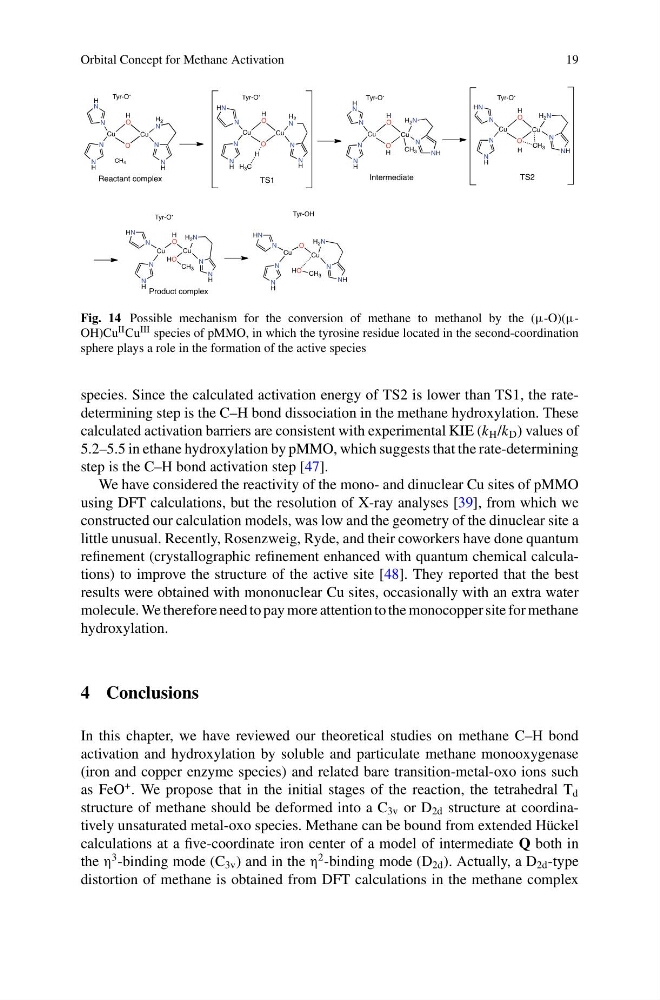
Fig. 14 Possible mechanism for the conversion of methane to methanol by the (μ-O)(μOH)Cu II Cu III species of pMMO, in which the tyrosine residue located in the second-coordination
sphere plays a role in the formation of the active species
species. Since the calculated activation energy of TS2 is lower than TS1, the ratedetermining step is the C–H bond dissociation in the methane hydroxylation. These
calculated activation barriers are consistent with experimental KIE (k H /k D ) values of
5.2–5.5 in ethane hydroxylation by pMMO, which suggests that the rate-determining
step is the C–H bond activation step [47].
We have considered the reactivity of the mono- and dinuclear Cu sites of pMMO
using DFT calculations, but the resolution of X-ray analyses [39], from which we
constructed our calculation models, was low and the geometry of the dinuclear site a
little unusual. Recently, Rosenzweig, Ryde, and their coworkers have done quantum
refinement (crystallographic refinement enhanced with quantum chemical calculations) to improve the structure of the active site [48]. They reported that the best
results were obtained with mononuclear Cu sites, occasionally with an extra water
molecule. We therefore need to pay more attention to the monocopper site for methane
hydroxylation.
4 Conclusions
In this chapter, we have reviewed our theoretical studies on methane C–H bond
activation and hydroxylation by soluble and particulate methane monooxygenase
(iron and copper enzyme species) and related bare transition-metal-oxo ions such
as FeO
+ . We propose that in the initial stages of the reaction, the tetrahedral T d
structure of methane should be deformed into a C 3v or D 2d structure at coordinatively unsaturated metal-oxo species. Methane can be bound from extended Hückel
calculations at a five-coordinate iron center of a model of intermediate Q both in
the η
3 -binding mode (C 3v ) and in the η
2 -binding mode (D 2d ). Actually, a D 2d -type
distortion of methane is obtained from DFT calculations in the methane complex
19
Fig. 14 Possible mechanism for the conversion of methane to methanol by the (μ-O)(μOH)Cu II Cu III species of pMMO, in which the tyrosine residue located in the second-coordination
sphere plays a role in the formation of the active species
species. Since the calculated activation energy of TS2 is lower than TS1, the ratedetermining step is the C–H bond dissociation in the methane hydroxylation. These
calculated activation barriers are consistent with experimental KIE (k H /k D ) values of
5.2–5.5 in ethane hydroxylation by pMMO, which suggests that the rate-determining
step is the C–H bond activation step [47].
We have considered the reactivity of the mono- and dinuclear Cu sites of pMMO
using DFT calculations, but the resolution of X-ray analyses [39], from which we
constructed our calculation models, was low and the geometry of the dinuclear site a
little unusual. Recently, Rosenzweig, Ryde, and their coworkers have done quantum
refinement (crystallographic refinement enhanced with quantum chemical calculations) to improve the structure of the active site [48]. They reported that the best
results were obtained with mononuclear Cu sites, occasionally with an extra water
molecule. We therefore need to pay more attention to the monocopper site for methane
hydroxylation.
4 Conclusions
In this chapter, we have reviewed our theoretical studies on methane C–H bond
activation and hydroxylation by soluble and particulate methane monooxygenase
(iron and copper enzyme species) and related bare transition-metal-oxo ions such
as FeO
+ . We propose that in the initial stages of the reaction, the tetrahedral T d
structure of methane should be deformed into a C 3v or D 2d structure at coordinatively unsaturated metal-oxo species. Methane can be bound from extended Hückel
calculations at a five-coordinate iron center of a model of intermediate Q both in
the η
3 -binding mode (C 3v ) and in the η
2 -binding mode (D 2d ). Actually, a D 2d -type
distortion of methane is obtained from DFT calculations in the methane complex