

18
K. Yoshizawa and M. Miyanishi
TS1
Product complex
Intermediate
N Cu
O
O
N
NH
HN
O
H 3 C
CH 4
N Cu
O
O
N
NH
HN
O
H 3 C
CH 3
H
N Cu
O
HO
N
NH
HN
O
H 3 C
CH 3
N Cu
O
OH
N
NH
HN
O
H 3 C
CH 3
N Cu
O
O
N
NH
HN
O
H 3 C
CH 3
Reactant complex
TS2
H
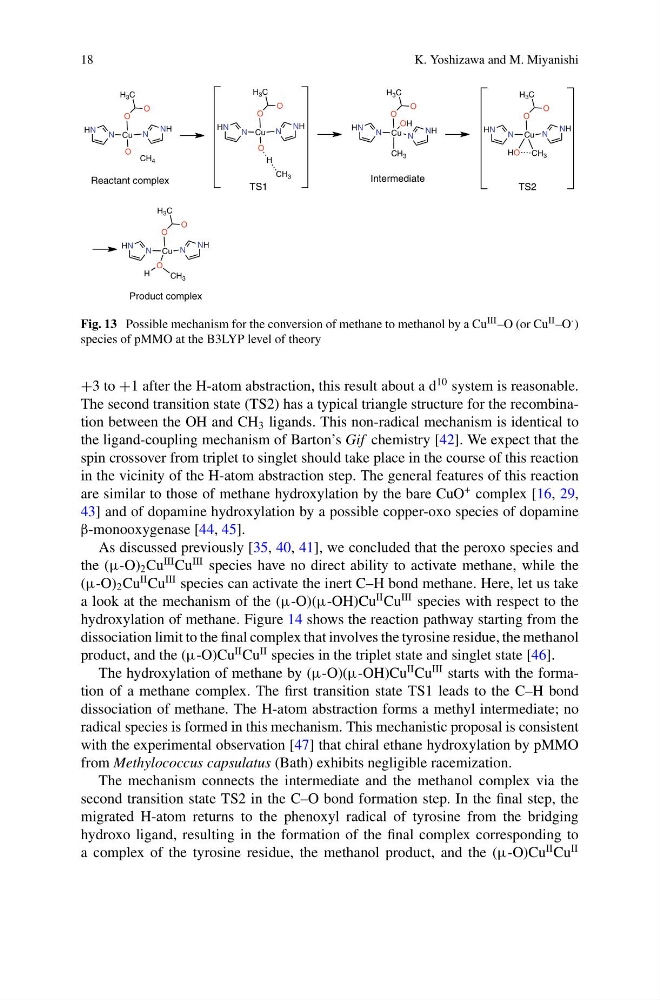
Fig. 13 Possible mechanism for the conversion of methane to methanol by a Cu III –O (or Cu II –O · )
species of pMMO at the B3LYP level of theory
+3 to +1 after the H-atom abstraction, this result about a d
10 system is reasonable.
The second transition state (TS2) has a typical triangle structure for the recombination between the OH and CH 3 ligands. This non-radical mechanism is identical to
the ligand-coupling mechanism of Barton’s Gif chemistry [42]. We expect that the
spin crossover from triplet to singlet should take place in the course of this reaction
in the vicinity of the H-atom abstraction step. The general features of this reaction
are similar to those of methane hydroxylation by the bare CuO
+ complex [16, 29,
43] and of dopamine hydroxylation by a possible copper-oxo species of dopamine
β-monooxygenase [44, 45].
As discussed previously [35, 40, 41], we concluded that the peroxo species and
the (μ-O) 2 Cu
III Cu
III species have no direct ability to activate methane, while the
(μ-O) 2 Cu
II Cu
III species can activate the inert C–H bond methane. Here, let us take
a look at the mechanism of the (μ-O)(μ-OH)Cu
II Cu
III species with respect to the
hydroxylation of methane. Figure 14 shows the reaction pathway starting from the
dissociation limit to the final complex that involves the tyrosine residue, the methanol
product, and the (μ-O)Cu
II Cu
II species in the triplet state and singlet state [46].
The hydroxylation of methane by (μ-O)(μ-OH)Cu
II Cu
III starts with the formation of a methane complex. The first transition state TS1 leads to the C–H bond
dissociation of methane. The H-atom abstraction forms a methyl intermediate; no
radical species is formed in this mechanism. This mechanistic proposal is consistent
with the experimental observation [47] that chiral ethane hydroxylation by pMMO
from Methylococcus capsulatus (Bath) exhibits negligible racemization.
The mechanism connects the intermediate and the methanol complex via the
second transition state TS2 in the C–O bond formation step. In the final step, the
migrated H-atom returns to the phenoxyl radical of tyrosine from the bridging
hydroxo ligand, resulting in the formation of the final complex corresponding to
a complex of the tyrosine residue, the methanol product, and the (μ-O)Cu
II Cu
II
K. Yoshizawa and M. Miyanishi
TS1
Product complex
Intermediate
N Cu
O
O
N
NH
HN
O
H 3 C
CH 4
N Cu
O
O
N
NH
HN
O
H 3 C
CH 3
H
N Cu
O
HO
N
NH
HN
O
H 3 C
CH 3
N Cu
O
OH
N
NH
HN
O
H 3 C
CH 3
N Cu
O
O
N
NH
HN
O
H 3 C
CH 3
Reactant complex
TS2
H
Fig. 13 Possible mechanism for the conversion of methane to methanol by a Cu III –O (or Cu II –O · )
species of pMMO at the B3LYP level of theory
+3 to +1 after the H-atom abstraction, this result about a d
10 system is reasonable.
The second transition state (TS2) has a typical triangle structure for the recombination between the OH and CH 3 ligands. This non-radical mechanism is identical to
the ligand-coupling mechanism of Barton’s Gif chemistry [42]. We expect that the
spin crossover from triplet to singlet should take place in the course of this reaction
in the vicinity of the H-atom abstraction step. The general features of this reaction
are similar to those of methane hydroxylation by the bare CuO
+ complex [16, 29,
43] and of dopamine hydroxylation by a possible copper-oxo species of dopamine
β-monooxygenase [44, 45].
As discussed previously [35, 40, 41], we concluded that the peroxo species and
the (μ-O) 2 Cu
III Cu
III species have no direct ability to activate methane, while the
(μ-O) 2 Cu
II Cu
III species can activate the inert C–H bond methane. Here, let us take
a look at the mechanism of the (μ-O)(μ-OH)Cu
II Cu
III species with respect to the
hydroxylation of methane. Figure 14 shows the reaction pathway starting from the
dissociation limit to the final complex that involves the tyrosine residue, the methanol
product, and the (μ-O)Cu
II Cu
II species in the triplet state and singlet state [46].
The hydroxylation of methane by (μ-O)(μ-OH)Cu
II Cu
III starts with the formation of a methane complex. The first transition state TS1 leads to the C–H bond
dissociation of methane. The H-atom abstraction forms a methyl intermediate; no
radical species is formed in this mechanism. This mechanistic proposal is consistent
with the experimental observation [47] that chiral ethane hydroxylation by pMMO
from Methylococcus capsulatus (Bath) exhibits negligible racemization.
The mechanism connects the intermediate and the methanol complex via the
second transition state TS2 in the C–O bond formation step. In the final step, the
migrated H-atom returns to the phenoxyl radical of tyrosine from the bridging
hydroxo ligand, resulting in the formation of the final complex corresponding to
a complex of the tyrosine residue, the methanol product, and the (μ-O)Cu
II Cu
II