

142
T. Toyao et al.
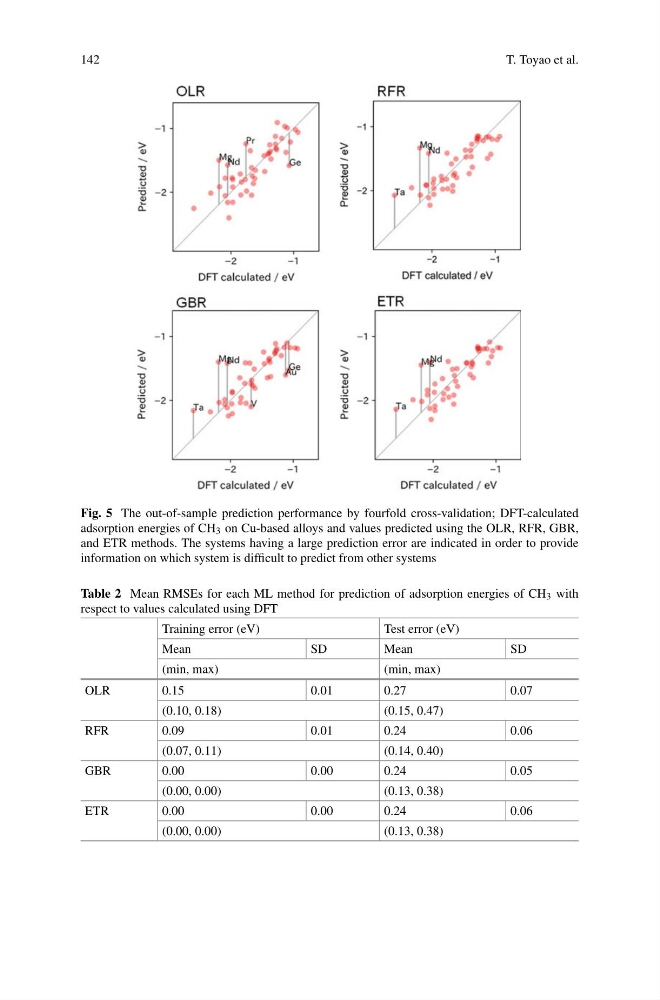
Fig. 5 The out-of-sample prediction performance by fourfold cross-validation; DFT-calculated
adsorption energies of CH 3 on Cu-based alloys and values predicted using the OLR, RFR, GBR,
and ETR methods. The systems having a large prediction error are indicated in order to provide
information on which system is difficult to predict from other systems
Table 2 Mean RMSEs for each ML method for prediction of adsorption energies of CH 3 with
respect to values calculated using DFT
Training error (eV)
Test error (eV)
Mean
SD
Mean
SD
(min, max)
(min, max)
OLR
0.15
0.01
0.27
0.07
(0.10, 0.18)
(0.15, 0.47)
RFR
0.09
0.01
0.24
0.06
(0.07, 0.11)
(0.14, 0.40)
GBR
0.00
0.00
0.24
0.05
(0.00, 0.00)
(0.13, 0.38)
ETR
0.00
0.00
0.24
0.06
(0.00, 0.00)
(0.13, 0.38)
T. Toyao et al.
Fig. 5 The out-of-sample prediction performance by fourfold cross-validation; DFT-calculated
adsorption energies of CH 3 on Cu-based alloys and values predicted using the OLR, RFR, GBR,
and ETR methods. The systems having a large prediction error are indicated in order to provide
information on which system is difficult to predict from other systems
Table 2 Mean RMSEs for each ML method for prediction of adsorption energies of CH 3 with
respect to values calculated using DFT
Training error (eV)
Test error (eV)
Mean
SD
Mean
SD
(min, max)
(min, max)
OLR
0.15
0.01
0.27
0.07
(0.10, 0.18)
(0.15, 0.47)
RFR
0.09
0.01
0.24
0.06
(0.07, 0.11)
(0.14, 0.40)
GBR
0.00
0.00
0.24
0.05
(0.00, 0.00)
(0.13, 0.38)
ETR
0.00
0.00
0.24
0.06
(0.00, 0.00)
(0.13, 0.38)