

Machine Learning Predictions of Adsorption Energies …
137
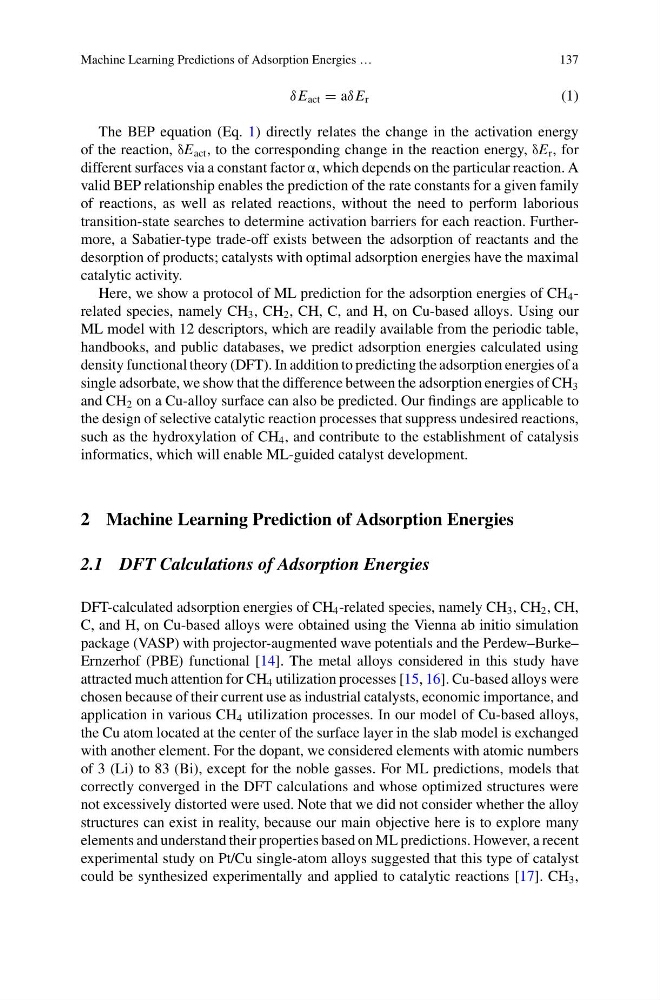
δ E act = aδ E r
(1)
The BEP equation (Eq. 1) directly relates the change in the activation energy
of the reaction, δE act , to the corresponding change in the reaction energy, δE r , for
different surfaces via a constant factor α, which depends on the particular reaction. A
valid BEP relationship enables the prediction of the rate constants for a given family
of reactions, as well as related reactions, without the need to perform laborious
transition-state searches to determine activation barriers for each reaction. Furthermore, a Sabatier-type trade-off exists between the adsorption of reactants and the
desorption of products; catalysts with optimal adsorption energies have the maximal
catalytic activity.
Here, we show a protocol of ML prediction for the adsorption energies of CH 4 -
related species, namely CH 3 , CH 2 , CH, C, and H, on Cu-based alloys. Using our
ML model with 12 descriptors, which are readily available from the periodic table,
handbooks, and public databases, we predict adsorption energies calculated using
density functional theory (DFT). In addition to predicting the adsorption energies of a
single adsorbate, we show that the difference between the adsorption energies of CH 3
and CH 2 on a Cu-alloy surface can also be predicted. Our findings are applicable to
the design of selective catalytic reaction processes that suppress undesired reactions,
such as the hydroxylation of CH 4 , and contribute to the establishment of catalysis
informatics, which will enable ML-guided catalyst development.
2 Machine Learning Prediction of Adsorption Energies
2.1 DFT Calculations of Adsorption Energies
DFT-calculated adsorption energies of CH 4 -related species, namely CH 3 , CH 2 , CH,
C, and H, on Cu-based alloys were obtained using the Vienna ab initio simulation
package (VASP) with projector-augmented wave potentials and the Perdew–Burke–
Ernzerhof (PBE) functional [14]. The metal alloys considered in this study have
attracted much attention for CH 4 utilization processes [15, 16]. Cu-based alloys were
chosen because of their current use as industrial catalysts, economic importance, and
application in various CH 4 utilization processes. In our model of Cu-based alloys,
the Cu atom located at the center of the surface layer in the slab model is exchanged
with another element. For the dopant, we considered elements with atomic numbers
of 3 (Li) to 83 (Bi), except for the noble gasses. For ML predictions, models that
correctly converged in the DFT calculations and whose optimized structures were
not excessively distorted were used. Note that we did not consider whether the alloy
structures can exist in reality, because our main objective here is to explore many
elements and understand their properties based on ML predictions. However, a recent
experimental study on Pt/Cu single-atom alloys suggested that this type of catalyst
could be synthesized experimentally and applied to catalytic reactions [17]. CH 3 ,
137
δ E act = aδ E r
(1)
The BEP equation (Eq. 1) directly relates the change in the activation energy
of the reaction, δE act , to the corresponding change in the reaction energy, δE r , for
different surfaces via a constant factor α, which depends on the particular reaction. A
valid BEP relationship enables the prediction of the rate constants for a given family
of reactions, as well as related reactions, without the need to perform laborious
transition-state searches to determine activation barriers for each reaction. Furthermore, a Sabatier-type trade-off exists between the adsorption of reactants and the
desorption of products; catalysts with optimal adsorption energies have the maximal
catalytic activity.
Here, we show a protocol of ML prediction for the adsorption energies of CH 4 -
related species, namely CH 3 , CH 2 , CH, C, and H, on Cu-based alloys. Using our
ML model with 12 descriptors, which are readily available from the periodic table,
handbooks, and public databases, we predict adsorption energies calculated using
density functional theory (DFT). In addition to predicting the adsorption energies of a
single adsorbate, we show that the difference between the adsorption energies of CH 3
and CH 2 on a Cu-alloy surface can also be predicted. Our findings are applicable to
the design of selective catalytic reaction processes that suppress undesired reactions,
such as the hydroxylation of CH 4 , and contribute to the establishment of catalysis
informatics, which will enable ML-guided catalyst development.
2 Machine Learning Prediction of Adsorption Energies
2.1 DFT Calculations of Adsorption Energies
DFT-calculated adsorption energies of CH 4 -related species, namely CH 3 , CH 2 , CH,
C, and H, on Cu-based alloys were obtained using the Vienna ab initio simulation
package (VASP) with projector-augmented wave potentials and the Perdew–Burke–
Ernzerhof (PBE) functional [14]. The metal alloys considered in this study have
attracted much attention for CH 4 utilization processes [15, 16]. Cu-based alloys were
chosen because of their current use as industrial catalysts, economic importance, and
application in various CH 4 utilization processes. In our model of Cu-based alloys,
the Cu atom located at the center of the surface layer in the slab model is exchanged
with another element. For the dopant, we considered elements with atomic numbers
of 3 (Li) to 83 (Bi), except for the noble gasses. For ML predictions, models that
correctly converged in the DFT calculations and whose optimized structures were
not excessively distorted were used. Note that we did not consider whether the alloy
structures can exist in reality, because our main objective here is to explore many
elements and understand their properties based on ML predictions. However, a recent
experimental study on Pt/Cu single-atom alloys suggested that this type of catalyst
could be synthesized experimentally and applied to catalytic reactions [17]. CH 3 ,