

Bergman’s paper describes both the anatomy and ethology of the leeches and
although the title of the paper suggests that it is the first part, no further publications
on the subject followed. Bergman had made such an impression on Linnaeus that he
named a moth, Tortrix bergmanniana (modern name Acleris bergmanniana or
yellow rose button moth) after Bergman in 1758. Bergman now wrote a paper in
Latin on the classification of larvae, which he sent to The Royal Society of Sciences
at Uppsala in 1757, [12] but which was not printed until 1773 [13]. Swedish
entomologist Charles de Geer (1720–1778) borrowed the manuscript from the
society and wrote in a letter to Linnaeus (April 1757) that “Bergman must have
large knowledge in entomology and must have read and observed much. Such
things always pleases me much”. A few years later Bergman, anonymously,
reviewed a work on insects by de Geer, [14] and he also gave the memorial lecture
over de Geer in the Royal Swedish Academy of Sciences [15].
On Mars 15, 1758, Bergman defended his thesis on correcting errors in astronomical observations, de interpolatione astronomica (astronomical interpolations),
now under supervision of Bengt Ferner. By midsummer, he graduated as master of
philosophy, and when the faculty members voted who would be the primus, the
highest ranked student at the ceremony, Bergman lost with only one vote [8]. The
statement by Schufle [16] that Bergman immediately joined the faculty staff and
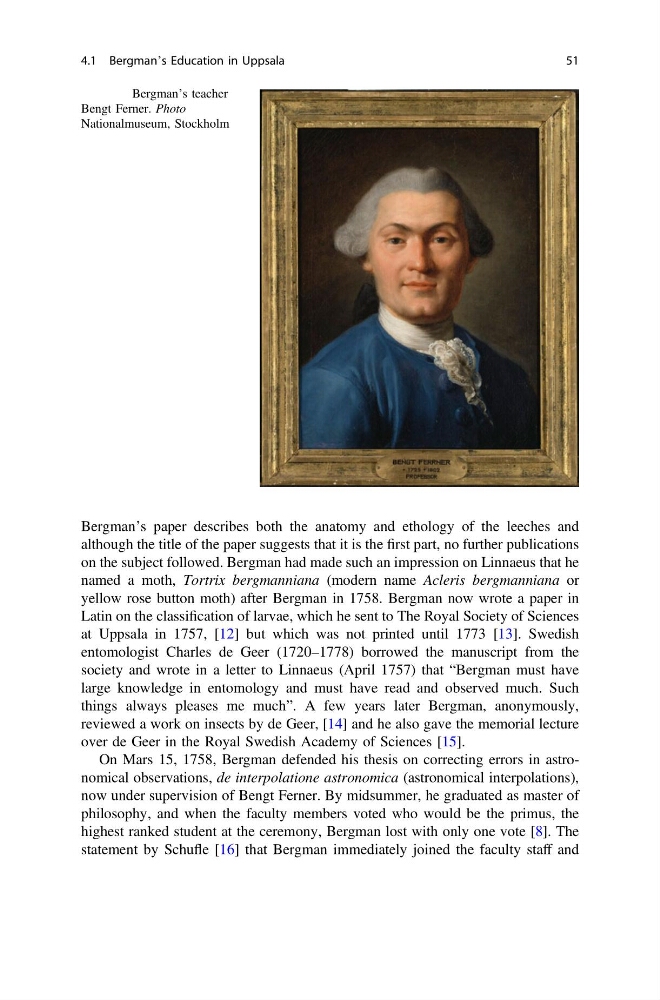
Fig. 4.5 Bergman’s teacher
Bengt Ferner. Photo
Nationalmuseum, Stockholm
4.1 Bergman’s Education in Uppsala
51
although the title of the paper suggests that it is the first part, no further publications
on the subject followed. Bergman had made such an impression on Linnaeus that he
named a moth, Tortrix bergmanniana (modern name Acleris bergmanniana or
yellow rose button moth) after Bergman in 1758. Bergman now wrote a paper in
Latin on the classification of larvae, which he sent to The Royal Society of Sciences
at Uppsala in 1757, [12] but which was not printed until 1773 [13]. Swedish
entomologist Charles de Geer (1720–1778) borrowed the manuscript from the
society and wrote in a letter to Linnaeus (April 1757) that “Bergman must have
large knowledge in entomology and must have read and observed much. Such
things always pleases me much”. A few years later Bergman, anonymously,
reviewed a work on insects by de Geer, [14] and he also gave the memorial lecture
over de Geer in the Royal Swedish Academy of Sciences [15].
On Mars 15, 1758, Bergman defended his thesis on correcting errors in astronomical observations, de interpolatione astronomica (astronomical interpolations),
now under supervision of Bengt Ferner. By midsummer, he graduated as master of
philosophy, and when the faculty members voted who would be the primus, the
highest ranked student at the ceremony, Bergman lost with only one vote [8]. The
statement by Schufle [16] that Bergman immediately joined the faculty staff and
Fig. 4.5 Bergman’s teacher
Bengt Ferner. Photo
Nationalmuseum, Stockholm
4.1 Bergman’s Education in Uppsala
51