

transformed into something similar to an oak apple. However, no one had actually
seen the insects attaching to the vegetation. Bergman collected these hard shells and
found that they developed into leeches which he identified as the species Hirudo
depressa fusca. He also witnessed one of the leeches laying eggs. Although the
leeches are hermaphrodites, the lonely leech’s eggs did not develop. At first,
Linnaeus refused to believe Bergman but was finally convinced when Bergman had
shown him the hatching. Linnaeus then asked Bergman to write a paper [9] for the
Transactions of the Royal Academy of Sciences. Bergman did so, and Linnaeus sent
the manuscript to Stockholm after signing it with the words “Vidi & obstupui”
[10],
6 (I have seen and been surprised) thus ensuring a swift publication. Surprisingly enough, this is not mentioned by Bergman in his autobiography. The
Transactions (Sect. 6.1) was the leading scientific journal in Sweden and also
received considerable international interest, so this publication was a major merit
for Bergman, now aged 21.
Inspired by this success, Bergman undertook an extensive study of leeches
(Fig. 4.6) resulting in another paper in the Transactions [11]. Here Bergman gave a
general description of the Swedish species of leeches, describing six new species.
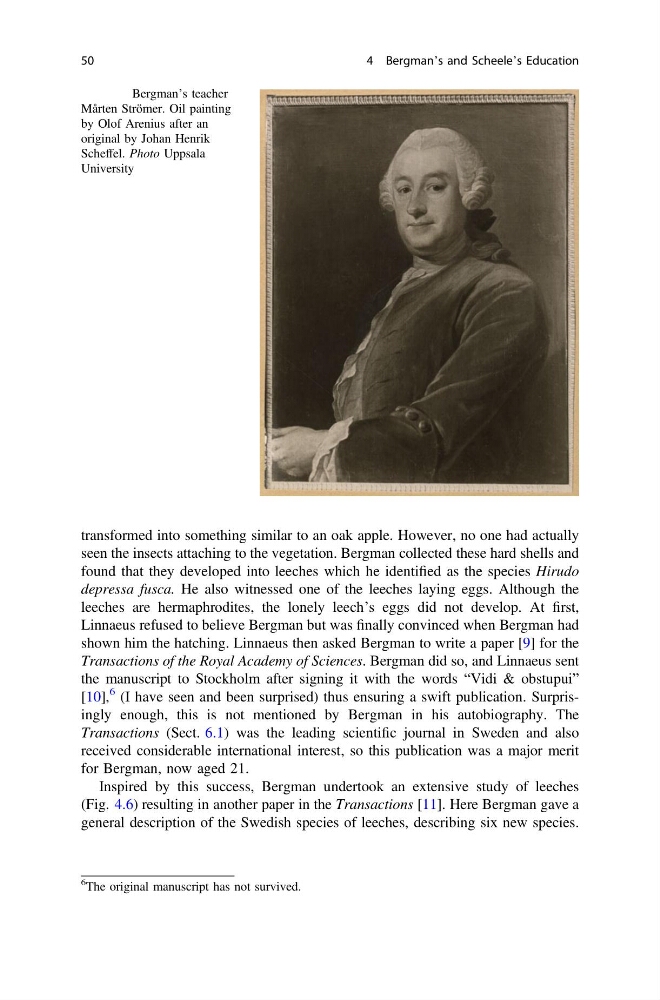
Fig. 4.4 Bergman’s teacher
Mårten Strömer. Oil painting
by Olof Arenius after an
original by Johan Henrik
Scheffel. Photo Uppsala
University
6
The original manuscript has not survived.
50
4 Bergman’s and Scheele’s Education
seen the insects attaching to the vegetation. Bergman collected these hard shells and
found that they developed into leeches which he identified as the species Hirudo
depressa fusca. He also witnessed one of the leeches laying eggs. Although the
leeches are hermaphrodites, the lonely leech’s eggs did not develop. At first,
Linnaeus refused to believe Bergman but was finally convinced when Bergman had
shown him the hatching. Linnaeus then asked Bergman to write a paper [9] for the
Transactions of the Royal Academy of Sciences. Bergman did so, and Linnaeus sent
the manuscript to Stockholm after signing it with the words “Vidi & obstupui”
[10],
6 (I have seen and been surprised) thus ensuring a swift publication. Surprisingly enough, this is not mentioned by Bergman in his autobiography. The
Transactions (Sect. 6.1) was the leading scientific journal in Sweden and also
received considerable international interest, so this publication was a major merit
for Bergman, now aged 21.
Inspired by this success, Bergman undertook an extensive study of leeches
(Fig. 4.6) resulting in another paper in the Transactions [11]. Here Bergman gave a
general description of the Swedish species of leeches, describing six new species.
Fig. 4.4 Bergman’s teacher
Mårten Strömer. Oil painting
by Olof Arenius after an
original by Johan Henrik
Scheffel. Photo Uppsala
University
6
The original manuscript has not survived.
50
4 Bergman’s and Scheele’s Education