

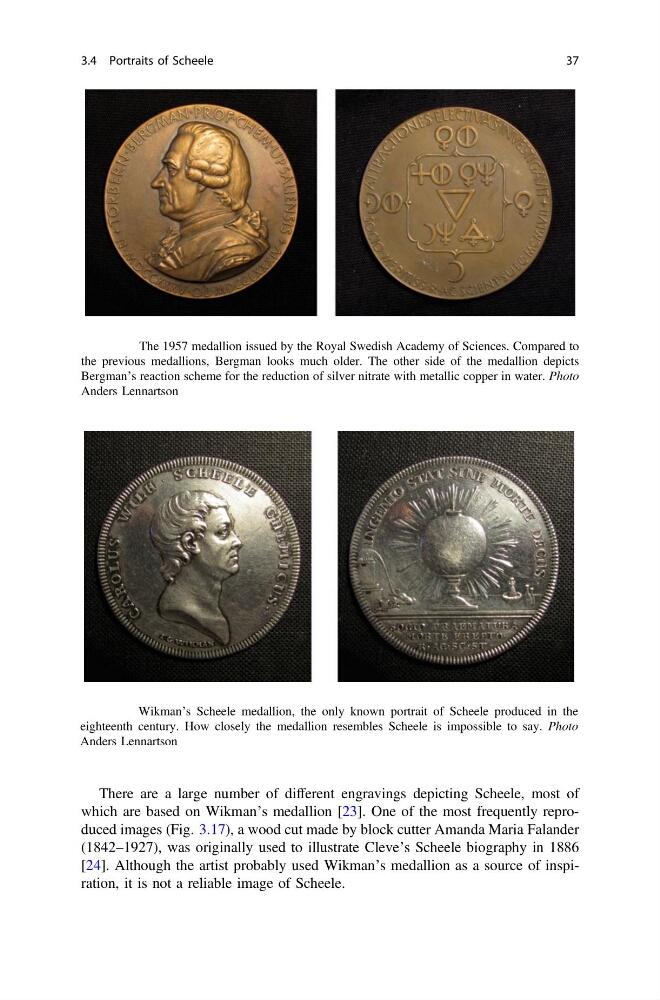
There are a large number of different engravings depicting Scheele, most of
which are based on Wikman’s medallion [23]. One of the most frequently reproduced images (Fig. 3.17), a wood cut made by block cutter Amanda Maria Falander
(1842–1927), was originally used to illustrate Cleve’s Scheele biography in 1886
[24]. Although the artist probably used Wikman’s medallion as a source of inspiration, it is not a reliable image of Scheele.
Fig. 3.14 The 1957 medallion issued by the Royal Swedish Academy of Sciences. Compared to
the previous medallions, Bergman looks much older. The other side of the medallion depicts
Bergman’s reaction scheme for the reduction of silver nitrate with metallic copper in water. Photo
Anders Lennartson
Fig. 3.15 Wikman’s Scheele medallion, the only known portrait of Scheele produced in the
eighteenth century. How closely the medallion resembles Scheele is impossible to say. Photo
Anders Lennartson
3.4 Portraits of Scheele
37
which are based on Wikman’s medallion [23]. One of the most frequently reproduced images (Fig. 3.17), a wood cut made by block cutter Amanda Maria Falander
(1842–1927), was originally used to illustrate Cleve’s Scheele biography in 1886
[24]. Although the artist probably used Wikman’s medallion as a source of inspiration, it is not a reliable image of Scheele.
Fig. 3.14 The 1957 medallion issued by the Royal Swedish Academy of Sciences. Compared to
the previous medallions, Bergman looks much older. The other side of the medallion depicts
Bergman’s reaction scheme for the reduction of silver nitrate with metallic copper in water. Photo
Anders Lennartson
Fig. 3.15 Wikman’s Scheele medallion, the only known portrait of Scheele produced in the
eighteenth century. How closely the medallion resembles Scheele is impossible to say. Photo
Anders Lennartson
3.4 Portraits of Scheele
37