

Bergman’s analytical methods relied heavily on the accurate knowledge of the
composition of the insoluble salts that he precipitated from the analyte. This subject
was further explored in an essay called De praecipitatis metallicis (On Metallic
Precipitates) which appeared in the second volume of Bergman’s collected works
published in 1780 [41]. This essay contains long discussions both on the dissolution
of metals in acids and on precipitation phenomena. It ends with a section where
Bergman discussed the advantages and disadvantages of analysis by wet methods.
It contains a long table where Bergman has determined the composition of a large
number of metallic precipitates, mainly those obtained by adding sodium carbonate,
sodium hydroxide or potassium hexacyanoferrate (phlogisticated alkali) to solutions
of metal salts. Bergman’s method was to dissolve 100 parts of metal in acid and
weigh the precipitate obtained by adding sodium carbonate to the solution. As
indicated above, this is somewhat problematic. The precipitates with phlogisticated
alkali are also problematic, since the phlogisticated alkali was probably not a pure
substance, but a mixture containing potassium hexayanoferrate (II). The cases
where the chemical nature of the precipitate can be predicted with certainty and thus
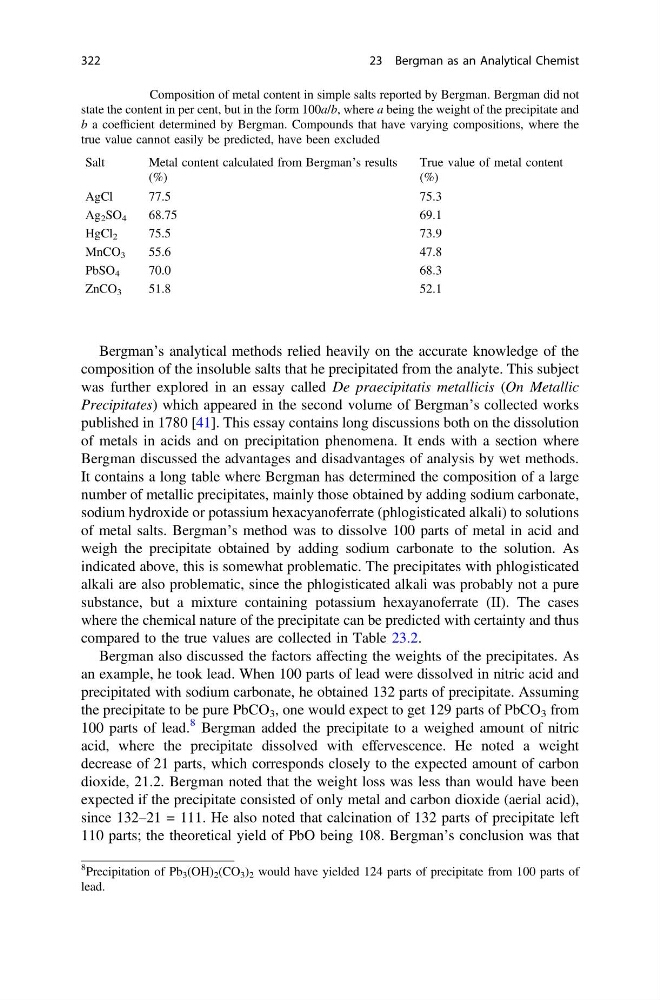
compared to the true values are collected in Table 23.2.
Bergman also discussed the factors affecting the weights of the precipitates. As
an example, he took lead. When 100 parts of lead were dissolved in nitric acid and
precipitated with sodium carbonate, he obtained 132 parts of precipitate. Assuming
the precipitate to be pure PbCO 3 , one would expect to get 129 parts of PbCO 3 from
100 parts of lead.
8 Bergman added the precipitate to a weighed amount of nitric
acid, where the precipitate dissolved with effervescence. He noted a weight
decrease of 21 parts, which corresponds closely to the expected amount of carbon
dioxide, 21.2. Bergman noted that the weight loss was less than would have been
expected if the precipitate consisted of only metal and carbon dioxide (aerial acid),
since 132–21 = 111. He also noted that calcination of 132 parts of precipitate left
110 parts; the theoretical yield of PbO being 108. Bergman’s conclusion was that
Table 23.1 Composition of metal content in simple salts reported by Bergman. Bergman did not
state the content in per cent, but in the form 100a/b, where a being the weight of the precipitate and
b a coefficient determined by Bergman. Compounds that have varying compositions, where the
true value cannot easily be predicted, have been excluded
Salt
Metal content calculated from Bergman’s results
(%)
True value of metal content
(%)
AgCl
77.5
75.3
Ag 2 SO 4
68.75
69.1
HgCl 2
75.5
73.9
MnCO 3
55.6
47.8
PbSO 4
70.0
68.3
ZnCO 3
51.8
52.1
8
Precipitation of Pb 3 (OH) 2 (CO 3 ) 2 would have yielded 124 parts of precipitate from 100 parts of
lead.
322
23 Bergman as an Analytical Chemist
composition of the insoluble salts that he precipitated from the analyte. This subject
was further explored in an essay called De praecipitatis metallicis (On Metallic
Precipitates) which appeared in the second volume of Bergman’s collected works
published in 1780 [41]. This essay contains long discussions both on the dissolution
of metals in acids and on precipitation phenomena. It ends with a section where
Bergman discussed the advantages and disadvantages of analysis by wet methods.
It contains a long table where Bergman has determined the composition of a large
number of metallic precipitates, mainly those obtained by adding sodium carbonate,
sodium hydroxide or potassium hexacyanoferrate (phlogisticated alkali) to solutions
of metal salts. Bergman’s method was to dissolve 100 parts of metal in acid and
weigh the precipitate obtained by adding sodium carbonate to the solution. As
indicated above, this is somewhat problematic. The precipitates with phlogisticated
alkali are also problematic, since the phlogisticated alkali was probably not a pure
substance, but a mixture containing potassium hexayanoferrate (II). The cases
where the chemical nature of the precipitate can be predicted with certainty and thus
compared to the true values are collected in Table 23.2.
Bergman also discussed the factors affecting the weights of the precipitates. As
an example, he took lead. When 100 parts of lead were dissolved in nitric acid and
precipitated with sodium carbonate, he obtained 132 parts of precipitate. Assuming
the precipitate to be pure PbCO 3 , one would expect to get 129 parts of PbCO 3 from
100 parts of lead.
8 Bergman added the precipitate to a weighed amount of nitric
acid, where the precipitate dissolved with effervescence. He noted a weight
decrease of 21 parts, which corresponds closely to the expected amount of carbon
dioxide, 21.2. Bergman noted that the weight loss was less than would have been
expected if the precipitate consisted of only metal and carbon dioxide (aerial acid),
since 132–21 = 111. He also noted that calcination of 132 parts of precipitate left
110 parts; the theoretical yield of PbO being 108. Bergman’s conclusion was that
Table 23.1 Composition of metal content in simple salts reported by Bergman. Bergman did not
state the content in per cent, but in the form 100a/b, where a being the weight of the precipitate and
b a coefficient determined by Bergman. Compounds that have varying compositions, where the
true value cannot easily be predicted, have been excluded
Salt
Metal content calculated from Bergman’s results
(%)
True value of metal content
(%)
AgCl
77.5
75.3
Ag 2 SO 4
68.75
69.1
HgCl 2
75.5
73.9
MnCO 3
55.6
47.8
PbSO 4
70.0
68.3
ZnCO 3
51.8
52.1
8
Precipitation of Pb 3 (OH) 2 (CO 3 ) 2 would have yielded 124 parts of precipitate from 100 parts of
lead.
322
23 Bergman as an Analytical Chemist