

in 1775 that he had used the same method for carbonating water for 6 years [11].
One possible explanation of these contradictions would be that he initially used a
simpler carbonated water free of iron.
17.3 Bergman’s Early Work on Mineral Water
Bergman was not, as we have seen, the first in Sweden to pay interest to mineral
waters, he was preceded by both Hiärne and, to some extent, by Wallerius, who had
published a book in 1748 where he tried to classify different types of water,
although in a completely arbitrary system [12].
Bergman had a more practical interest in mineral waters. He was of poor health,
and after trying various cures, he turned to imported mineral water. During the
winter 1769–1770, he consumed 80 stop (nearly 100 L). This improved his health,
but was about to ruin his economy. As a solution, Bergman started to analyse
mineral waters in order to prepare cheap substitutes. Therefore, Bergman always
confirmed his analyses of mineral waters by preparing artificial water and comparing it to the genuine water. As Bergman most certainly suffered from anaemia
(Sect. 28.1), iron rich mineral water could actually have had some positive effect on
Bergman’s health. From 1781 and to the end of his life, Bergman also travelled to
Medevi every summer for recreation [13].
On Christmas Eve, 1770, Bergman’s student Pehr Dubb defended a thesis on the
waters in Uppsala (Fig. 17.2) [14]. It differs from the majority of Bergman’s theses
by being written in Swedish rather than Latin, and thus may have been written by
Dubb rather than Bergman. In this thesis, the water from the public well
Qvarn-källan (the Mill well) in Uppsala was described and analysed. Litmus was
first used to determine the presence of acid. Addition of lead(II) acetate (sugar of
lead) gave precipitates with chloride and sulphate, and the visual appearance of the
precipitate would tell whether it was chloride or sulphate in the water. To detect
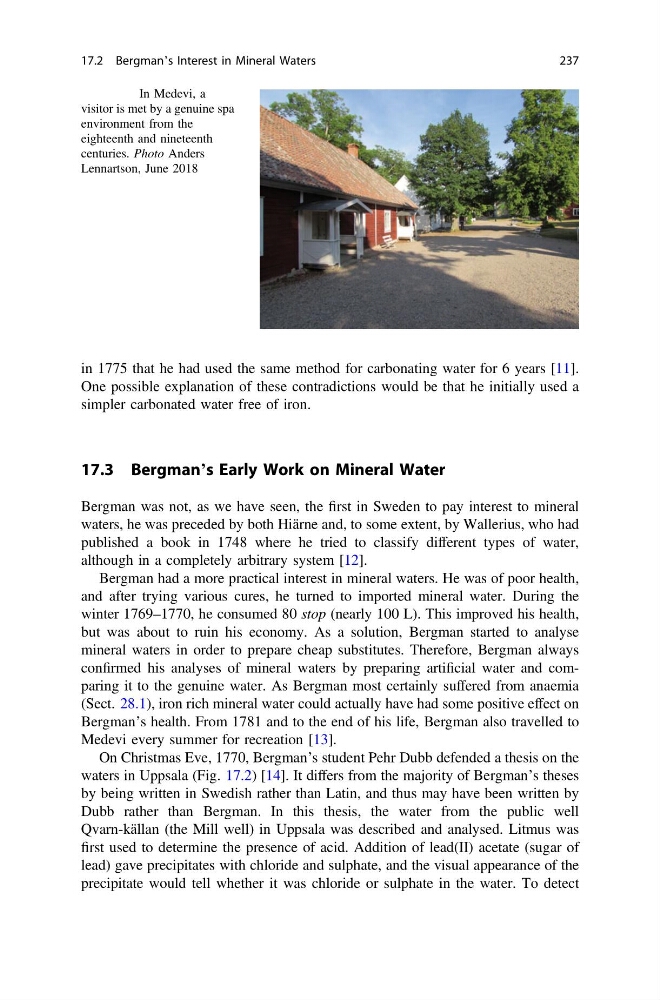
Fig. 17.1 In Medevi, a
visitor is met by a genuine spa
environment from the
eighteenth and nineteenth
centuries. Photo Anders
Lennartson, June 2018
17.2 Bergman’s Interest in Mineral Waters
237
One possible explanation of these contradictions would be that he initially used a
simpler carbonated water free of iron.
17.3 Bergman’s Early Work on Mineral Water
Bergman was not, as we have seen, the first in Sweden to pay interest to mineral
waters, he was preceded by both Hiärne and, to some extent, by Wallerius, who had
published a book in 1748 where he tried to classify different types of water,
although in a completely arbitrary system [12].
Bergman had a more practical interest in mineral waters. He was of poor health,
and after trying various cures, he turned to imported mineral water. During the
winter 1769–1770, he consumed 80 stop (nearly 100 L). This improved his health,
but was about to ruin his economy. As a solution, Bergman started to analyse
mineral waters in order to prepare cheap substitutes. Therefore, Bergman always
confirmed his analyses of mineral waters by preparing artificial water and comparing it to the genuine water. As Bergman most certainly suffered from anaemia
(Sect. 28.1), iron rich mineral water could actually have had some positive effect on
Bergman’s health. From 1781 and to the end of his life, Bergman also travelled to
Medevi every summer for recreation [13].
On Christmas Eve, 1770, Bergman’s student Pehr Dubb defended a thesis on the
waters in Uppsala (Fig. 17.2) [14]. It differs from the majority of Bergman’s theses
by being written in Swedish rather than Latin, and thus may have been written by
Dubb rather than Bergman. In this thesis, the water from the public well
Qvarn-källan (the Mill well) in Uppsala was described and analysed. Litmus was
first used to determine the presence of acid. Addition of lead(II) acetate (sugar of
lead) gave precipitates with chloride and sulphate, and the visual appearance of the
precipitate would tell whether it was chloride or sulphate in the water. To detect
Fig. 17.1 In Medevi, a
visitor is met by a genuine spa
environment from the
eighteenth and nineteenth
centuries. Photo Anders
Lennartson, June 2018
17.2 Bergman’s Interest in Mineral Waters
237