

continued his work on alum and published a second paper
11 in 1776 presenting a
systematic study of the crystallisation of alum from solutions containing excess
sulphuric acid [40]. Here, he made the interesting discovery that “common alum
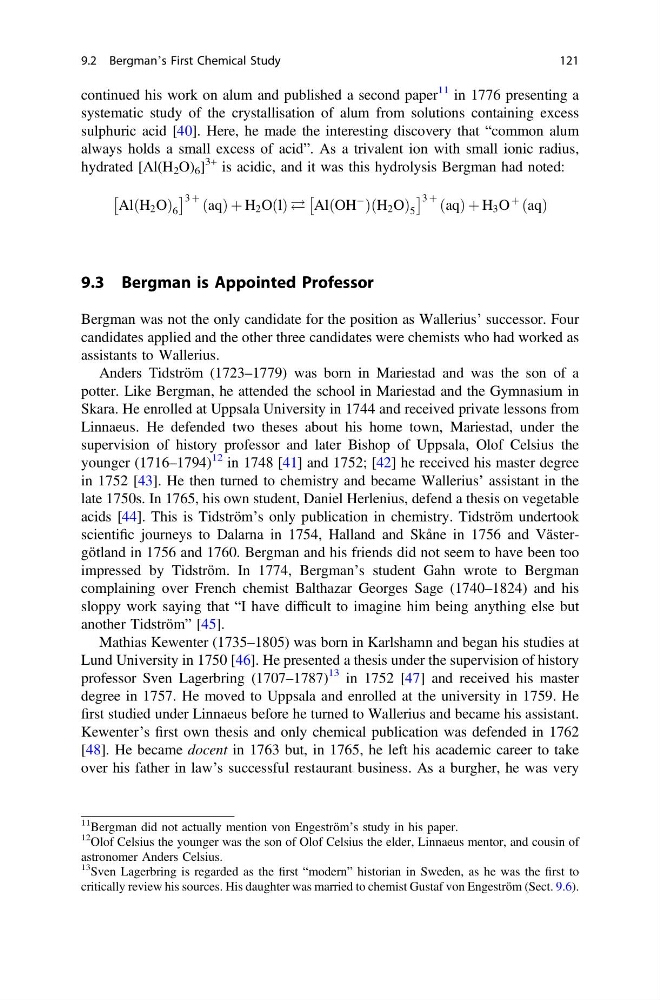
always holds a small excess of acid”. As a trivalent ion with small ionic radius,
hydrated [Al(H 2 O) 6 ]
3+ is acidic, and it was this hydrolysis Bergman had noted:
Al H 2 O
ð
Þ 6
Â
à 3 þ aq
ð ÞþH 2 O l
ð Þ Al OH
À
ð
Þ H 2 O
ð
Þ 5
Â
à 3 þ aq
ð ÞþH 3 O
þ
aq
ð Þ
9.3 Bergman is Appointed Professor
Bergman was not the only candidate for the position as Wallerius’ successor. Four
candidates applied and the other three candidates were chemists who had worked as
assistants to Wallerius.
Anders Tidström (1723–1779) was born in Mariestad and was the son of a
potter. Like Bergman, he attended the school in Mariestad and the Gymnasium in
Skara. He enrolled at Uppsala University in 1744 and received private lessons from
Linnaeus. He defended two theses about his home town, Mariestad, under the
supervision of history professor and later Bishop of Uppsala, Olof Celsius the
younger (1716–1794)
12 in 1748 [41] and 1752; [42] he received his master degree
in 1752 [43]. He then turned to chemistry and became Wallerius’ assistant in the
late 1750s. In 1765, his own student, Daniel Herlenius, defend a thesis on vegetable
acids [44]. This is Tidström’s only publication in chemistry. Tidström undertook
scientific journeys to Dalarna in 1754, Halland and Skåne in 1756 and Västergötland in 1756 and 1760. Bergman and his friends did not seem to have been too
impressed by Tidström. In 1774, Bergman’s student Gahn wrote to Bergman
complaining over French chemist Balthazar Georges Sage (1740–1824) and his
sloppy work saying that “I have difficult to imagine him being anything else but
another Tidström” [45].
Mathias Kewenter (1735–1805) was born in Karlshamn and began his studies at
Lund University in 1750 [46]. He presented a thesis under the supervision of history
professor Sven Lagerbring (1707–1787)
13 in 1752 [47] and received his master
degree in 1757. He moved to Uppsala and enrolled at the university in 1759. He
first studied under Linnaeus before he turned to Wallerius and became his assistant.
Kewenter’s first own thesis and only chemical publication was defended in 1762
[48]. He became docent in 1763 but, in 1765, he left his academic career to take
over his father in law’s successful restaurant business. As a burgher, he was very
11
Bergman did not actually mention von Engeström’s study in his paper.
12
Olof Celsius the younger was the son of Olof Celsius the elder, Linnaeus mentor, and cousin of
astronomer Anders Celsius.
13
Sven Lagerbring is regarded as the first “modern” historian in Sweden, as he was the first to
critically review his sources. His daughter was married to chemist Gustaf von Engeström (Sect. 9.6).
9.2 Bergman’s First Chemical Study
121
11 in 1776 presenting a
systematic study of the crystallisation of alum from solutions containing excess
sulphuric acid [40]. Here, he made the interesting discovery that “common alum
always holds a small excess of acid”. As a trivalent ion with small ionic radius,
hydrated [Al(H 2 O) 6 ]
3+ is acidic, and it was this hydrolysis Bergman had noted:
Al H 2 O
ð
Þ 6
Â
à 3 þ aq
ð ÞþH 2 O l
ð Þ Al OH
À
ð
Þ H 2 O
ð
Þ 5
Â
à 3 þ aq
ð ÞþH 3 O
þ
aq
ð Þ
9.3 Bergman is Appointed Professor
Bergman was not the only candidate for the position as Wallerius’ successor. Four
candidates applied and the other three candidates were chemists who had worked as
assistants to Wallerius.
Anders Tidström (1723–1779) was born in Mariestad and was the son of a
potter. Like Bergman, he attended the school in Mariestad and the Gymnasium in
Skara. He enrolled at Uppsala University in 1744 and received private lessons from
Linnaeus. He defended two theses about his home town, Mariestad, under the
supervision of history professor and later Bishop of Uppsala, Olof Celsius the
younger (1716–1794)
12 in 1748 [41] and 1752; [42] he received his master degree
in 1752 [43]. He then turned to chemistry and became Wallerius’ assistant in the
late 1750s. In 1765, his own student, Daniel Herlenius, defend a thesis on vegetable
acids [44]. This is Tidström’s only publication in chemistry. Tidström undertook
scientific journeys to Dalarna in 1754, Halland and Skåne in 1756 and Västergötland in 1756 and 1760. Bergman and his friends did not seem to have been too
impressed by Tidström. In 1774, Bergman’s student Gahn wrote to Bergman
complaining over French chemist Balthazar Georges Sage (1740–1824) and his
sloppy work saying that “I have difficult to imagine him being anything else but
another Tidström” [45].
Mathias Kewenter (1735–1805) was born in Karlshamn and began his studies at
Lund University in 1750 [46]. He presented a thesis under the supervision of history
professor Sven Lagerbring (1707–1787)
13 in 1752 [47] and received his master
degree in 1757. He moved to Uppsala and enrolled at the university in 1759. He
first studied under Linnaeus before he turned to Wallerius and became his assistant.
Kewenter’s first own thesis and only chemical publication was defended in 1762
[48]. He became docent in 1763 but, in 1765, he left his academic career to take
over his father in law’s successful restaurant business. As a burgher, he was very
11
Bergman did not actually mention von Engeström’s study in his paper.
12
Olof Celsius the younger was the son of Olof Celsius the elder, Linnaeus mentor, and cousin of
astronomer Anders Celsius.
13
Sven Lagerbring is regarded as the first “modern” historian in Sweden, as he was the first to
critically review his sources. His daughter was married to chemist Gustaf von Engeström (Sect. 9.6).
9.2 Bergman’s First Chemical Study
121