

montmorillonite clay.
9 Absorption of Fe
3+ was even smaller.
10 Bergman was not
happy with Faggot’s paper since a good reception of this work was essential if he
should have any chance of becoming a professor. He contacted Wargentin, and von
Swab’s addendum was written on Wargentin’s request [35]. Swab wrote that
Bergman’s study was so thorough, that he had little to add.
Bergman adapted his work on alum to a dissertation in Latin, Disquisitio
chemica de confectione aluminis which was defended by Gustaf Swedelius on
April 1, 1767 [36]. This was Bergman’s first dissertation in chemistry; opponent
was Carl Peter Wibom (1736–1801), Wallerius assistant [37]. Although Bergman’s
work on alum gained general recognition and served its primary purpose of
establishing Bergman as a competent candidate for the chair in chemistry, there is
no evidence that Bergman’s theories were actually put in practice in Garphyttan
[38]. It is, after all, far from certain that it would have worked.
In 1774, Gustaf von Engeström (one of Bergman’s opponents; Sect. 9.6) published a long paper on alum production. Bergman is not mentioned, but it is clear
that Bergman’s study is his target [39]. von Engeström reported that sulphuric acid
did not prevent the crystallisation of alum (here, von Engeström seems to be
correct), and he had never observed any fatty residue in the alum lye. Bergman
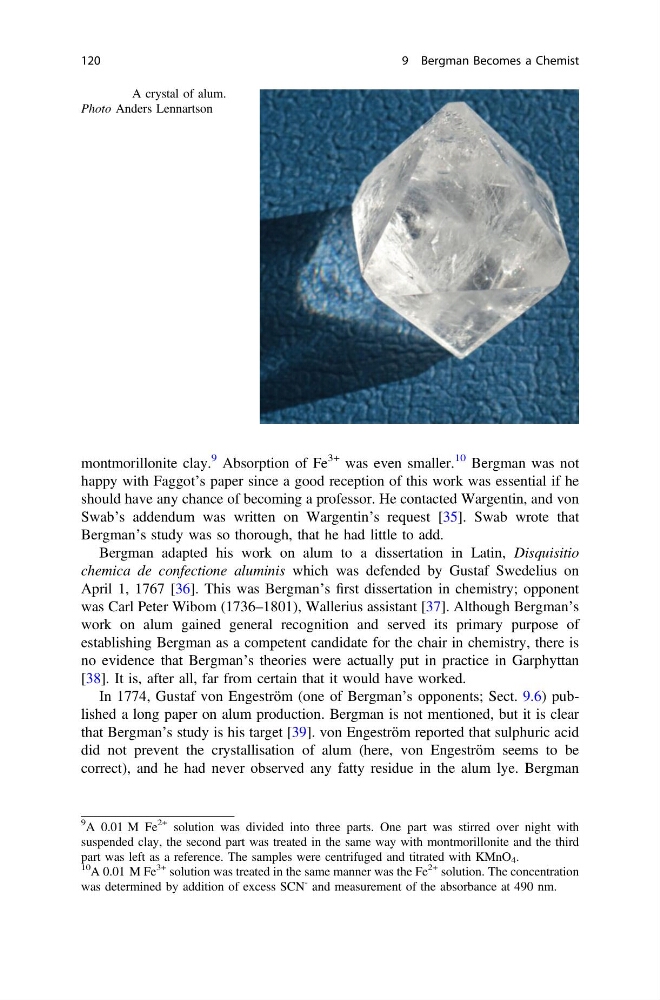
Fig. 9.6 A crystal of alum.
Photo Anders Lennartson
9
A 0.01 M Fe
2+ solution was divided into three parts. One part was stirred over night with
suspended clay, the second part was treated in the same way with montmorillonite and the third
part was left as a reference. The samples were centrifuged and titrated with KMnO 4 .
10
A 0.01 M Fe
3+ solution was treated in the same manner was the Fe
2+ solution. The concentration
was determined by addition of excess SCN
- and measurement of the absorbance at 490 nm.
120
9 Bergman Becomes a Chemist
9 Absorption of Fe
3+ was even smaller.
10 Bergman was not
happy with Faggot’s paper since a good reception of this work was essential if he
should have any chance of becoming a professor. He contacted Wargentin, and von
Swab’s addendum was written on Wargentin’s request [35]. Swab wrote that
Bergman’s study was so thorough, that he had little to add.
Bergman adapted his work on alum to a dissertation in Latin, Disquisitio
chemica de confectione aluminis which was defended by Gustaf Swedelius on
April 1, 1767 [36]. This was Bergman’s first dissertation in chemistry; opponent
was Carl Peter Wibom (1736–1801), Wallerius assistant [37]. Although Bergman’s
work on alum gained general recognition and served its primary purpose of
establishing Bergman as a competent candidate for the chair in chemistry, there is
no evidence that Bergman’s theories were actually put in practice in Garphyttan
[38]. It is, after all, far from certain that it would have worked.
In 1774, Gustaf von Engeström (one of Bergman’s opponents; Sect. 9.6) published a long paper on alum production. Bergman is not mentioned, but it is clear
that Bergman’s study is his target [39]. von Engeström reported that sulphuric acid
did not prevent the crystallisation of alum (here, von Engeström seems to be
correct), and he had never observed any fatty residue in the alum lye. Bergman
Fig. 9.6 A crystal of alum.
Photo Anders Lennartson
9
A 0.01 M Fe
2+ solution was divided into three parts. One part was stirred over night with
suspended clay, the second part was treated in the same way with montmorillonite and the third
part was left as a reference. The samples were centrifuged and titrated with KMnO 4 .
10
A 0.01 M Fe
3+ solution was treated in the same manner was the Fe
2+ solution. The concentration
was determined by addition of excess SCN
- and measurement of the absorbance at 490 nm.
120
9 Bergman Becomes a Chemist