

Bergman could not conclude whether Iceland had formed solely by volcanic
activity. To make such a conclusion, an extensive survey of the whole island had to
be performed in order to rule out the occurrence of granite and other forms of
ancient rock, which Bergman believed had formed in water. Bergman did not
believe it likely for granite to form from a melt, since he thought that the crystals of
quartz and feldspar would crack and become opaque due to the heat [56]. Bergman
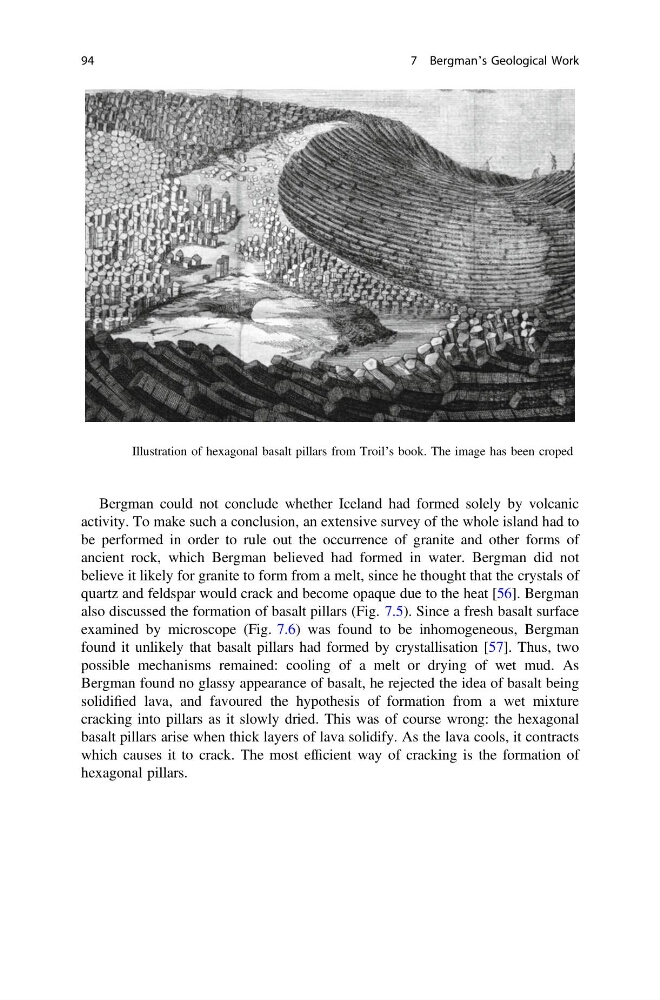
also discussed the formation of basalt pillars (Fig. 7.5). Since a fresh basalt surface
examined by microscope (Fig. 7.6) was found to be inhomogeneous, Bergman
found it unlikely that basalt pillars had formed by crystallisation [57]. Thus, two
possible mechanisms remained: cooling of a melt or drying of wet mud. As
Bergman found no glassy appearance of basalt, he rejected the idea of basalt being
solidified lava, and favoured the hypothesis of formation from a wet mixture
cracking into pillars as it slowly dried. This was of course wrong: the hexagonal
basalt pillars arise when thick layers of lava solidify. As the lava cools, it contracts
which causes it to crack. The most efficient way of cracking is the formation of
hexagonal pillars.
Fig. 7.5 Illustration of hexagonal basalt pillars from Troil’s book. The image has been croped
94
7 Bergman’s Geological Work
activity. To make such a conclusion, an extensive survey of the whole island had to
be performed in order to rule out the occurrence of granite and other forms of
ancient rock, which Bergman believed had formed in water. Bergman did not
believe it likely for granite to form from a melt, since he thought that the crystals of
quartz and feldspar would crack and become opaque due to the heat [56]. Bergman
also discussed the formation of basalt pillars (Fig. 7.5). Since a fresh basalt surface
examined by microscope (Fig. 7.6) was found to be inhomogeneous, Bergman
found it unlikely that basalt pillars had formed by crystallisation [57]. Thus, two
possible mechanisms remained: cooling of a melt or drying of wet mud. As
Bergman found no glassy appearance of basalt, he rejected the idea of basalt being
solidified lava, and favoured the hypothesis of formation from a wet mixture
cracking into pillars as it slowly dried. This was of course wrong: the hexagonal
basalt pillars arise when thick layers of lava solidify. As the lava cools, it contracts
which causes it to crack. The most efficient way of cracking is the formation of
hexagonal pillars.
Fig. 7.5 Illustration of hexagonal basalt pillars from Troil’s book. The image has been croped
94
7 Bergman’s Geological Work