

collection, it was a request that Bergman could not turn down: “It would be very
ungrateful if I hesitated to comply with this request, as you presented me with the
intire collection you made there, that I might chemically examine the nature of
each” [54]. Bergman rejected the idea of working out theories about the origin of
Earth behind the writing-desk; theories had to be based on experiments [55]. Thus,
Troil had to wait until June 1776 for an answer, but then he received a long
4 essay
from Bergman, which he included in his book.
The first section of Bergman’s essay dealt with geysers, and Bergman examined
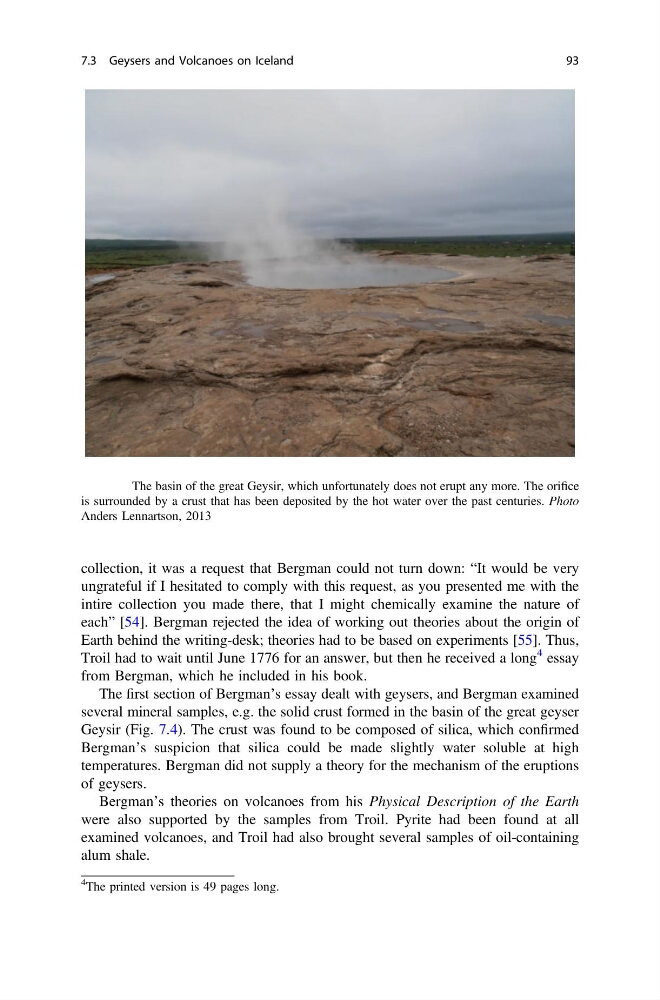
several mineral samples, e.g. the solid crust formed in the basin of the great geyser
Geysir (Fig. 7.4). The crust was found to be composed of silica, which confirmed
Bergman’s suspicion that silica could be made slightly water soluble at high
temperatures. Bergman did not supply a theory for the mechanism of the eruptions
of geysers.
Bergman’s theories on volcanoes from his Physical Description of the Earth
were also supported by the samples from Troil. Pyrite had been found at all
examined volcanoes, and Troil had also brought several samples of oil-containing
alum shale.
Fig. 7.4 The basin of the great Geysir, which unfortunately does not erupt any more. The orifice
is surrounded by a crust that has been deposited by the hot water over the past centuries. Photo
Anders Lennartson, 2013
4
The printed version is 49 pages long.
7.3 Geysers and Volcanoes on Iceland
93
ungrateful if I hesitated to comply with this request, as you presented me with the
intire collection you made there, that I might chemically examine the nature of
each” [54]. Bergman rejected the idea of working out theories about the origin of
Earth behind the writing-desk; theories had to be based on experiments [55]. Thus,
Troil had to wait until June 1776 for an answer, but then he received a long
4 essay
from Bergman, which he included in his book.
The first section of Bergman’s essay dealt with geysers, and Bergman examined
several mineral samples, e.g. the solid crust formed in the basin of the great geyser
Geysir (Fig. 7.4). The crust was found to be composed of silica, which confirmed
Bergman’s suspicion that silica could be made slightly water soluble at high
temperatures. Bergman did not supply a theory for the mechanism of the eruptions
of geysers.
Bergman’s theories on volcanoes from his Physical Description of the Earth
were also supported by the samples from Troil. Pyrite had been found at all
examined volcanoes, and Troil had also brought several samples of oil-containing
alum shale.
Fig. 7.4 The basin of the great Geysir, which unfortunately does not erupt any more. The orifice
is surrounded by a crust that has been deposited by the hot water over the past centuries. Photo
Anders Lennartson, 2013
4
The printed version is 49 pages long.
7.3 Geysers and Volcanoes on Iceland
93