

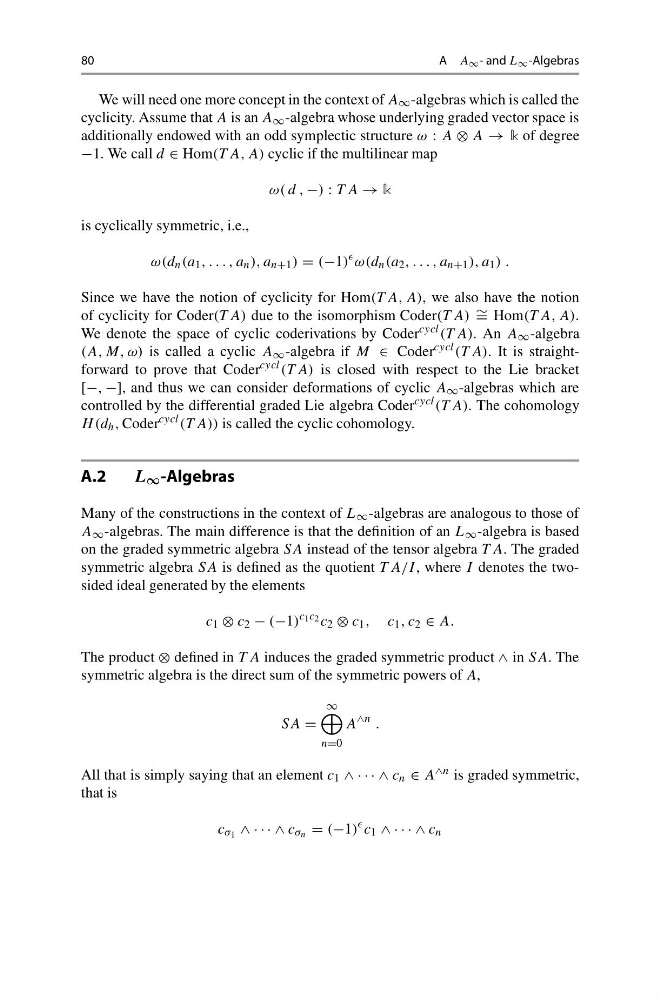
80
A A ∞ - and L ∞ -Algebras
We will need one more concept in the context of A ∞ -algebras which is called the
cyclicity. Assume that A is an A ∞ -algebra whose underlying graded vector space is
additionally endowed with an odd symplectic structure ω : A ⊗ A → k of degree
−1. We call d ∈ Hom(T A, A) cyclic if the multilinear map
ω( d , −) : T A → k
is cyclically symmetric, i.e.,
ω(d n (a 1 , . . . , a n ), a n+1 ) = (−1)
ω(d n (a 2 , . . . , a n+1 ), a 1 ) .
Since we have the notion of cyclicity for Hom(T A, A), we also have the notion
of cyclicity for Coder(T A) due to the isomorphism Coder(T A) ∼ = Hom(T A, A).
We denote the space of cyclic coderivations by Coder
cycl (T A). An A ∞ -algebra
(A, M, ω) is called a cyclic A ∞ -algebra if M ∈ Coder
cycl (T A). It is straightforward to prove that Coder
cycl (T A) is closed with respect to the Lie bracket
[−, −], and thus we can consider deformations of cyclic A ∞ -algebras which are
controlled by the differential graded Lie algebra Coder
cycl (T A). The cohomology
H (d h , Coder
cycl (T A)) is called the cyclic cohomology.
A.2
L ∞ -Algebras
Many of the constructions in the context of L ∞ -algebras are analogous to those of
A ∞ -algebras. The main difference is that the definition of an L ∞ -algebra is based
on the graded symmetric algebra SA instead of the tensor algebra T A. The graded
symmetric algebra SA is defined as the quotient T A/I, where I denotes the twosided ideal generated by the elements
c 1 ⊗ c 2 − (−1)
c 1 c 2 c 2 ⊗ c 1 , c 1 , c 2 ∈ A.
The product ⊗ defined in T A induces the graded symmetric product ∧ in SA. The
symmetric algebra is the direct sum of the symmetric powers of A,
SA =
∞
n=0
A
∧n .
All that is simply saying that an element c 1 ∧ · · · ∧ c n ∈ A ∧n is graded symmetric,
that is
c σ 1 ∧ · · · ∧ c σ n = (−1)
c 1 ∧ · · · ∧ c n
A A ∞ - and L ∞ -Algebras
We will need one more concept in the context of A ∞ -algebras which is called the
cyclicity. Assume that A is an A ∞ -algebra whose underlying graded vector space is
additionally endowed with an odd symplectic structure ω : A ⊗ A → k of degree
−1. We call d ∈ Hom(T A, A) cyclic if the multilinear map
ω( d , −) : T A → k
is cyclically symmetric, i.e.,
ω(d n (a 1 , . . . , a n ), a n+1 ) = (−1)
ω(d n (a 2 , . . . , a n+1 ), a 1 ) .
Since we have the notion of cyclicity for Hom(T A, A), we also have the notion
of cyclicity for Coder(T A) due to the isomorphism Coder(T A) ∼ = Hom(T A, A).
We denote the space of cyclic coderivations by Coder
cycl (T A). An A ∞ -algebra
(A, M, ω) is called a cyclic A ∞ -algebra if M ∈ Coder
cycl (T A). It is straightforward to prove that Coder
cycl (T A) is closed with respect to the Lie bracket
[−, −], and thus we can consider deformations of cyclic A ∞ -algebras which are
controlled by the differential graded Lie algebra Coder
cycl (T A). The cohomology
H (d h , Coder
cycl (T A)) is called the cyclic cohomology.
A.2
L ∞ -Algebras
Many of the constructions in the context of L ∞ -algebras are analogous to those of
A ∞ -algebras. The main difference is that the definition of an L ∞ -algebra is based
on the graded symmetric algebra SA instead of the tensor algebra T A. The graded
symmetric algebra SA is defined as the quotient T A/I, where I denotes the twosided ideal generated by the elements
c 1 ⊗ c 2 − (−1)
c 1 c 2 c 2 ⊗ c 1 , c 1 , c 2 ∈ A.
The product ⊗ defined in T A induces the graded symmetric product ∧ in SA. The
symmetric algebra is the direct sum of the symmetric powers of A,
SA =
∞
n=0
A
∧n .
All that is simply saying that an element c 1 ∧ · · · ∧ c n ∈ A ∧n is graded symmetric,
that is
c σ 1 ∧ · · · ∧ c σ n = (−1)
c 1 ∧ · · · ∧ c n