

A A ∞ - and L ∞ -Algebras
79
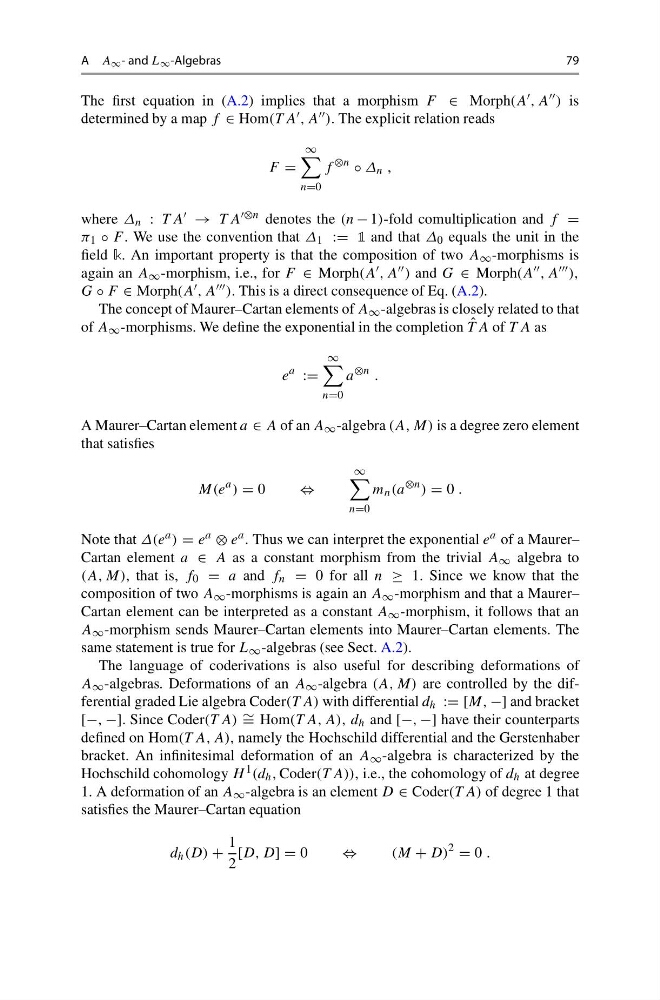
The first equation in (A.2) implies that a morphism F ∈ Morph(A , A ) is
determined by a map f ∈ Hom(T A , A ). The explicit relation reads
F =
∞
n=0
f
⊗n
◦ Δ n ,
where Δ n : T A → T A denotes the (n − 1)-fold comultiplication and f =
π 1 ◦ F . We use the convention that Δ 1 := 1 and that Δ 0 equals the unit in the
field k. An important property is that the composition of two A ∞ -morphisms is
again an A ∞ -morphism, i.e., for F ∈ Morph(A , A ) and G ∈ Morph(A , A ),
G ◦ F ∈ Morph(A , A ). This is a direct consequence of Eq. (A.2).
The concept of Maurer–Cartan elements of A ∞ -algebras is closely related to that
of A ∞ -morphisms. We define the exponential in the completion ˆ
T A of T A as
e
a
:=
∞
n=0
a
⊗n .
A Maurer–Cartan element a ∈ A of an A ∞ -algebra (A, M) is a degree zero element
that satisfies
M(e
a ) = 0
⇔
∞
n=0
m n (a
⊗n ) = 0 .
Note that Δ(e a ) = e a ⊗ e a . Thus we can interpret the exponential e a of a Maurer–
Cartan element a ∈ A as a constant morphism from the trivial A ∞ algebra to
(A, M), that is, f 0 = a and f n = 0 for all n ≥ 1. Since we know that the
composition of two A ∞ -morphisms is again an A ∞ -morphism and that a Maurer–
Cartan element can be interpreted as a constant A ∞ -morphism, it follows that an
A ∞ -morphism sends Maurer–Cartan elements into Maurer–Cartan elements. The
same statement is true for L ∞ -algebras (see Sect. A.2).
The language of coderivations is also useful for describing deformations of
A ∞ -algebras. Deformations of an A ∞ -algebra (A, M) are controlled by the differential graded Lie algebra Coder(T A) with differential d h := [M, −] and bracket
[−, −]. Since Coder(T A) ∼ = Hom(T A, A), d h and [−, −] have their counterparts
defined on Hom(T A, A), namely the Hochschild differential and the Gerstenhaber
bracket. An infinitesimal deformation of an A ∞ -algebra is characterized by the
Hochschild cohomology H 1 (d h , Coder(T A)), i.e., the cohomology of d h at degree
1. A deformation of an A ∞ -algebra is an element D ∈ Coder(T A) of degree 1 that
satisfies the Maurer–Cartan equation
d h (D) +
1
2
[D, D] = 0
⇔
(M + D)
2
= 0 .
79
The first equation in (A.2) implies that a morphism F ∈ Morph(A , A ) is
determined by a map f ∈ Hom(T A , A ). The explicit relation reads
F =
∞
n=0
f
⊗n
◦ Δ n ,
where Δ n : T A → T A denotes the (n − 1)-fold comultiplication and f =
π 1 ◦ F . We use the convention that Δ 1 := 1 and that Δ 0 equals the unit in the
field k. An important property is that the composition of two A ∞ -morphisms is
again an A ∞ -morphism, i.e., for F ∈ Morph(A , A ) and G ∈ Morph(A , A ),
G ◦ F ∈ Morph(A , A ). This is a direct consequence of Eq. (A.2).
The concept of Maurer–Cartan elements of A ∞ -algebras is closely related to that
of A ∞ -morphisms. We define the exponential in the completion ˆ
T A of T A as
e
a
:=
∞
n=0
a
⊗n .
A Maurer–Cartan element a ∈ A of an A ∞ -algebra (A, M) is a degree zero element
that satisfies
M(e
a ) = 0
⇔
∞
n=0
m n (a
⊗n ) = 0 .
Note that Δ(e a ) = e a ⊗ e a . Thus we can interpret the exponential e a of a Maurer–
Cartan element a ∈ A as a constant morphism from the trivial A ∞ algebra to
(A, M), that is, f 0 = a and f n = 0 for all n ≥ 1. Since we know that the
composition of two A ∞ -morphisms is again an A ∞ -morphism and that a Maurer–
Cartan element can be interpreted as a constant A ∞ -morphism, it follows that an
A ∞ -morphism sends Maurer–Cartan elements into Maurer–Cartan elements. The
same statement is true for L ∞ -algebras (see Sect. A.2).
The language of coderivations is also useful for describing deformations of
A ∞ -algebras. Deformations of an A ∞ -algebra (A, M) are controlled by the differential graded Lie algebra Coder(T A) with differential d h := [M, −] and bracket
[−, −]. Since Coder(T A) ∼ = Hom(T A, A), d h and [−, −] have their counterparts
defined on Hom(T A, A), namely the Hochschild differential and the Gerstenhaber
bracket. An infinitesimal deformation of an A ∞ -algebra is characterized by the
Hochschild cohomology H 1 (d h , Coder(T A)), i.e., the cohomology of d h at degree
1. A deformation of an A ∞ -algebra is an element D ∈ Coder(T A) of degree 1 that
satisfies the Maurer–Cartan equation
d h (D) +
1
2
[D, D] = 0
⇔
(M + D)
2
= 0 .