

3.4 Measure, Vertices, and BV Action
43
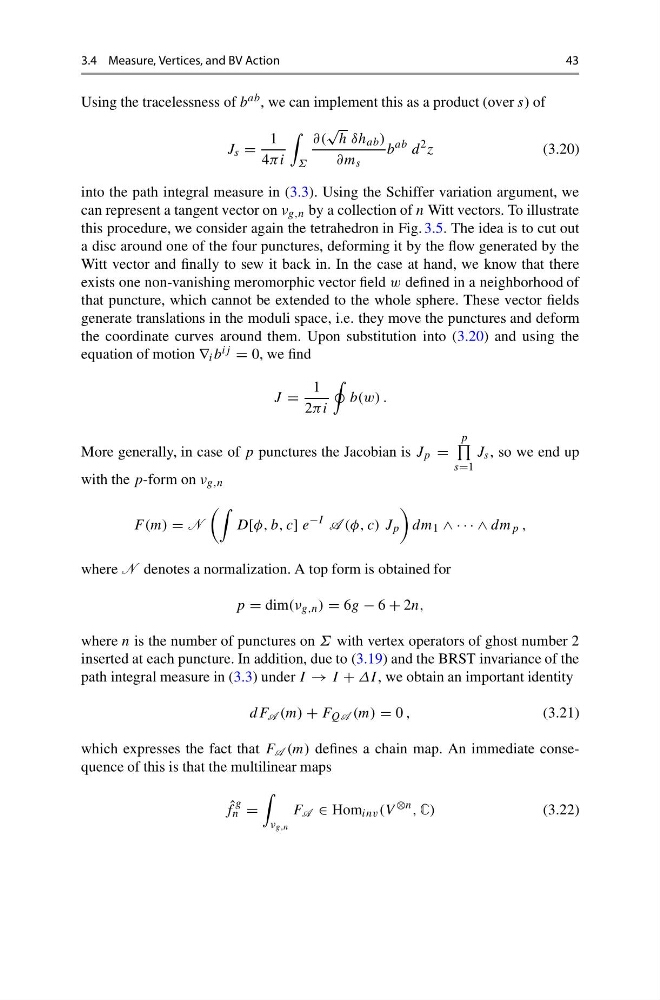
Using the tracelessness of b ab , we can implement this as a product (over s) of
J s =
1
4πi
Σ
∂(
√
h δh ab )
∂m s
b
ab d
2 z
(3.20)
into the path integral measure in (3.3). Using the Schiffer variation argument, we
can represent a tangent vector on ν g,n by a collection of n Witt vectors. To illustrate
this procedure, we consider again the tetrahedron in Fig. 3.5. The idea is to cut out
a disc around one of the four punctures, deforming it by the flow generated by the
Witt vector and finally to sew it back in. In the case at hand, we know that there
exists one non-vanishing meromorphic vector field w defined in a neighborhood of
that puncture, which cannot be extended to the whole sphere. These vector fields
generate translations in the moduli space, i.e. they move the punctures and deform
the coordinate curves around them. Upon substitution into (3.20) and using the
equation of motion ∇ i b ij = 0, we find
J =
1
2πi
b(w) .
More generally, in case of p punctures the Jacobian is J p =
p
s=1
J s , so we end up
with the p-form on ν g,n
F (m) = N
D[φ, b, c] e
−I
A (φ, c) J p
dm 1 ∧ · · · ∧ dm p ,
where N denotes a normalization. A top form is obtained for
p = dim(ν g,n ) = 6g − 6 + 2n,
where n is the number of punctures on Σ with vertex operators of ghost number 2
inserted at each puncture. In addition, due to (3.19) and the BRST invariance of the
path integral measure in (3.3) under I → I + ΔI , we obtain an important identity
dF A (m) + F QA (m) = 0 ,
(3.21)
which expresses the fact that F A (m) defines a chain map. An immediate consequence of this is that the multilinear maps
ˆ
f
g
n =
ν g,n
F A ∈ Hom inv (V
⊗n , C)
(3.22)
43
Using the tracelessness of b ab , we can implement this as a product (over s) of
J s =
1
4πi
Σ
∂(
√
h δh ab )
∂m s
b
ab d
2 z
(3.20)
into the path integral measure in (3.3). Using the Schiffer variation argument, we
can represent a tangent vector on ν g,n by a collection of n Witt vectors. To illustrate
this procedure, we consider again the tetrahedron in Fig. 3.5. The idea is to cut out
a disc around one of the four punctures, deforming it by the flow generated by the
Witt vector and finally to sew it back in. In the case at hand, we know that there
exists one non-vanishing meromorphic vector field w defined in a neighborhood of
that puncture, which cannot be extended to the whole sphere. These vector fields
generate translations in the moduli space, i.e. they move the punctures and deform
the coordinate curves around them. Upon substitution into (3.20) and using the
equation of motion ∇ i b ij = 0, we find
J =
1
2πi
b(w) .
More generally, in case of p punctures the Jacobian is J p =
p
s=1
J s , so we end up
with the p-form on ν g,n
F (m) = N
D[φ, b, c] e
−I
A (φ, c) J p
dm 1 ∧ · · · ∧ dm p ,
where N denotes a normalization. A top form is obtained for
p = dim(ν g,n ) = 6g − 6 + 2n,
where n is the number of punctures on Σ with vertex operators of ghost number 2
inserted at each puncture. In addition, due to (3.19) and the BRST invariance of the
path integral measure in (3.3) under I → I + ΔI , we obtain an important identity
dF A (m) + F QA (m) = 0 ,
(3.21)
which expresses the fact that F A (m) defines a chain map. An immediate consequence of this is that the multilinear maps
ˆ
f
g
n =
ν g,n
F A ∈ Hom inv (V
⊗n , C)
(3.22)