

16
2 Relativistic Point Particle
which is clearly Q-closed since c squares to zero. On the other hand, if g+δg = f ∗ g
for an infinitesimal diffeomorphism generated by a smooth vector field ξ , then δQ =
−
1
2 [Q, p(ξ )]. Thus the nonequivalent deformations of the point particle action are
given by the cohomology of the adjoint action of Q at degree 1, while the spectrum
of physical states is isomorphic to the cohomology of Q at degree 0.
2.2
Scattering Matrix and Minimal Model
In particle physics, one is typically (though not exclusively) interested in transition
amplitudes between ingoing and outgoing particles. In the absence of four-body
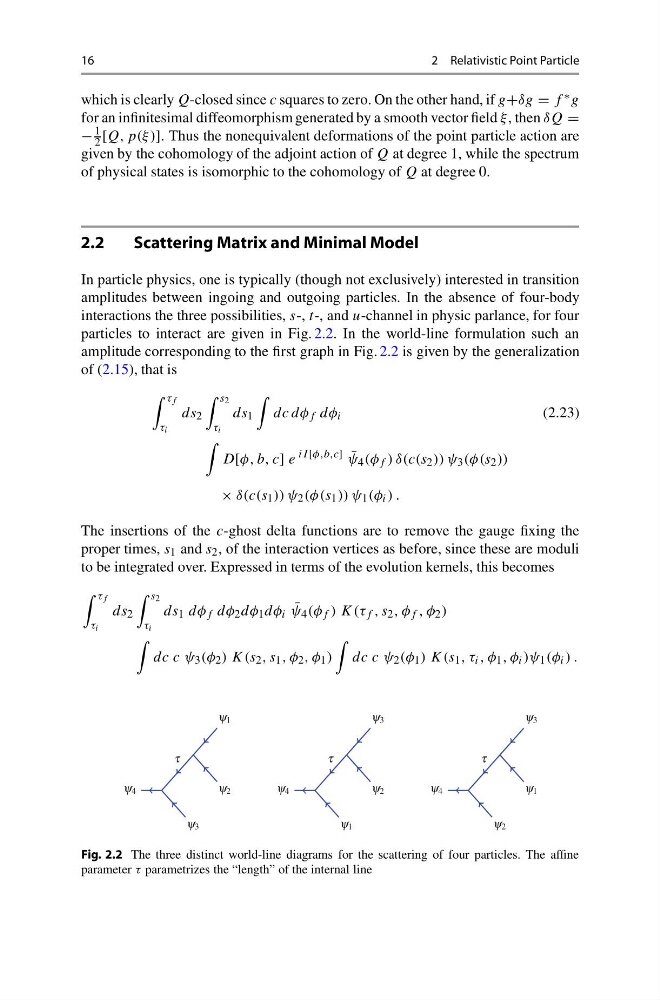
interactions the three possibilities, s-, t-, and u-channel in physic parlance, for four
particles to interact are given in Fig. 2.2. In the world-line formulation such an
amplitude corresponding to the first graph in Fig. 2.2 is given by the generalization
of (2.15), that is
τ f
τ i
ds 2
s 2
τ i
ds 1
dc dφ f dφ i
(2.23)
D[φ, b, c] e
iI [φ,b,c] ¯
ψ 4 (φ f ) δ(c(s 2 )) ψ 3 (φ(s 2 ))
× δ(c(s 1 )) ψ 2 (φ(s 1 )) ψ 1 (φ i ) .
The insertions of the c-ghost delta functions are to remove the gauge fixing the
proper times, s 1 and s 2 , of the interaction vertices as before, since these are moduli
to be integrated over. Expressed in terms of the evolution kernels, this becomes
τ f
τ i
ds 2
s 2
τ i
ds 1 dφ f dφ 2 dφ 1 dφ i ¯
ψ 4 (φ f ) K(τ f , s 2 , φ f , φ 2 )
dc c ψ 3 (φ 2 ) K(s 2 , s 1 , φ 2 , φ 1 )
dc c ψ 2 (φ 1 ) K(s 1 , τ i , φ 1 , φ i )ψ 1 (φ i ) .
ψ 4
ψ 3
ψ 2
ψ 1
τ
ψ 4
ψ 1
ψ 2
ψ 3
τ
ψ 4
ψ 2
ψ 1
ψ 3
τ
Fig. 2.2 The three distinct world-line diagrams for the scattering of four particles. The affine
parameter τ parametrizes the “length” of the internal line
2 Relativistic Point Particle
which is clearly Q-closed since c squares to zero. On the other hand, if g+δg = f ∗ g
for an infinitesimal diffeomorphism generated by a smooth vector field ξ , then δQ =
−
1
2 [Q, p(ξ )]. Thus the nonequivalent deformations of the point particle action are
given by the cohomology of the adjoint action of Q at degree 1, while the spectrum
of physical states is isomorphic to the cohomology of Q at degree 0.
2.2
Scattering Matrix and Minimal Model
In particle physics, one is typically (though not exclusively) interested in transition
amplitudes between ingoing and outgoing particles. In the absence of four-body
interactions the three possibilities, s-, t-, and u-channel in physic parlance, for four
particles to interact are given in Fig. 2.2. In the world-line formulation such an
amplitude corresponding to the first graph in Fig. 2.2 is given by the generalization
of (2.15), that is
τ f
τ i
ds 2
s 2
τ i
ds 1
dc dφ f dφ i
(2.23)
D[φ, b, c] e
iI [φ,b,c] ¯
ψ 4 (φ f ) δ(c(s 2 )) ψ 3 (φ(s 2 ))
× δ(c(s 1 )) ψ 2 (φ(s 1 )) ψ 1 (φ i ) .
The insertions of the c-ghost delta functions are to remove the gauge fixing the
proper times, s 1 and s 2 , of the interaction vertices as before, since these are moduli
to be integrated over. Expressed in terms of the evolution kernels, this becomes
τ f
τ i
ds 2
s 2
τ i
ds 1 dφ f dφ 2 dφ 1 dφ i ¯
ψ 4 (φ f ) K(τ f , s 2 , φ f , φ 2 )
dc c ψ 3 (φ 2 ) K(s 2 , s 1 , φ 2 , φ 1 )
dc c ψ 2 (φ 1 ) K(s 1 , τ i , φ 1 , φ i )ψ 1 (φ i ) .
ψ 4
ψ 3
ψ 2
ψ 1
τ
ψ 4
ψ 1
ψ 2
ψ 3
τ
ψ 4
ψ 2
ψ 1
ψ 3
τ
Fig. 2.2 The three distinct world-line diagrams for the scattering of four particles. The affine
parameter τ parametrizes the “length” of the internal line