

2.1 BV Action for the Point Particle
15
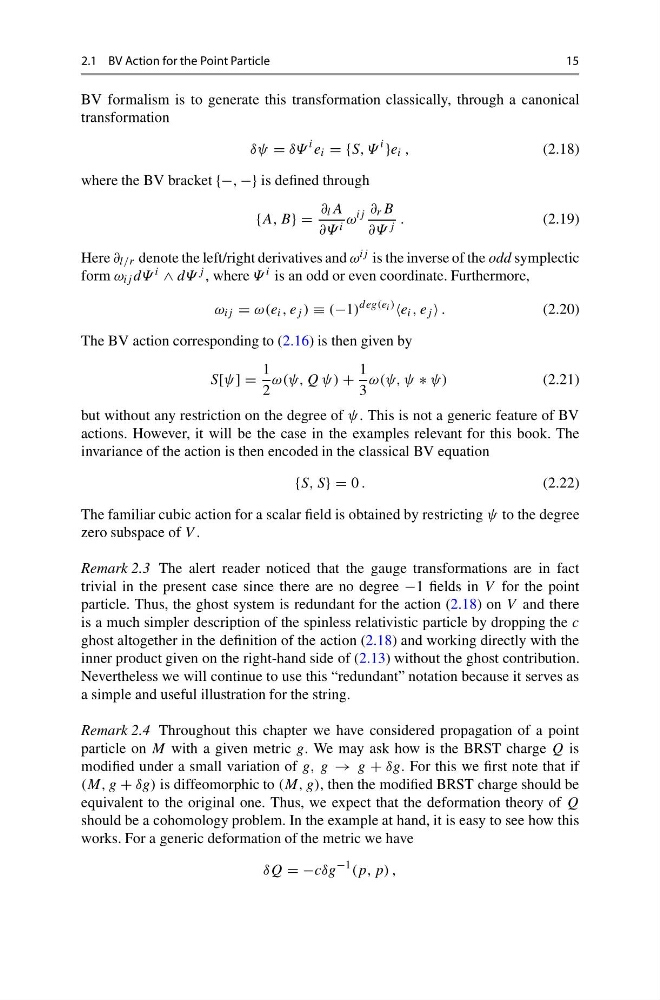
BV formalism is to generate this transformation classically, through a canonical
transformation
δψ = δΨ
i e i = {S, Ψ
i
}e i ,
(2.18)
where the BV bracket {−, −} is defined through
{A, B} =
∂ l A
∂Ψ i ω
ij ∂ r B
∂Ψ j .
(2.19)
Here ∂ l/r denote the left/right derivatives and ω ij is the inverse of the odd symplectic
form ω ij dΨ i ∧ dΨ j , where Ψ i is an odd or even coordinate. Furthermore,
ω ij = ω(e i , e j ) ≡ (−1)
deg(e i )
i , e j .
(2.20)
The BV action corresponding to (2.16) is then given by
S[ψ] =
1
2
ω(ψ, Q ψ) +
1
3
ω(ψ, ψ ∗ ψ)
(2.21)
but without any restriction on the degree of ψ. This is not a generic feature of BV
actions. However, it will be the case in the examples relevant for this book. The
invariance of the action is then encoded in the classical BV equation
{S, S} = 0 .
(2.22)
The familiar cubic action for a scalar field is obtained by restricting ψ to the degree
zero subspace of V .
Remark 2.3 The alert reader noticed that the gauge transformations are in fact
trivial in the present case since there are no degree −1 fields in V for the point
particle. Thus, the ghost system is redundant for the action (2.18) on V and there
is a much simpler description of the spinless relativistic particle by dropping the c
ghost altogether in the definition of the action (2.18) and working directly with the
inner product given on the right-hand side of (2.13) without the ghost contribution.
Nevertheless we will continue to use this “redundant” notation because it serves as
a simple and useful illustration for the string.
Remark 2.4 Throughout this chapter we have considered propagation of a point
particle on M with a given metric g. We may ask how is the BRST charge Q is
modified under a small variation of g, g → g + δg. For this we first note that if
(M, g + δg) is diffeomorphic to (M, g), then the modified BRST charge should be
equivalent to the original one. Thus, we expect that the deformation theory of Q
should be a cohomology problem. In the example at hand, it is easy to see how this
works. For a generic deformation of the metric we have
δQ = −cδg
−1 (p, p) ,
15
BV formalism is to generate this transformation classically, through a canonical
transformation
δψ = δΨ
i e i = {S, Ψ
i
}e i ,
(2.18)
where the BV bracket {−, −} is defined through
{A, B} =
∂ l A
∂Ψ i ω
ij ∂ r B
∂Ψ j .
(2.19)
Here ∂ l/r denote the left/right derivatives and ω ij is the inverse of the odd symplectic
form ω ij dΨ i ∧ dΨ j , where Ψ i is an odd or even coordinate. Furthermore,
ω ij = ω(e i , e j ) ≡ (−1)
deg(e i )
i , e j .
(2.20)
The BV action corresponding to (2.16) is then given by
S[ψ] =
1
2
ω(ψ, Q ψ) +
1
3
ω(ψ, ψ ∗ ψ)
(2.21)
but without any restriction on the degree of ψ. This is not a generic feature of BV
actions. However, it will be the case in the examples relevant for this book. The
invariance of the action is then encoded in the classical BV equation
{S, S} = 0 .
(2.22)
The familiar cubic action for a scalar field is obtained by restricting ψ to the degree
zero subspace of V .
Remark 2.3 The alert reader noticed that the gauge transformations are in fact
trivial in the present case since there are no degree −1 fields in V for the point
particle. Thus, the ghost system is redundant for the action (2.18) on V and there
is a much simpler description of the spinless relativistic particle by dropping the c
ghost altogether in the definition of the action (2.18) and working directly with the
inner product given on the right-hand side of (2.13) without the ghost contribution.
Nevertheless we will continue to use this “redundant” notation because it serves as
a simple and useful illustration for the string.
Remark 2.4 Throughout this chapter we have considered propagation of a point
particle on M with a given metric g. We may ask how is the BRST charge Q is
modified under a small variation of g, g → g + δg. For this we first note that if
(M, g + δg) is diffeomorphic to (M, g), then the modified BRST charge should be
equivalent to the original one. Thus, we expect that the deformation theory of Q
should be a cohomology problem. In the example at hand, it is easy to see how this
works. For a generic deformation of the metric we have
δQ = −cδg
−1 (p, p) ,