

8.1 BV Algebras and the Master Equation
189
Let us verify (8.7). A tedious but straightforward calculation yields that, for f ∈
MT(n 1 ; g 1 ) and g ∈ MT(n 2 ; g 2 ),
Δ{f, g} =
1 + 2 2 + 3
(f ⊗ g),
(8.10)
where
1 :=
S 1 S 2 =[n 1 +n 2 −4]
◦ uv a ◦ b ⊗ • uv a • b
τ (θ
1 ⊗ θ
1 ⊗ θ
2 ⊗ θ
2 )
2 :=
S 1 S 2 =[n 1 +n 2 −4]
◦ uv a ◦ b ⊗ • uv a • b
τ (θ 1 ⊗ θ 1 ⊗ θ 2 ⊗ θ 2 )
3 :=
S 1 S 2 =[n 1 +n 2 −4]
◦ uv a ◦ b ⊗ • uv a • b
τ (θ
1 ⊗ θ
1 ⊗ θ
2 ⊗ θ
2 )
where the bijections
θ
1 : [n 1 ]
∼ =
− → S 1 {a, u, v}, θ
2 : [n 2 ]
∼ =
− → S 2 {b} in 1 ,
θ 1 : [n 1 ]
∼ =
− → S 1 {a, u}, θ 2 : [n 2 ]
∼ =
− → S 2 {b, v} in 2 , and
θ
1 : [n 1 ]
∼ =
− → S 1 {a}, θ
2 : [n 2 ]
∼ =
− → S 2 {b, u, v} in 3 ,
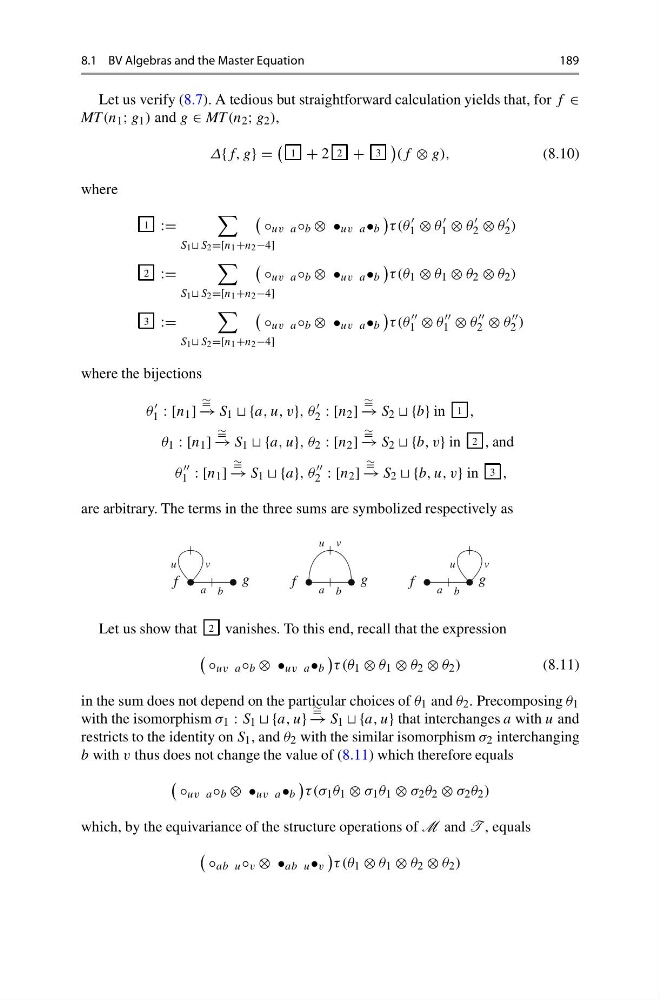
are arbitrary. The terms in the three sums are symbolized respectively as
a b
u
f
g
v
a b
u
f
g
v
a b
u
f
g
v
Let us show that 2 vanishes. To this end, recall that the expression
◦ uv a ◦ b ⊗ • uv a • b
τ (θ 1 ⊗ θ 1 ⊗ θ 2 ⊗ θ 2 )
(8.11)
in the sum does not depend on the particular choices of θ 1 and θ 2 . Precomposing θ 1
with the isomorphism σ 1 : S 1 {a, u}
∼ =
− → S 1 {a, u} that interchanges a with u and
restricts to the identity on S 1 , and θ 2 with the similar isomorphism σ 2 interchanging
b with v thus does not change the value of (8.11) which therefore equals
◦ uv a ◦ b ⊗ • uv a • b
τ (σ 1 θ 1 ⊗ σ 1 θ 1 ⊗ σ 2 θ 2 ⊗ σ 2 θ 2 )
which, by the equivariance of the structure operations of M and T , equals
◦ ab u ◦ v ⊗ • ab u • v
τ (θ 1 ⊗ θ 1 ⊗ θ 2 ⊗ θ 2 )
189
Let us verify (8.7). A tedious but straightforward calculation yields that, for f ∈
MT(n 1 ; g 1 ) and g ∈ MT(n 2 ; g 2 ),
Δ{f, g} =
1 + 2 2 + 3
(f ⊗ g),
(8.10)
where
1 :=
S 1 S 2 =[n 1 +n 2 −4]
◦ uv a ◦ b ⊗ • uv a • b
τ (θ
1 ⊗ θ
1 ⊗ θ
2 ⊗ θ
2 )
2 :=
S 1 S 2 =[n 1 +n 2 −4]
◦ uv a ◦ b ⊗ • uv a • b
τ (θ 1 ⊗ θ 1 ⊗ θ 2 ⊗ θ 2 )
3 :=
S 1 S 2 =[n 1 +n 2 −4]
◦ uv a ◦ b ⊗ • uv a • b
τ (θ
1 ⊗ θ
1 ⊗ θ
2 ⊗ θ
2 )
where the bijections
θ
1 : [n 1 ]
∼ =
− → S 1 {a, u, v}, θ
2 : [n 2 ]
∼ =
− → S 2 {b} in 1 ,
θ 1 : [n 1 ]
∼ =
− → S 1 {a, u}, θ 2 : [n 2 ]
∼ =
− → S 2 {b, v} in 2 , and
θ
1 : [n 1 ]
∼ =
− → S 1 {a}, θ
2 : [n 2 ]
∼ =
− → S 2 {b, u, v} in 3 ,
are arbitrary. The terms in the three sums are symbolized respectively as
a b
u
f
g
v
a b
u
f
g
v
a b
u
f
g
v
Let us show that 2 vanishes. To this end, recall that the expression
◦ uv a ◦ b ⊗ • uv a • b
τ (θ 1 ⊗ θ 1 ⊗ θ 2 ⊗ θ 2 )
(8.11)
in the sum does not depend on the particular choices of θ 1 and θ 2 . Precomposing θ 1
with the isomorphism σ 1 : S 1 {a, u}
∼ =
− → S 1 {a, u} that interchanges a with u and
restricts to the identity on S 1 , and θ 2 with the similar isomorphism σ 2 interchanging
b with v thus does not change the value of (8.11) which therefore equals
◦ uv a ◦ b ⊗ • uv a • b
τ (σ 1 θ 1 ⊗ σ 1 θ 1 ⊗ σ 2 θ 2 ⊗ σ 2 θ 2 )
which, by the equivariance of the structure operations of M and T , equals
◦ ab u ◦ v ⊗ • ab u • v
τ (θ 1 ⊗ θ 1 ⊗ θ 2 ⊗ θ 2 )