

188
8 Structures Relevant to Physics
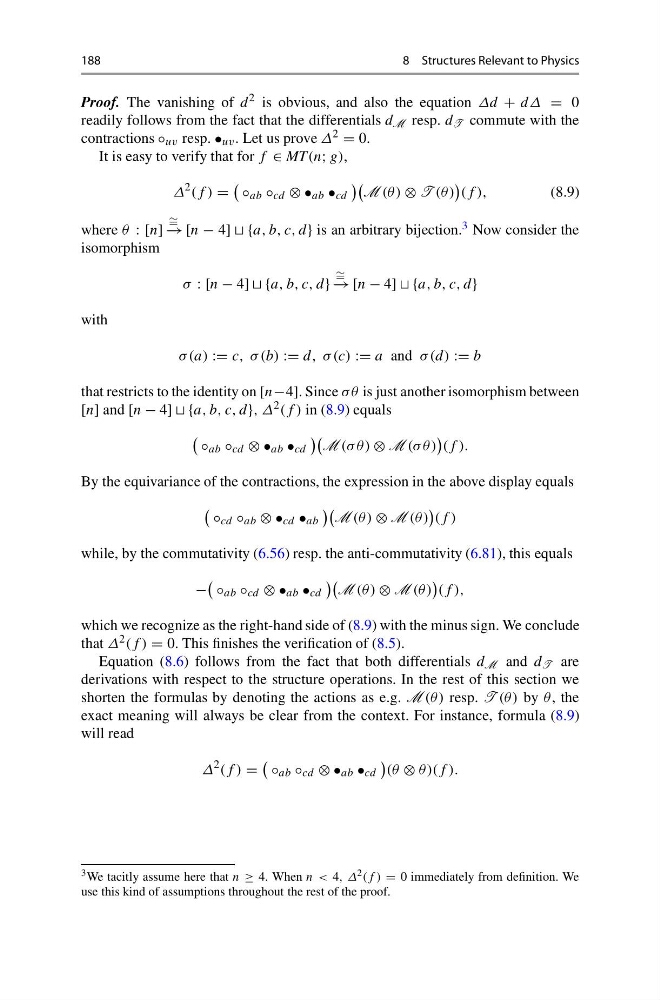
Proof. The vanishing of d 2 is obvious, and also the equation Δd + dΔ = 0
readily follows from the fact that the differentials d M resp. d T commute with the
contractions ◦ uv resp. • uv . Let us prove Δ 2 = 0.
It is easy to verify that for f ∈ MT(n; g),
Δ
2 (f ) =
◦ ab ◦ cd ⊗ • ab • cd
M (θ ) ⊗ T (θ )
(f ),
(8.9)
where θ : [n]
∼ =
− → [n − 4] ] {a, b, c, d} is an arbitrary bijection. 3 Now consider the
isomorphism
σ : [n − 4] ] {a, b, c, d}
∼ =
− → [n − 4] ] {a, b, c, d}
with
σ (a) := c, σ (b) := d, σ (c) := a and σ (d) := b
that restricts to the identity on [n−4]. Since σ θ is just another isomorphism between
[n] and [n − 4] ] {a, b, c, d}, Δ 2 (f ) in (8.9) equals
◦ ab ◦ cd ⊗ • ab • cd
M (σ θ ) ⊗ M (σ θ )
(f ).
By the equivariance of the contractions, the expression in the above display equals
◦ cd ◦ ab ⊗ • cd • ab
M (θ ) ⊗ M (θ )
(f )
while, by the commutativity (6.56) resp. the anti-commutativity (6.81), this equals
−
◦ ab ◦ cd ⊗ • ab • cd
M (θ ) ⊗ M (θ )
(f ),
which we recognize as the right-hand side of (8.9) with the minus sign. We conclude
that Δ 2 (f ) = 0. This finishes the verification of (8.5).
Equation (8.6) follows from the fact that both differentials d M and d T are
derivations with respect to the structure operations. In the rest of this section we
shorten the formulas by denoting the actions as e.g. M (θ ) resp. T (θ ) by θ , the
exact meaning will always be clear from the context. For instance, formula (8.9)
will read
Δ
2 (f ) =
◦ ab ◦ cd ⊗ • ab • cd
(θ ⊗ θ )(f ).
3 We tacitly assume here that n ≥ 4. When n < 4, Δ 2 (f ) = 0 immediately from definition. We
use this kind of assumptions throughout the rest of the proof.
8 Structures Relevant to Physics
Proof. The vanishing of d 2 is obvious, and also the equation Δd + dΔ = 0
readily follows from the fact that the differentials d M resp. d T commute with the
contractions ◦ uv resp. • uv . Let us prove Δ 2 = 0.
It is easy to verify that for f ∈ MT(n; g),
Δ
2 (f ) =
◦ ab ◦ cd ⊗ • ab • cd
M (θ ) ⊗ T (θ )
(f ),
(8.9)
where θ : [n]
∼ =
− → [n − 4] ] {a, b, c, d} is an arbitrary bijection. 3 Now consider the
isomorphism
σ : [n − 4] ] {a, b, c, d}
∼ =
− → [n − 4] ] {a, b, c, d}
with
σ (a) := c, σ (b) := d, σ (c) := a and σ (d) := b
that restricts to the identity on [n−4]. Since σ θ is just another isomorphism between
[n] and [n − 4] ] {a, b, c, d}, Δ 2 (f ) in (8.9) equals
◦ ab ◦ cd ⊗ • ab • cd
M (σ θ ) ⊗ M (σ θ )
(f ).
By the equivariance of the contractions, the expression in the above display equals
◦ cd ◦ ab ⊗ • cd • ab
M (θ ) ⊗ M (θ )
(f )
while, by the commutativity (6.56) resp. the anti-commutativity (6.81), this equals
−
◦ ab ◦ cd ⊗ • ab • cd
M (θ ) ⊗ M (θ )
(f ),
which we recognize as the right-hand side of (8.9) with the minus sign. We conclude
that Δ 2 (f ) = 0. This finishes the verification of (8.5).
Equation (8.6) follows from the fact that both differentials d M and d T are
derivations with respect to the structure operations. In the rest of this section we
shorten the formulas by denoting the actions as e.g. M (θ ) resp. T (θ ) by θ , the
exact meaning will always be clear from the context. For instance, formula (8.9)
will read
Δ
2 (f ) =
◦ ab ◦ cd ⊗ • ab • cd
(θ ⊗ θ )(f ).
3 We tacitly assume here that n ≥ 4. When n < 4, Δ 2 (f ) = 0 immediately from definition. We
use this kind of assumptions throughout the rest of the proof.