

7.2 Feynman Transform
181
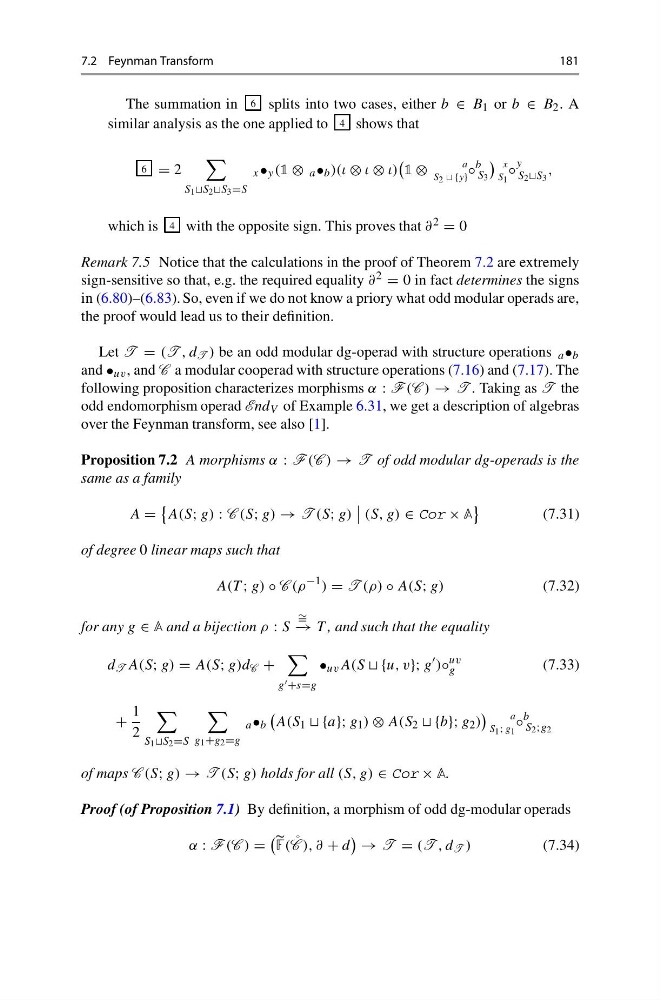
The summation in 6 splits into two cases, either b ∈ B 1 or b ∈ B 2 . A
similar analysis as the one applied to 4 shows that
6 = 2
S 1 2 3 =S
x • y (1 ⊗ a • b )(ι ⊗ ι ⊗ ι)
1 ⊗
a
S 2 {y}
◦
b
S 3
x
S 1
◦
y
S 2 3
,
which is 4 with the opposite sign. This proves that ∂ 2 = 0
Remark 7.5 Notice that the calculations in the proof of Theorem 7.2 are extremely
sign-sensitive so that, e.g. the required equality ∂ 2 = 0 in fact determines the signs
in (6.80)–(6.83). So, even if we do not know a priory what odd modular operads are,
the proof would lead us to their definition.
Let T = (T , d T ) be an odd modular dg-operad with structure operations a • b
and • uv , and C a modular cooperad with structure operations (7.16) and (7.17). The
following proposition characterizes morphisms α : F (C ) → T . Taking as T the
odd endomorphism operad End V of Example 6.31, we get a description of algebras
over the Feynman transform, see also [1].
Proposition 7.2 A morphisms α : F (C ) → T of odd modular dg-operads is the
same as a family
A =
A(S; g) : C (S; g) → T (S; g)
(S, g) ∈ Cor × A
(7.31)
of degree 0 linear maps such that
A(T ; g) ◦ C (ρ
−1 ) = T (ρ) ◦ A(S; g)
(7.32)
for any g ∈ A and a bijection ρ : S
∼ =
− → T , and such that the equality
d T A(S; g) = A(S; g)d C +
g +s=g
• uv A(S {u, v}; g
)◦
uv
g
(7.33)
+
1
2
S 1 2 =S
g 1 +g 2 =g
a • b
A(S 1 {a}; g 1 ) ⊗ A(S 2 {b}; g 2 )
a
S 1 ; g 1
◦
b
S 2 ;g 2
of maps C (S; g) → T (S; g) holds for all (S, g) ∈ Cor × A.
Proof (of Proposition 7.1) By definition, a morphism of odd dg-modular operads
α : F (C ) =
F( ˚
C ), ∂ + d
→ T = (T , d T )
(7.34)
181
The summation in 6 splits into two cases, either b ∈ B 1 or b ∈ B 2 . A
similar analysis as the one applied to 4 shows that
6 = 2
S 1 2 3 =S
x • y (1 ⊗ a • b )(ι ⊗ ι ⊗ ι)
1 ⊗
a
S 2 {y}
◦
b
S 3
x
S 1
◦
y
S 2 3
,
which is 4 with the opposite sign. This proves that ∂ 2 = 0
Remark 7.5 Notice that the calculations in the proof of Theorem 7.2 are extremely
sign-sensitive so that, e.g. the required equality ∂ 2 = 0 in fact determines the signs
in (6.80)–(6.83). So, even if we do not know a priory what odd modular operads are,
the proof would lead us to their definition.
Let T = (T , d T ) be an odd modular dg-operad with structure operations a • b
and • uv , and C a modular cooperad with structure operations (7.16) and (7.17). The
following proposition characterizes morphisms α : F (C ) → T . Taking as T the
odd endomorphism operad End V of Example 6.31, we get a description of algebras
over the Feynman transform, see also [1].
Proposition 7.2 A morphisms α : F (C ) → T of odd modular dg-operads is the
same as a family
A =
A(S; g) : C (S; g) → T (S; g)
(S, g) ∈ Cor × A
(7.31)
of degree 0 linear maps such that
A(T ; g) ◦ C (ρ
−1 ) = T (ρ) ◦ A(S; g)
(7.32)
for any g ∈ A and a bijection ρ : S
∼ =
− → T , and such that the equality
d T A(S; g) = A(S; g)d C +
g +s=g
• uv A(S {u, v}; g
)◦
uv
g
(7.33)
+
1
2
S 1 2 =S
g 1 +g 2 =g
a • b
A(S 1 {a}; g 1 ) ⊗ A(S 2 {b}; g 2 )
a
S 1 ; g 1
◦
b
S 2 ;g 2
of maps C (S; g) → T (S; g) holds for all (S, g) ∈ Cor × A.
Proof (of Proposition 7.1) By definition, a morphism of odd dg-modular operads
α : F (C ) =
F( ˚
C ), ∂ + d
→ T = (T , d T )
(7.34)