

178
7 Feynman Transform of a Modular Operad
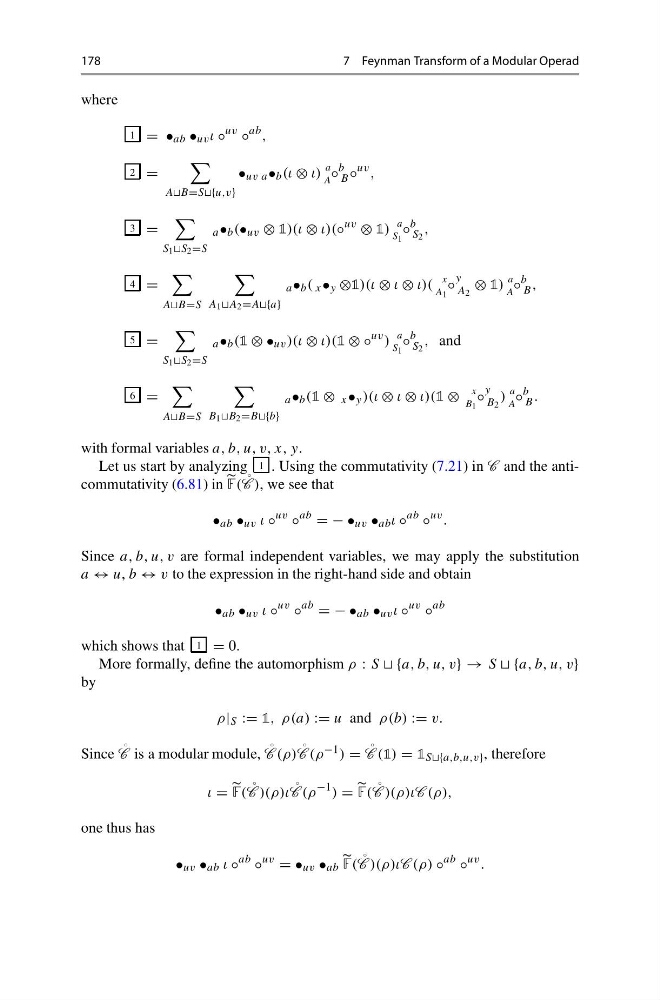
where
1 = • ab • uv ι ◦
uv
◦
ab ,
2 =
A
• uv a • b (ι ⊗ ι)
a
A
◦
b
B ◦
uv ,
3 =
S 1 2 =S
a • b (• uv ⊗ 1)(ι ⊗ ι)(◦
uv
⊗ 1)
a
S 1
◦
b
S 2
,
4 =
A
A 1 2 =A
a • b ( x • y ⊗1)(ι ⊗ ι ⊗ ι)(
x
A 1
◦
y
A 2
⊗ 1)
a
A
◦
b
B ,
5 =
S 1 2 =S
a • b (1 ⊗ • uv )(ι ⊗ ι)(1 ⊗ ◦
uv )
a
S 1
◦
b
S 2
, and
6 =
A
B 1 2 =B
a • b (1 ⊗ x • y )(ι ⊗ ι ⊗ ι)(1 ⊗
x
B 1
◦
y
B 2
)
a
A
◦
b
B .
with formal variables a, b, u, v, x, y.
Let us start by analyzing 1 . Using the commutativity (7.21) in C and the anticommutativity (6.81) in F( ˚
C ), we see that
• ab • uv ι ◦
uv
◦
ab
= − • uv • ab ι ◦
ab
◦
uv .
Since a, b, u, v are formal independent variables, we may apply the substitution
a ↔ u, b ↔ v to the expression in the right-hand side and obtain
• ab • uv ι ◦
uv
◦
ab
= − • ab • uv ι ◦
uv
◦
ab
which shows that 1 = 0.
More formally, define the automorphism ρ : S {a, b, u, v} → S {a, b, u, v}
by
ρ| S := 1, ρ(a) := u and ρ(b) := v.
Since ˚
C is a modular module, ˚
C (ρ) ˚
C (ρ −1 ) = ˚
C (1) = 1 S{a,b,u,v} , therefore
ι = F( ˚
C )(ρ)ι ˚
C (ρ
−1 ) = F( ˚
C )(ρ)ιC (ρ),
one thus has
• uv • ab ι ◦
ab
◦
uv
= • uv • ab F( ˚
C )(ρ)ιC (ρ) ◦
ab
◦
uv .
7 Feynman Transform of a Modular Operad
where
1 = • ab • uv ι ◦
uv
◦
ab ,
2 =
A
• uv a • b (ι ⊗ ι)
a
A
◦
b
B ◦
uv ,
3 =
S 1 2 =S
a • b (• uv ⊗ 1)(ι ⊗ ι)(◦
uv
⊗ 1)
a
S 1
◦
b
S 2
,
4 =
A
A 1 2 =A
a • b ( x • y ⊗1)(ι ⊗ ι ⊗ ι)(
x
A 1
◦
y
A 2
⊗ 1)
a
A
◦
b
B ,
5 =
S 1 2 =S
a • b (1 ⊗ • uv )(ι ⊗ ι)(1 ⊗ ◦
uv )
a
S 1
◦
b
S 2
, and
6 =
A
B 1 2 =B
a • b (1 ⊗ x • y )(ι ⊗ ι ⊗ ι)(1 ⊗
x
B 1
◦
y
B 2
)
a
A
◦
b
B .
with formal variables a, b, u, v, x, y.
Let us start by analyzing 1 . Using the commutativity (7.21) in C and the anticommutativity (6.81) in F( ˚
C ), we see that
• ab • uv ι ◦
uv
◦
ab
= − • uv • ab ι ◦
ab
◦
uv .
Since a, b, u, v are formal independent variables, we may apply the substitution
a ↔ u, b ↔ v to the expression in the right-hand side and obtain
• ab • uv ι ◦
uv
◦
ab
= − • ab • uv ι ◦
uv
◦
ab
which shows that 1 = 0.
More formally, define the automorphism ρ : S {a, b, u, v} → S {a, b, u, v}
by
ρ| S := 1, ρ(a) := u and ρ(b) := v.
Since ˚
C is a modular module, ˚
C (ρ) ˚
C (ρ −1 ) = ˚
C (1) = 1 S{a,b,u,v} , therefore
ι = F( ˚
C )(ρ)ι ˚
C (ρ
−1 ) = F( ˚
C )(ρ)ιC (ρ),
one thus has
• uv • ab ι ◦
ab
◦
uv
= • uv • ab F( ˚
C )(ρ)ιC (ρ) ◦
ab
◦
uv .