

7.2 Feynman Transform
177
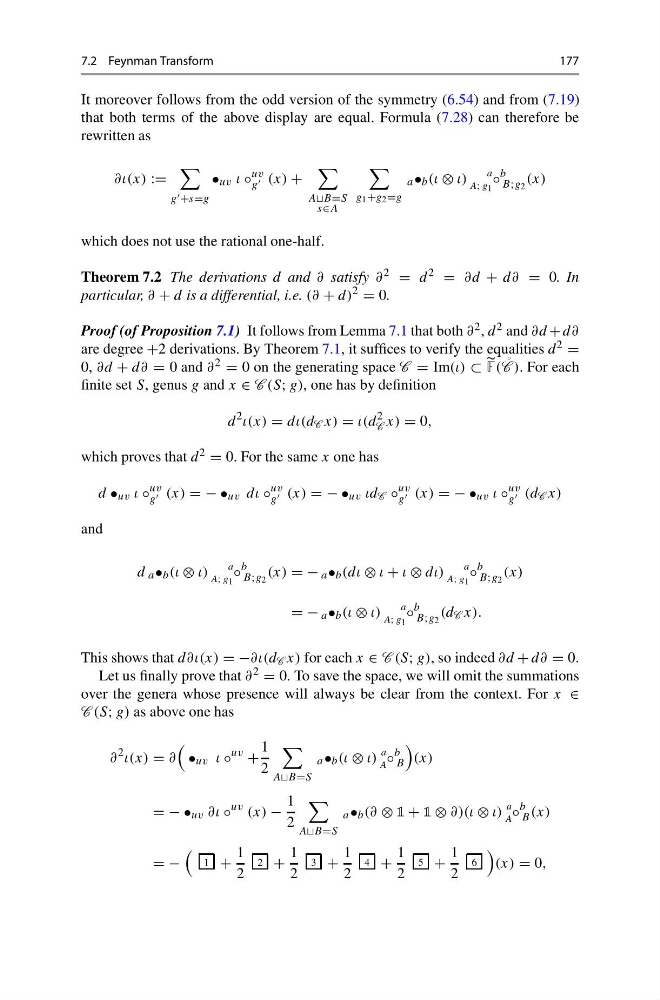
It moreover follows from the odd version of the symmetry (6.54) and from (7.19)
that both terms of the above display are equal. Formula (7.28) can therefore be
rewritten as
∂ι(x) :=
g +s=g
• uv ι ◦
uv
g (x) +
A
s∈A
g 1 +g 2 =g
a • b (ι ⊗ ι)
a
A; g 1
◦
b
B;g 2
(x)
which does not use the rational one-half.
Theorem 7.2 The derivations d and ∂ satisfy ∂ 2 = d 2 = ∂d + d∂ = 0. In
particular, ∂ + d is a differential, i.e. (∂ + d) 2 = 0.
Proof (of Proposition 7.1) It follows from Lemma 7.1 that both ∂ 2 , d 2 and ∂d + d∂
are degree +2 derivations. By Theorem 7.1, it suffices to verify the equalities d 2 =
0, ∂d + d∂ = 0 and ∂ 2 = 0 on the generating space C = Im(ι) ⊂ F( ˚
C ). For each
finite set S, genus g and x ∈ C (S; g), one has by definition
d
2 ι(x) = dι(d C x) = ι(d
2
C x) = 0,
which proves that d 2 = 0. For the same x one has
d • uv ι ◦
uv
g (x) = − • uv dι ◦
uv
g (x) = − • uv ιd C ◦
uv
g (x) = − • uv ι ◦
uv
g (d C x)
and
d a • b (ι ⊗ ι)
a
A; g 1
◦
b
B;g 2
(x) = − a • b (dι ⊗ ι + ι ⊗ dι)
a
A; g 1
◦
b
B;g 2
(x)
= − a • b (ι ⊗ ι)
a
A; g 1
◦
b
B;g 2
(d C x).
This shows that d∂ι(x) = −∂ι(d C x) for each x ∈ C (S; g), so indeed ∂d + d∂ = 0.
Let us finally prove that ∂ 2 = 0. To save the space, we will omit the summations
over the genera whose presence will always be clear from the context. For x ∈
C (S; g) as above one has
∂
2 ι(x) = ∂
• uv ι ◦
uv
+
1
2
A
a • b (ι ⊗ ι)
a
A
◦
b
B
(x)
= − • uv ∂ι ◦
uv (x) −
1
2
A
a • b (∂ ⊗ 1 + 1 ⊗ ∂)(ι ⊗ ι)
a
A
◦
b
B (x)
= −
1 +
1
2
2 +
1
2
3 +
1
2
4 +
1
2
5 +
1
2
6
(x) = 0,
177
It moreover follows from the odd version of the symmetry (6.54) and from (7.19)
that both terms of the above display are equal. Formula (7.28) can therefore be
rewritten as
∂ι(x) :=
g +s=g
• uv ι ◦
uv
g (x) +
A
s∈A
g 1 +g 2 =g
a • b (ι ⊗ ι)
a
A; g 1
◦
b
B;g 2
(x)
which does not use the rational one-half.
Theorem 7.2 The derivations d and ∂ satisfy ∂ 2 = d 2 = ∂d + d∂ = 0. In
particular, ∂ + d is a differential, i.e. (∂ + d) 2 = 0.
Proof (of Proposition 7.1) It follows from Lemma 7.1 that both ∂ 2 , d 2 and ∂d + d∂
are degree +2 derivations. By Theorem 7.1, it suffices to verify the equalities d 2 =
0, ∂d + d∂ = 0 and ∂ 2 = 0 on the generating space C = Im(ι) ⊂ F( ˚
C ). For each
finite set S, genus g and x ∈ C (S; g), one has by definition
d
2 ι(x) = dι(d C x) = ι(d
2
C x) = 0,
which proves that d 2 = 0. For the same x one has
d • uv ι ◦
uv
g (x) = − • uv dι ◦
uv
g (x) = − • uv ιd C ◦
uv
g (x) = − • uv ι ◦
uv
g (d C x)
and
d a • b (ι ⊗ ι)
a
A; g 1
◦
b
B;g 2
(x) = − a • b (dι ⊗ ι + ι ⊗ dι)
a
A; g 1
◦
b
B;g 2
(x)
= − a • b (ι ⊗ ι)
a
A; g 1
◦
b
B;g 2
(d C x).
This shows that d∂ι(x) = −∂ι(d C x) for each x ∈ C (S; g), so indeed ∂d + d∂ = 0.
Let us finally prove that ∂ 2 = 0. To save the space, we will omit the summations
over the genera whose presence will always be clear from the context. For x ∈
C (S; g) as above one has
∂
2 ι(x) = ∂
• uv ι ◦
uv
+
1
2
A
a • b (ι ⊗ ι)
a
A
◦
b
B
(x)
= − • uv ∂ι ◦
uv (x) −
1
2
A
a • b (∂ ⊗ 1 + 1 ⊗ ∂)(ι ⊗ ι)
a
A
◦
b
B (x)
= −
1 +
1
2
2 +
1
2
3 +
1
2
4 +
1
2
5 +
1
2
6
(x) = 0,