

124
6 Operads
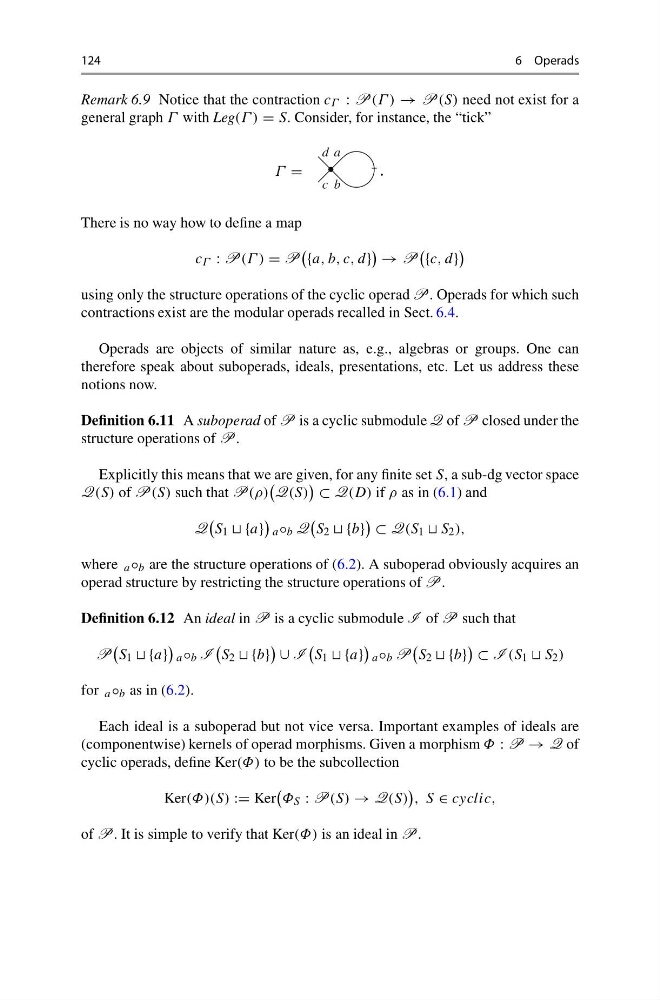
Remark 6.9 Notice that the contraction c Γ : P(Γ ) → P(S) need not exist for a
general graph Γ with Leg(Γ ) = S. Consider, for instance, the “tick”
a
d
b
c
.
Γ =
There is no way how to define a map
c Γ : P(Γ ) = P
{a, b, c, d}
→ P
{c, d}
using only the structure operations of the cyclic operad P. Operads for which such
contractions exist are the modular operads recalled in Sect. 6.4.
Operads are objects of similar nature as, e.g., algebras or groups. One can
therefore speak about suboperads, ideals, presentations, etc. Let us address these
notions now.
Definition 6.11 A suboperad of P is a cyclic submodule Q of P closed under the
structure operations of P.
Explicitly this means that we are given, for any finite set S, a sub-dg vector space
Q(S) of P(S) such that P(ρ)
Q(S)
⊂ Q(D) if ρ as in (6.1) and
Q
S 1 {a}
a ◦ b Q
S 2 {b}
⊂ Q(S 1 S 2 ),
where a ◦ b are the structure operations of (6.2). A suboperad obviously acquires an
operad structure by restricting the structure operations of P.
Definition 6.12 An ideal in P is a cyclic submodule I of P such that
P
S 1 {a}
a ◦ b I
S 2 {b}
∪ I
S 1 {a}
a ◦ b P
S 2 {b}
⊂ I (S 1 S 2 )
for a ◦ b as in (6.2).
Each ideal is a suboperad but not vice versa. Important examples of ideals are
(componentwise) kernels of operad morphisms. Given a morphism Φ : P → Q of
cyclic operads, define Ker(Φ) to be the subcollection
Ker(Φ)(S) := Ker
Φ S : P(S) → Q(S)
, S ∈ cyclic,
of P. It is simple to verify that Ker(Φ) is an ideal in P.
6 Operads
Remark 6.9 Notice that the contraction c Γ : P(Γ ) → P(S) need not exist for a
general graph Γ with Leg(Γ ) = S. Consider, for instance, the “tick”
a
d
b
c
.
Γ =
There is no way how to define a map
c Γ : P(Γ ) = P
{a, b, c, d}
→ P
{c, d}
using only the structure operations of the cyclic operad P. Operads for which such
contractions exist are the modular operads recalled in Sect. 6.4.
Operads are objects of similar nature as, e.g., algebras or groups. One can
therefore speak about suboperads, ideals, presentations, etc. Let us address these
notions now.
Definition 6.11 A suboperad of P is a cyclic submodule Q of P closed under the
structure operations of P.
Explicitly this means that we are given, for any finite set S, a sub-dg vector space
Q(S) of P(S) such that P(ρ)
Q(S)
⊂ Q(D) if ρ as in (6.1) and
Q
S 1 {a}
a ◦ b Q
S 2 {b}
⊂ Q(S 1 S 2 ),
where a ◦ b are the structure operations of (6.2). A suboperad obviously acquires an
operad structure by restricting the structure operations of P.
Definition 6.12 An ideal in P is a cyclic submodule I of P such that
P
S 1 {a}
a ◦ b I
S 2 {b}
∪ I
S 1 {a}
a ◦ b P
S 2 {b}
⊂ I (S 1 S 2 )
for a ◦ b as in (6.2).
Each ideal is a suboperad but not vice versa. Important examples of ideals are
(componentwise) kernels of operad morphisms. Given a morphism Φ : P → Q of
cyclic operads, define Ker(Φ) to be the subcollection
Ker(Φ)(S) := Ker
Φ S : P(S) → Q(S)
, S ∈ cyclic,
of P. It is simple to verify that Ker(Φ) is an ideal in P.