

74
4 Solid and Liquid Skins
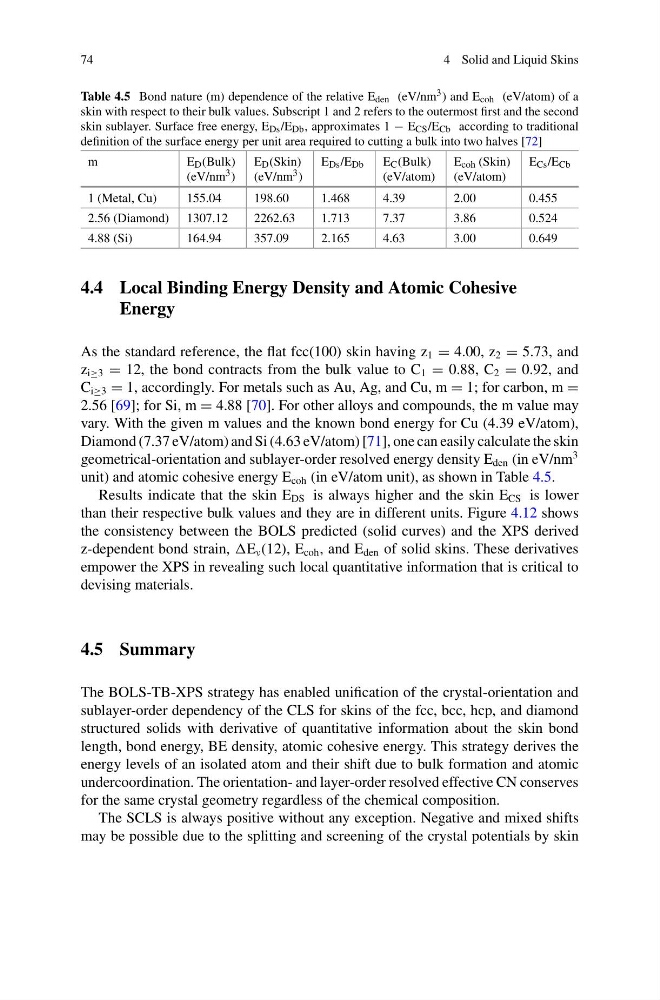
Table 4.5 Bond nature (m) dependence of the relative E den (eV/nm 3 ) and E coh (eV/atom) of a
skin with respect to their bulk values. Subscript 1 and 2 refers to the outermost first and the second
skin sublayer. Surface free energy, E Ds /E Db , approximates 1 − E CS /E Cb according to traditional
definition of the surface energy per unit area required to cutting a bulk into two halves [72]
m
E D (Bulk)
(eV/nm 3 )
E D (Skin)
(eV/nm 3 )
E Ds /E Db
E C (Bulk)
(eV/atom)
E coh (Skin)
(eV/atom)
E Cs /E Cb
1 (Metal, Cu)
155.04
198.60
1.468
4.39
2.00
0.455
2.56 (Diamond) 1307.12
2262.63
1.713
7.37
3.86
0.524
4.88 (Si)
164.94
357.09
2.165
4.63
3.00
0.649
4.4 Local Binding Energy Density and Atomic Cohesive
Energy
As the standard reference, the flat fcc(100) skin having z 1 = 4.00, z 2 = 5.73, and
z i≥3 = 12, the bond contracts from the bulk value to C 1 = 0.88, C 2 = 0.92, and
C i≥3 = 1, accordingly. For metals such as Au, Ag, and Cu, m = 1; for carbon, m =
2.56 [69]; for Si, m = 4.88 [70]. For other alloys and compounds, the m value may
vary. With the given m values and the known bond energy for Cu (4.39 eV/atom),
Diamond (7.37 eV/atom) and Si (4.63 eV/atom) [71], one can easily calculate the skin
geometrical-orientation and sublayer-order resolved energy density E den (in eV/nm
3
unit) and atomic cohesive energy E coh (in eV/atom unit), as shown in Table 4.5.
Results indicate that the skin E DS is always higher and the skin E CS is lower
than their respective bulk values and they are in different units. Figure 4.12 shows
the consistency between the BOLS predicted (solid curves) and the XPS derived
z-dependent bond strain, E ν (12), E coh , and E den of solid skins. These derivatives
empower the XPS in revealing such local quantitative information that is critical to
devising materials.
4.5 Summary
The BOLS-TB-XPS strategy has enabled unification of the crystal-orientation and
sublayer-order dependency of the CLS for skins of the fcc, bcc, hcp, and diamond
structured solids with derivative of quantitative information about the skin bond
length, bond energy, BE density, atomic cohesive energy. This strategy derives the
energy levels of an isolated atom and their shift due to bulk formation and atomic
undercoordination. The orientation- and layer-order resolved effective CN conserves
for the same crystal geometry regardless of the chemical composition.
The SCLS is always positive without any exception. Negative and mixed shifts
may be possible due to the splitting and screening of the crystal potentials by skin
4 Solid and Liquid Skins
Table 4.5 Bond nature (m) dependence of the relative E den (eV/nm 3 ) and E coh (eV/atom) of a
skin with respect to their bulk values. Subscript 1 and 2 refers to the outermost first and the second
skin sublayer. Surface free energy, E Ds /E Db , approximates 1 − E CS /E Cb according to traditional
definition of the surface energy per unit area required to cutting a bulk into two halves [72]
m
E D (Bulk)
(eV/nm 3 )
E D (Skin)
(eV/nm 3 )
E Ds /E Db
E C (Bulk)
(eV/atom)
E coh (Skin)
(eV/atom)
E Cs /E Cb
1 (Metal, Cu)
155.04
198.60
1.468
4.39
2.00
0.455
2.56 (Diamond) 1307.12
2262.63
1.713
7.37
3.86
0.524
4.88 (Si)
164.94
357.09
2.165
4.63
3.00
0.649
4.4 Local Binding Energy Density and Atomic Cohesive
Energy
As the standard reference, the flat fcc(100) skin having z 1 = 4.00, z 2 = 5.73, and
z i≥3 = 12, the bond contracts from the bulk value to C 1 = 0.88, C 2 = 0.92, and
C i≥3 = 1, accordingly. For metals such as Au, Ag, and Cu, m = 1; for carbon, m =
2.56 [69]; for Si, m = 4.88 [70]. For other alloys and compounds, the m value may
vary. With the given m values and the known bond energy for Cu (4.39 eV/atom),
Diamond (7.37 eV/atom) and Si (4.63 eV/atom) [71], one can easily calculate the skin
geometrical-orientation and sublayer-order resolved energy density E den (in eV/nm
3
unit) and atomic cohesive energy E coh (in eV/atom unit), as shown in Table 4.5.
Results indicate that the skin E DS is always higher and the skin E CS is lower
than their respective bulk values and they are in different units. Figure 4.12 shows
the consistency between the BOLS predicted (solid curves) and the XPS derived
z-dependent bond strain, E ν (12), E coh , and E den of solid skins. These derivatives
empower the XPS in revealing such local quantitative information that is critical to
devising materials.
4.5 Summary
The BOLS-TB-XPS strategy has enabled unification of the crystal-orientation and
sublayer-order dependency of the CLS for skins of the fcc, bcc, hcp, and diamond
structured solids with derivative of quantitative information about the skin bond
length, bond energy, BE density, atomic cohesive energy. This strategy derives the
energy levels of an isolated atom and their shift due to bulk formation and atomic
undercoordination. The orientation- and layer-order resolved effective CN conserves
for the same crystal geometry regardless of the chemical composition.
The SCLS is always positive without any exception. Negative and mixed shifts
may be possible due to the splitting and screening of the crystal potentials by skin