

4.3 Registry and Sublayer-Order Resolution
73
(a)
(b)
(c)
(d)
(e)
(f)
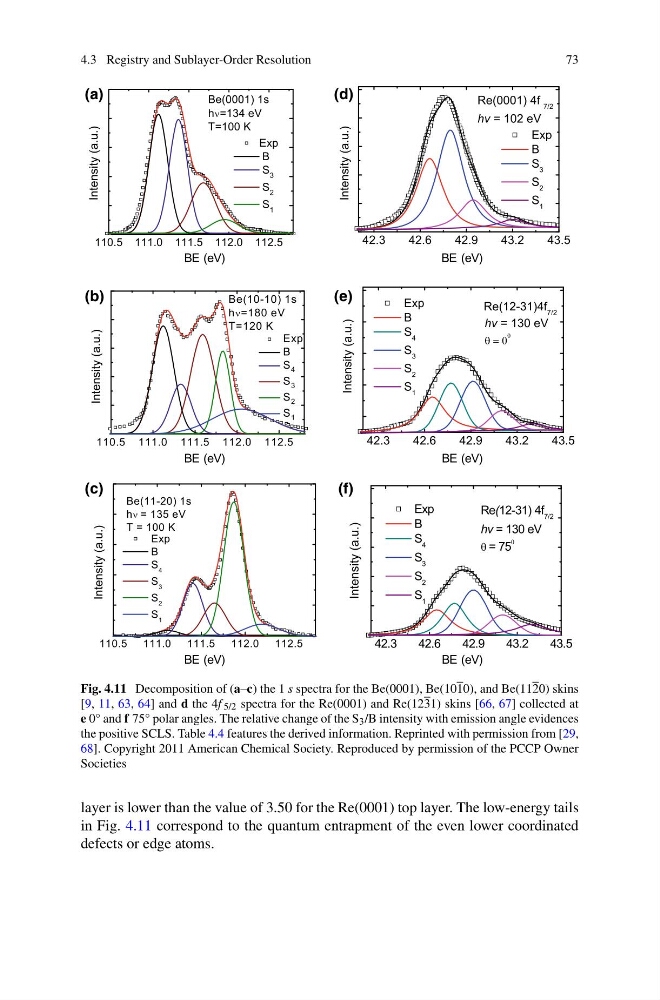
Fig. 4.11 Decomposition of (a–c) the 1 s spectra for the Be(0001), Be(1010), and Be(1120) skins
[9, 11, 63, 64] and d the 4f 5/2 spectra for the Re(0001) and Re(1231) skins [66, 67] collected at
e 0° and f 75° polar angles. The relative change of the S 3 /B intensity with emission angle evidences
the positive SCLS. Table 4.4 features the derived information. Reprinted with permission from [29,
68]. Copyright 2011 American Chemical Society. Reproduced by permission of the PCCP Owner
Societies
layer is lower than the value of 3.50 for the Re(0001) top layer. The low-energy tails
in Fig. 4.11 correspond to the quantum entrapment of the even lower coordinated
defects or edge atoms.
73
(a)
(b)
(c)
(d)
(e)
(f)
Fig. 4.11 Decomposition of (a–c) the 1 s spectra for the Be(0001), Be(1010), and Be(1120) skins
[9, 11, 63, 64] and d the 4f 5/2 spectra for the Re(0001) and Re(1231) skins [66, 67] collected at
e 0° and f 75° polar angles. The relative change of the S 3 /B intensity with emission angle evidences
the positive SCLS. Table 4.4 features the derived information. Reprinted with permission from [29,
68]. Copyright 2011 American Chemical Society. Reproduced by permission of the PCCP Owner
Societies
layer is lower than the value of 3.50 for the Re(0001) top layer. The low-energy tails
in Fig. 4.11 correspond to the quantum entrapment of the even lower coordinated
defects or edge atoms.