

3.4 APECS/XAS: Dual Energy-Level Shifts
51
E BL (0)
E BL (12)
E BL (2)
z(CN)
E BM (0)
E BM (12)
E BM (2)
(
)
(
)
45
BM
BL
M
BM
KM
BL
KM
KM
BM
E
E
E
E
E
Conservation
E
E
E
E
Derivative
φ
−
=
+
+ +
⎧
⎨ Δ
−Δ
=Δ
+Δ
⎩
(
)
2
'
2
BL
KL
BM
BL
KM
KL
KM
BM
E
E
E
E
E
E
E
E
α
Δ
=−Δ
⎧
⎨ Δ
=Δ
−Δ
⎩
Δ = − Δ
+Δ
= Δ
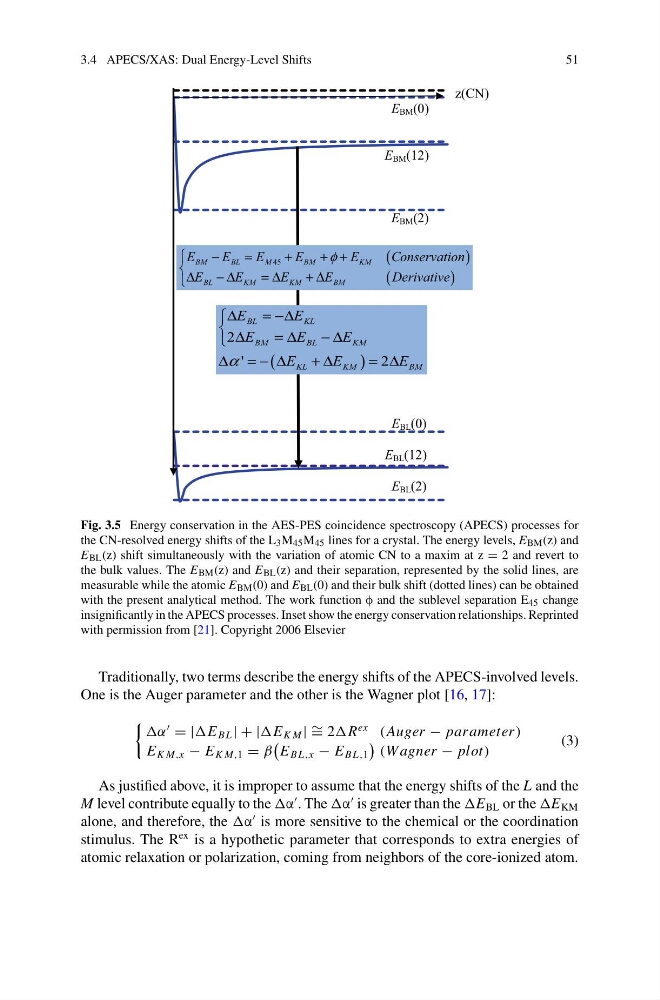
Fig. 3.5 Energy conservation in the AES-PES coincidence spectroscopy (APECS) processes for
the CN-resolved energy shifts of the L 3 M 45 M 45 lines for a crystal. The energy levels, E BM (z) and
E BL (z) shift simultaneously with the variation of atomic CN to a maxim at z = 2 and revert to
the bulk values. The E BM (z) and E BL (z) and their separation, represented by the solid lines, are
measurable while the atomic E BM (0) and E BL (0) and their bulk shift (dotted lines) can be obtained
with the present analytical method. The work function φ and the sublevel separation E 45 change
insignificantly in the APECS processes. Inset show the energy conservation relationships. Reprinted
with permission from [21]. Copyright 2006 Elsevier
Traditionally, two terms describe the energy shifts of the APECS-involved levels.
One is the Auger parameter and the other is the Wagner plot [16, 17]:
= | B L | + | K M | ∼ = 2
ex
(Auger − parameter)
E K M,x − E K M,1 = β
E B L,x − E B L,1
(W agner − plot)
(3)
As justified above, it is improper to assume that the energy shifts of the L and the
M level contribute equally to the
. The
is greater than the BL or the KM
alone, and therefore, the
is more sensitive to the chemical or the coordination
stimulus. The R
ex is a hypothetic parameter that corresponds to extra energies of
atomic relaxation or polarization, coming from neighbors of the core-ionized atom.
51
E BL (0)
E BL (12)
E BL (2)
z(CN)
E BM (0)
E BM (12)
E BM (2)
(
)
(
)
45
BM
BL
M
BM
KM
BL
KM
KM
BM
E
E
E
E
E
Conservation
E
E
E
E
Derivative
φ
−
=
+
+ +
⎧
⎨ Δ
−Δ
=Δ
+Δ
⎩
(
)
2
'
2
BL
KL
BM
BL
KM
KL
KM
BM
E
E
E
E
E
E
E
E
α
Δ
=−Δ
⎧
⎨ Δ
=Δ
−Δ
⎩
Δ = − Δ
+Δ
= Δ
Fig. 3.5 Energy conservation in the AES-PES coincidence spectroscopy (APECS) processes for
the CN-resolved energy shifts of the L 3 M 45 M 45 lines for a crystal. The energy levels, E BM (z) and
E BL (z) shift simultaneously with the variation of atomic CN to a maxim at z = 2 and revert to
the bulk values. The E BM (z) and E BL (z) and their separation, represented by the solid lines, are
measurable while the atomic E BM (0) and E BL (0) and their bulk shift (dotted lines) can be obtained
with the present analytical method. The work function φ and the sublevel separation E 45 change
insignificantly in the APECS processes. Inset show the energy conservation relationships. Reprinted
with permission from [21]. Copyright 2006 Elsevier
Traditionally, two terms describe the energy shifts of the APECS-involved levels.
One is the Auger parameter and the other is the Wagner plot [16, 17]:
= | B L | + | K M | ∼ = 2
ex
(Auger − parameter)
E K M,x − E K M,1 = β
E B L,x − E B L,1
(W agner − plot)
(3)
As justified above, it is improper to assume that the energy shifts of the L and the
M level contribute equally to the
. The
is greater than the BL or the KM
alone, and therefore, the
is more sensitive to the chemical or the coordination
stimulus. The R
ex is a hypothetic parameter that corresponds to extra energies of
atomic relaxation or polarization, coming from neighbors of the core-ionized atom.