

42
2 Theory: Bond-Electron-Energy Correlation
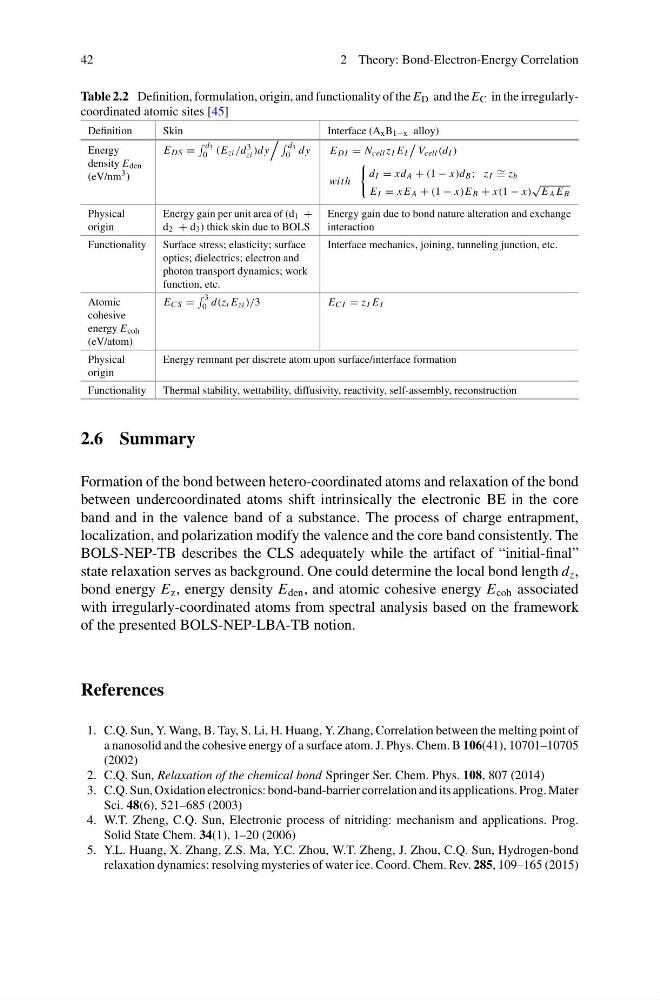
Table 2.2 Definition, formulation, origin, and functionality of the E D and the E C in the irregularlycoordinated atomic sites [45]
Definition
Skin
Interface (A x B 1−x alloy)
Energy
density E den
(eV/nm 3 )
E DS =
d3
0 (E zi /d 3
zi )dy
d3
0 dy
E DI = N cell z I E I
V cell (d I )
with
d I = xd A + (1 − x)d B ; z I ∼ = z b
E I = x E A + (1 − x)E B + x(1 − x)
√
E A E B
Physical
origin
Energy gain per unit area of (d 1 +
d 2 + d 3 ) thick skin due to BOLS
Energy gain due to bond nature alteration and exchange
interaction
Functionality
Surface stress; elasticity; surface
optics; dielectrics; electron and
photon transport dynamics; work
function, etc.
Interface mechanics, joining, tunneling junction, etc.
Atomic
cohesive
energy E coh
(eV/atom)
E C S =
3
0 d(z i E zi )/3
E C I = z I E I
Physical
origin
Energy remnant per discrete atom upon surface/interface formation
Functionality
Thermal stability, wettability, diffusivity, reactivity, self-assembly, reconstruction
2.6 Summary
Formation of the bond between hetero-coordinated atoms and relaxation of the bond
between undercoordinated atoms shift intrinsically the electronic BE in the core
band and in the valence band of a substance. The process of charge entrapment,
localization, and polarization modify the valence and the core band consistently. The
BOLS-NEP-TB describes the CLS adequately while the artifact of “initial-final”
state relaxation serves as background. One could determine the local bond length d z ,
bond energy E z , energy density E den , and atomic cohesive energy E coh associated
with irregularly-coordinated atoms from spectral analysis based on the framework
of the presented BOLS-NEP-LBA-TB notion.
References
1. C.Q. Sun, Y. Wang, B. Tay, S. Li, H. Huang, Y. Zhang, Correlation between the melting point of
a nanosolid and the cohesive energy of a surface atom. J. Phys. Chem. B 106(41), 10701–10705
(2002)
2. C.Q. Sun, Relaxation of the chemical bond Springer Ser. Chem. Phys. 108, 807 (2014)
3. C.Q. Sun, Oxidation electronics: bond-band-barrier correlation and its applications. Prog. Mater
Sci. 48(6), 521–685 (2003)
4. W.T. Zheng, C.Q. Sun, Electronic process of nitriding: mechanism and applications. Prog.
Solid State Chem. 34(1), 1–20 (2006)
5. Y.L. Huang, X. Zhang, Z.S. Ma, Y.C. Zhou, W.T. Zheng, J. Zhou, C.Q. Sun, Hydrogen-bond
relaxation dynamics: resolving mysteries of water ice. Coord. Chem. Rev. 285, 109–165 (2015)
2 Theory: Bond-Electron-Energy Correlation
Table 2.2 Definition, formulation, origin, and functionality of the E D and the E C in the irregularlycoordinated atomic sites [45]
Definition
Skin
Interface (A x B 1−x alloy)
Energy
density E den
(eV/nm 3 )
E DS =
d3
0 (E zi /d 3
zi )dy
d3
0 dy
E DI = N cell z I E I
V cell (d I )
with
d I = xd A + (1 − x)d B ; z I ∼ = z b
E I = x E A + (1 − x)E B + x(1 − x)
√
E A E B
Physical
origin
Energy gain per unit area of (d 1 +
d 2 + d 3 ) thick skin due to BOLS
Energy gain due to bond nature alteration and exchange
interaction
Functionality
Surface stress; elasticity; surface
optics; dielectrics; electron and
photon transport dynamics; work
function, etc.
Interface mechanics, joining, tunneling junction, etc.
Atomic
cohesive
energy E coh
(eV/atom)
E C S =
3
0 d(z i E zi )/3
E C I = z I E I
Physical
origin
Energy remnant per discrete atom upon surface/interface formation
Functionality
Thermal stability, wettability, diffusivity, reactivity, self-assembly, reconstruction
2.6 Summary
Formation of the bond between hetero-coordinated atoms and relaxation of the bond
between undercoordinated atoms shift intrinsically the electronic BE in the core
band and in the valence band of a substance. The process of charge entrapment,
localization, and polarization modify the valence and the core band consistently. The
BOLS-NEP-TB describes the CLS adequately while the artifact of “initial-final”
state relaxation serves as background. One could determine the local bond length d z ,
bond energy E z , energy density E den , and atomic cohesive energy E coh associated
with irregularly-coordinated atoms from spectral analysis based on the framework
of the presented BOLS-NEP-LBA-TB notion.
References
1. C.Q. Sun, Y. Wang, B. Tay, S. Li, H. Huang, Y. Zhang, Correlation between the melting point of
a nanosolid and the cohesive energy of a surface atom. J. Phys. Chem. B 106(41), 10701–10705
(2002)
2. C.Q. Sun, Relaxation of the chemical bond Springer Ser. Chem. Phys. 108, 807 (2014)
3. C.Q. Sun, Oxidation electronics: bond-band-barrier correlation and its applications. Prog. Mater
Sci. 48(6), 521–685 (2003)
4. W.T. Zheng, C.Q. Sun, Electronic process of nitriding: mechanism and applications. Prog.
Solid State Chem. 34(1), 1–20 (2006)
5. Y.L. Huang, X. Zhang, Z.S. Ma, Y.C. Zhou, W.T. Zheng, J. Zhou, C.Q. Sun, Hydrogen-bond
relaxation dynamics: resolving mysteries of water ice. Coord. Chem. Rev. 285, 109–165 (2015)