

2.3 BOLS-NEP-LBA Notion
35
above the open circles in the diagram, which modulates the band gap E g of a sized
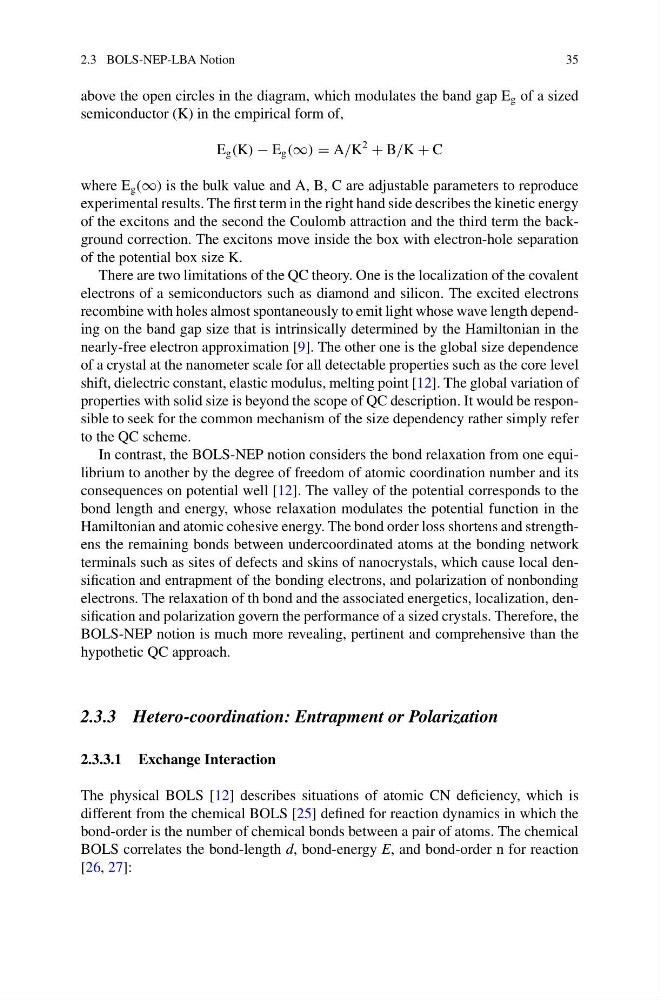
semiconductor (K) in the empirical form of,
E g (K) − E g (∞) = A/K
2
+ B/K + C
where E g (∞) is the bulk value and A, B, C are adjustable parameters to reproduce
experimental results. The first term in the right hand side describes the kinetic energy
of the excitons and the second the Coulomb attraction and the third term the background correction. The excitons move inside the box with electron-hole separation
of the potential box size K.
There are two limitations of the QC theory. One is the localization of the covalent
electrons of a semiconductors such as diamond and silicon. The excited electrons
recombine with holes almost spontaneously to emit light whose wave length depending on the band gap size that is intrinsically determined by the Hamiltonian in the
nearly-free electron approximation [9]. The other one is the global size dependence
of a crystal at the nanometer scale for all detectable properties such as the core level
shift, dielectric constant, elastic modulus, melting point [12]. The global variation of
properties with solid size is beyond the scope of QC description. It would be responsible to seek for the common mechanism of the size dependency rather simply refer
to the QC scheme.
In contrast, the BOLS-NEP notion considers the bond relaxation from one equilibrium to another by the degree of freedom of atomic coordination number and its
consequences on potential well [12]. The valley of the potential corresponds to the
bond length and energy, whose relaxation modulates the potential function in the
Hamiltonian and atomic cohesive energy. The bond order loss shortens and strengthens the remaining bonds between undercoordinated atoms at the bonding network
terminals such as sites of defects and skins of nanocrystals, which cause local densification and entrapment of the bonding electrons, and polarization of nonbonding
electrons. The relaxation of th bond and the associated energetics, localization, densification and polarization govern the performance of a sized crystals. Therefore, the
BOLS-NEP notion is much more revealing, pertinent and comprehensive than the
hypothetic QC approach.
2.3.3 Hetero-coordination: Entrapment or Polarization
2.3.3.1 Exchange Interaction
The physical BOLS [12] describes situations of atomic CN deficiency, which is
different from the chemical BOLS [25] defined for reaction dynamics in which the
bond-order is the number of chemical bonds between a pair of atoms. The chemical
BOLS correlates the bond-length d, bond-energy E, and bond-order n for reaction
[26, 27]:
35
above the open circles in the diagram, which modulates the band gap E g of a sized
semiconductor (K) in the empirical form of,
E g (K) − E g (∞) = A/K
2
+ B/K + C
where E g (∞) is the bulk value and A, B, C are adjustable parameters to reproduce
experimental results. The first term in the right hand side describes the kinetic energy
of the excitons and the second the Coulomb attraction and the third term the background correction. The excitons move inside the box with electron-hole separation
of the potential box size K.
There are two limitations of the QC theory. One is the localization of the covalent
electrons of a semiconductors such as diamond and silicon. The excited electrons
recombine with holes almost spontaneously to emit light whose wave length depending on the band gap size that is intrinsically determined by the Hamiltonian in the
nearly-free electron approximation [9]. The other one is the global size dependence
of a crystal at the nanometer scale for all detectable properties such as the core level
shift, dielectric constant, elastic modulus, melting point [12]. The global variation of
properties with solid size is beyond the scope of QC description. It would be responsible to seek for the common mechanism of the size dependency rather simply refer
to the QC scheme.
In contrast, the BOLS-NEP notion considers the bond relaxation from one equilibrium to another by the degree of freedom of atomic coordination number and its
consequences on potential well [12]. The valley of the potential corresponds to the
bond length and energy, whose relaxation modulates the potential function in the
Hamiltonian and atomic cohesive energy. The bond order loss shortens and strengthens the remaining bonds between undercoordinated atoms at the bonding network
terminals such as sites of defects and skins of nanocrystals, which cause local densification and entrapment of the bonding electrons, and polarization of nonbonding
electrons. The relaxation of th bond and the associated energetics, localization, densification and polarization govern the performance of a sized crystals. Therefore, the
BOLS-NEP notion is much more revealing, pertinent and comprehensive than the
hypothetic QC approach.
2.3.3 Hetero-coordination: Entrapment or Polarization
2.3.3.1 Exchange Interaction
The physical BOLS [12] describes situations of atomic CN deficiency, which is
different from the chemical BOLS [25] defined for reaction dynamics in which the
bond-order is the number of chemical bonds between a pair of atoms. The chemical
BOLS correlates the bond-length d, bond-energy E, and bond-order n for reaction
[26, 27]: